Rifle Lessons Learned from the Zimbabwe Professional Hunter Proficiency Exam
by Don Heath
Big Bore Rifles
Every year Zimbabwe holds two events which provide the perfect testing ground for rifles. These are the Rifa Professional Hunter and Guides training/refresher course, and the actual proficiency exam itself. As shooting is an important attribute of both a hunter and a guide, marksmanship and speed and dexterity of handling and reloading a rifle under great stress are fully tested with quite high grades required to pass. Consequently a fair amount of time at the Rifa refresher course is set aside to riflemanship. Most of the hunters have grown up with firearms, but a great many of the guides have simply grown up in the bush and the only hunting they may have done before commencing with their apprenticeships has been with spear or bow. The confidence with a rifle needed to protect one's clients in a close quarters contact with lion, elephant, hippo or buff requires complete familiarity with the rifle and a good deal of practice as well. During this year's Rifa course about 600 heavy caliber rounds went down range whilst on the proficiency some 50 shots went into dangerous game and over 500 crashing down range on a variety of shoots. All in all the five day refresher course and the week long exam provide an excellent opportunity to evaluate the different makes of rifle.
Most rifles work perfectly on range when zeroing a rifle or shooting off sticks in an accuracy test. A surprisingly large number fall apart as soon as the pressure is on and you have to shoot and reload in a hurry. Ten rifles out of 32 on the Rifa course came up with a problem, whilst 17 out of 51 came up short in one way or another on the actual exam. Only training can render one competent to carry a rifle in the bush and that is not the topic of this article, but it pains me to see poorly paid apprentices shelling out hard earned cash for sub standard rifles, especially sub standard new rifles. Also many of the student/candidates were well aware of the flaws with their rifles, but with all the hassles of licensing plus the costs involved in doing a trade, they were unable to change them. This article is intended as a guide so new purchasers don't get burned.
To set the tone, I think nobody sums up the American attitude to rifles better than W.W. Greener in his classic book The Gun and its Development (1910 edition). "In no country are better sportsmen to be found than in the United States of America, nor does any country posses keener buyers or better men of business, yet in no country is so much worthless rubbish of the (mass production) gun-factories offered for sale. The Boers are a race of sportsmen, but it is of no use to offer them rubbish at any price, and the author can hardly believe that the astute American will sacrifice everything to cheapness". That fortnight in the Zambezi valley showed that not a lot has changed in the last 90 years except that nasty rather than purely cheap describes most of America's offerings in the dangerous rifle field.
I'll start with my least favourite rifle:- the Weatherby. We don't often see them out here, thank goodness. The one we had this year exhibited the usual Weatherby failing of going off when the safety catch was disengaged. Like all I've seen with this problem, they work fine on the range. It is only after they have been bounced, bumped or jolted whilst loaded and on safe that they do this. I'm sure the problem is correctable and not all do it, however, this one would also not extract at all after the eighth round. It showed decidedly sticky extraction after the first three shots and finally died on number eight. It gives me great pleasure than to dig out my 2lb hammer and beat the bolt of a new rifle open whilst giving the owner a lecture on the benefits of reloading. Weatherby factory ammo always gives extraction problems and needs to be down loaded for use in hot conditions. The .460 is notorious and this .416 proved no different.
.275 Rigby
Remington 700. The 700 may be a very fine hunting rifle. I don't know because I've never used one, but I do know that it is a piss poor dangerous game rifle especially in .416 Rem caliber. Apart from the odd inexplicable misfire, a broken extractor cost us an elephant wounded and lost at Rifa. This is not the first year that I've seen a broken extractor on a Remington 700 in .416 either. In addition they are just about the hardest rifle to refill the magazine in a hurry. My memories this year of students and candidates using them is that of youngsters frantically trying to thrust cartridges into the mag, only to have a double feed, the rounds pop straight back out or many other problems. A two round reload took on average, twice as long with the Model 700's as it did with just about any other make of rifle. The difference between the Remington and the Weatherby is that the latter can be downloaded a little so as to operate flawlessly and the safety fixed, whilst I do not know that anything can be done with the Remingtons except to re-barrel them to a plains game cartridge and leave them at home when out after the dangerous stuff. To be fair though, all of the extraction problems seem to be confined to rifles in .416 and .375. and they seem reasonably reliable in .458 provided you are prepared to tolerate the awkwardness of the reload. I am not. A good single shot or even a Weatherby is a better choice.
Then we come to one that surprises me. Ruger. The early Ruger M77's with the non rotating claw extractors but still a push feed mechanism, in .458 Win could be relied upon to jam if the bolt was worked quickly. In the 1980's the National Parks culling teams found this out the hard way and the new Rugers were quickly disposed of or issued to stations where a heavy rifle was seldom required. The new MkII Ruger with a proper controlled feed seemed to be a vast improvement and were reputed to work a whole lot better and of course come at a top dollar price. I learned differently. All but one out of seven I've seen or handled this year (6 in .416 Rigby and one .458 Win) would not eject if the bolt was opened vigorously. Slow down just a fraction and they throw the empty case half way into the next province. For a client coming out to Africa this may be acceptable. Any really fast fancy shooting is going to be the PH's.
For the Professional Hunter or Guide though, a rifle that is guaranteed not to eject when worked at speed is a death sentence waiting to happen. The fault lies with the sprung loaded ejector that springs into place as the bolt is withdrawn. Work the bolt at a moderate speed and the ejector is in place to cleanly throw the case clear. Work the bolt fast and the ejector is still on its way up when the case passes over it. A few will work provided the ejector is scrupulously clean and well oiled but many will not do even that (and how do you keep it clean AND oiled in the usual dusty conditions?). A much stronger spring and a little polishing of the raceway that it fits into may cure the problem, but they are not safe as they come from the factory. A local gun shop tells me that they have sent two new rifles back this year because of this problem, and our local top gunsmith tells me that while most can be made to work perfectly, some cannot. Ruger needs to wake up, their No.1, single shot rifle is a far safer and more dependable weapon than their bolt action.
The Browning A Bolt. The Jury is still out on this as there are very few around at present and all the ones I've seen have been left handed models. One out of two had a problem with the magazine. Beating the floor plate back down with a rock is nearly as much fun as taking a hammer to a Weatherby. I must say I really LIKE the safety catch. It is certainly the best out of any of the rifles I've used this year, but I'm not sure on the push feed and extractor. Time will tell, but I have no intention of being the guinea pig.
Winchesters new M70 with the controlled feed back, is light years ahead of the old version which just about rivaled the Remington 700. I have only three complaints about the new ones. The bolt anti bind rail on one of them bent and briefly jammed the rifle, but I threw it away and the rifle worked just fine after that. The stocks need to be properly bedded and pinned. They are a good shape, nice wood, but they crack (and worse) if you don't take them to somebody and have the bedding seen to before you start throwing a few hundred rounds down range. My biggest gripe about the Winchester is that the safety catch is on the WRONG side. On the right handed model, the safety catch is perfect for a left hander and visa versa on the left handed edition. Heavens to Hiawatha, surely somebody at US Repeating Arms (who make Winchester) has walked outside and tried to swing the rifle up for a snap shot from either the trail or from a sling! You cannot grab the pistol grip and take the safety off in one movement, and on average it took Winchester owners a second longer to disengage the safety and fire the first shot compared to Mausers or Browning A Bolts. Time and fumbling around with an awkward safety can get you killed in a tight corner, and the real insult is that they make both, and that the current left handed safety is quicker and easier to use for a right hander than a Mauser type flag safety. More and more PH's are seeing the light and fitting a good Ghost ring aperture sight to their dangerous game rifles so I suppose the pathetic excuse of a rear sight that Winchester fits at the factory can be ignored.
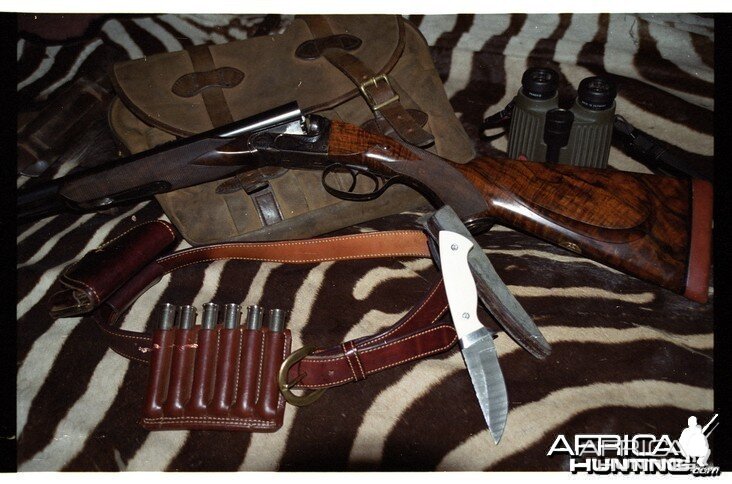
.470 Nitro Express
Interarms Mk X. Apart from the fact that the barrels are soft and wear out very quickly, these are intrinsically sound rifles that are simply shoddily put together. They are famed for springing the magazine floor plate open and dumping the contents on the firers feet. Never seen one that wouldn't feed reliably though, and with a little bit of gun smithing to make the safety catch more positive (it is also on the wrong side) so that it doesn't get accidentally swept on as the bolt is opened (or accidentally knocked off in the bush) and the stock properly bedded to cure the magazine dump they can be made into very workable rifles. They are though, very definitely rifles that you take first to your gunsmith and only then into the bush as the two students at Rifa discovered.
That sums up the American offerings for this year. The Winchester is definitely the best, but it still requires work and a replacement safety and rear sight when it comes out of the box before it can be considered serviceable.
Most of the European made rifles are priced well out of the reach of all learners and even most qualified PH's. The one Mannlicher in evidence this year worked superbly with much to recommend it if you can stomach the price. By far the most common big game rifles we see here, and the biggest single make on the exam, was the Bruno/CZ.
This is one of the most rugged but also the cheapest heavy rifles available in Africa and has been for many years now. There have also been a variety of different models. The early ones dating from the fifties and sixties were absolutely tops (I have a 1950 model), and these probably represent the best buys on the second hand market along with the Fabrique National made Mausers. The current models coming out are not bad, but far from perfect. CZ has finally got around to doing something about the safety catch which was perfect on the 1950's models (which was superior to an original Mauser) and singularly awful there after as it worked the wrong way around (back to fire) and was located on the wrong side of the action. The safety still isn't great, being small and still located on the wrong side of the receiver for a right handed person. It also comes on and off too easily. The biggest problem that arose with them was the firer accidentally knocking on the safety whilst manipulating the bolt. At least five Bruno/CZ owners had trouble with this either during the training sessions or in the exam.
Another problem patently apparent with all of the .458 Win models is that they will not reliably feed soft point ammunition until quite a lot of work has been done to the magazine box and feed. The .458 Win case is simply too short for the huge Bruno magnum action (which comfortably accommodates the .416 Rigby round), and the rounds slide around in that cavernous magazine under recoil and then feeding problems occur. The best thing anybody can do with a Bruno/CZ in .458 Win is to have a competent gunsmith re-chamber it to .458 Lott. This not only solves the feeding troubles but also gets away from the problems of the .458 Win cartridge. The only problem now though is that the stock needs to be properly bedded and pinned or it will crack. The other interesting phenomena arose with some of the older rifles chambered in .375 H&H. The chambers were fantastically oversize, and the spent cartridge cases emerge looking like an Ackley or Weatherby improved round. The head space is fine and it is not dangerous but forget about reloading. One thing is for sure, a little dirt in the action isn't going to tie up these rifles!
The remainder of the field was made up of Mauser actioned rifles. The original Mauser in .404 and the FN in .458 worked great, as expected. The trouble for a learner Hunter or Guide is that these makes are hard to come by. Original Mausers are beginning to wear out, and apart from .404 and 9,3x62, most are chambered for rounds unsuitable for serious hunting. As soon as you see a Mauser chambered in .458 or .375 you know that it is a conversion, (see my comments on custom rifles below). FN's are seldom seen on the second hand market. They represent the peak in the Mauser rifles development, and those lucky enough to own one seldom find a reason good enough to sell it.
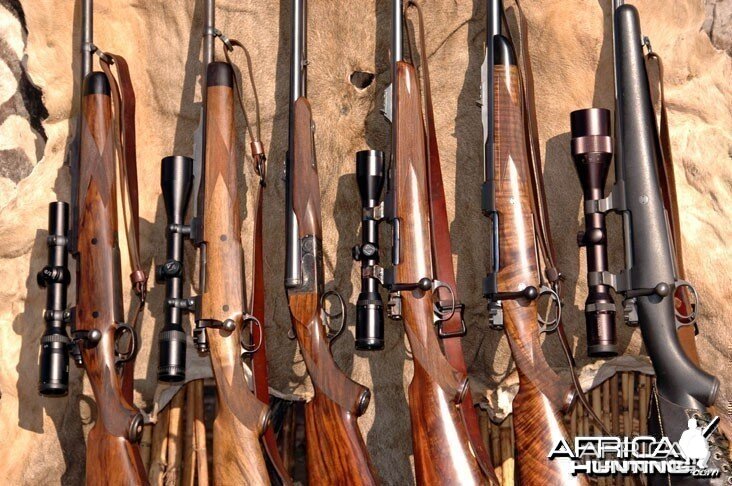
Custom Rifles. The Mauser is one of my all time favourite rifles, but apart from a very few original rifles all the ones we see arecustomï built. This year's exam reiterated that a custom rifle can vary greatly in quality. Two were fine, the other two not. There are an awful lot of armourers out there posing as gunsmiths, and only the best gunsmiths should be allowed to build a dangerous game rifle. The biggest problem with all custom Mausers occurs with the feed. Mausers were originally built with the magazine boxes machined to match the cartridge for which the rifle was being chambered. The magazine box on a 9,3 is quite different from that for a 8x57. Too many gunsmiths simply screw on a .458 barrel and forget that the magazine box must be altered (best option) or the feed rails extensively worked. I had a .308 Mauser that had been converted from a 7x57. It gave endless feeding trouble until I got it to a top smith. The conversion from 8x57 to .308 works fine but the 7mm magazine box is too narrow at the front and problems arise. One custom Mauser on the exam would not feed more than one round from the magazine and even loading a second round half way in so that it could be chambered (giving the shooter two rounds before a reload) was a bother. The fancy stock, the Ghost ring sight, etc did not alter the fact that this was a useless rifle. One of the two candidates who's custom Mausers worked on the exam told me that she had had feeding trouble and had taken the rifles to a competent gun smith to have the problem solved. It had cost a considerable amount of time and money to get her rifle into full working order. The last was from a local supplier of custom rifles who knows about such things and the requirements for absolute reliability, and it worked great. I retain an intrinsic mistrust of any custom rifle unless I've tried it thoroughly and I know who built it. That is the biggest advantage of purchasing a new custom rifle locally. It's guaranteed and you can take it back at the slightest sign of trouble. It should also come with all the required extras such as sights, safety and stock bedding already attended to.
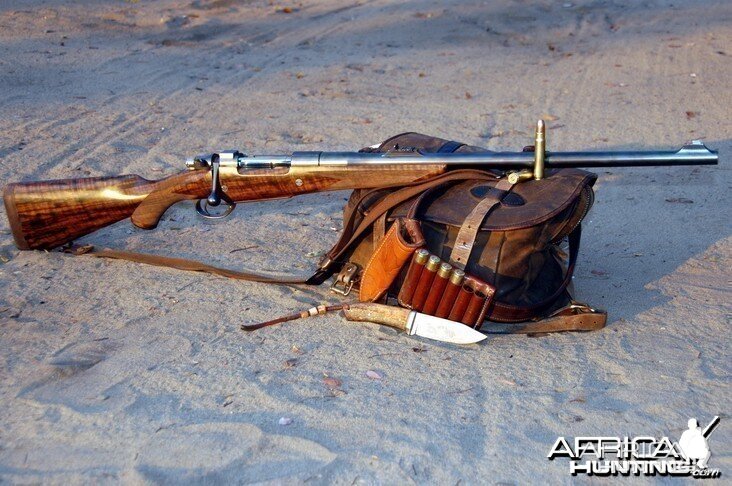
.500 Jeffries
We didn't see any of the English made rifles this year, but as a warning to potential purchasers there is a considerable difference between an English top grade rifle and a second or third class weapon. Back when they were originally sold the purchaser knew what he was getting, but these days any rifle with an English makers name on it is taken as being a good quality rifle. This is decidedly not true. Perhaps the two best examples are the Westley-Richards .425 "White Hunter" models and some (but decidedly not all) of the Cogswell and Harrison .404's. Westley Richards turned out a great many superb .425's but they also produced a cheap line intended for government service or the "native trade", known as the "White Hunter" model. These were built on war surplus K98 Mauser actions, without due attention to magazine box dimensions or the feed rails. They make a Weatherby cross Remington 700 look like a dream rifle. Much the same can be said for some of the Cogswells built on war surplus P14 actions. The second grade guns work fine, but the third grade weapons are on a par with the "White Hunter".
That completes the overview on this season's rifles. Too much rubbish is being sold, at vastly inflated prices that will get a tyro hunter killed. It annoys me, to put it mildly!