Is the 500 Jeffery really superior to the 458 Lott in stopping power?

BJH65

Bronze supporter
AH elite
Joined
Feb 2, 2024
Messages
1,253
Reaction score
4,399
Location
Oklahoma
Website
www.dksafaris.co.za
Media
53
Hunting reports
Africa
2
Member of
NRA
Hunted
South Africa (North West, Limpopo & Greater Kruger), Mozambique Save River Region, BC Canada, Alaska and Lower 48 U.S.
I’ve contemplated a 500 Jeffery off and on including the similar in power 505 Gibbs. Both vintage rounds with lots of wonderful history for use against the biggest and toughest African DG. Many of the rifles chambered for the aforementioned cartridges are really excellent rifles and many are custom rifles from notable makers.

But, is the 500 Jeffery (including 505 Gibbs) really superior to the 458 Lott? The 458 Lott will launch a 500 grain bullet at 2300 FPS and the 500 Jeffery launches a 535 grain bullet at 2250-2300 FPS. Very similar but the Lott has superior sectional density. Of course where the 500 Jeffery shines is using 570-600 grain bullets at 2100-2150 FPS. But again, the 458 Lott matches it with 550 and 600 grain bullets at the same velocity but superior sectional density. Granted, I’m only aware of 550 grain Woodleigh SP and 600 grain Hawk SP for the 458 Lott or .458 caliber.

The more I think on it, I do not see much of an advantage for the 500 Jeffery over the 458 Lott. I did not mention the 450 Rigby being only a bit more powerful than the 458 Lott but not in any meaningful way. So, I think the 458 Lott compares very well to the 500 Jeffery and is ample for anything that walks the earth!

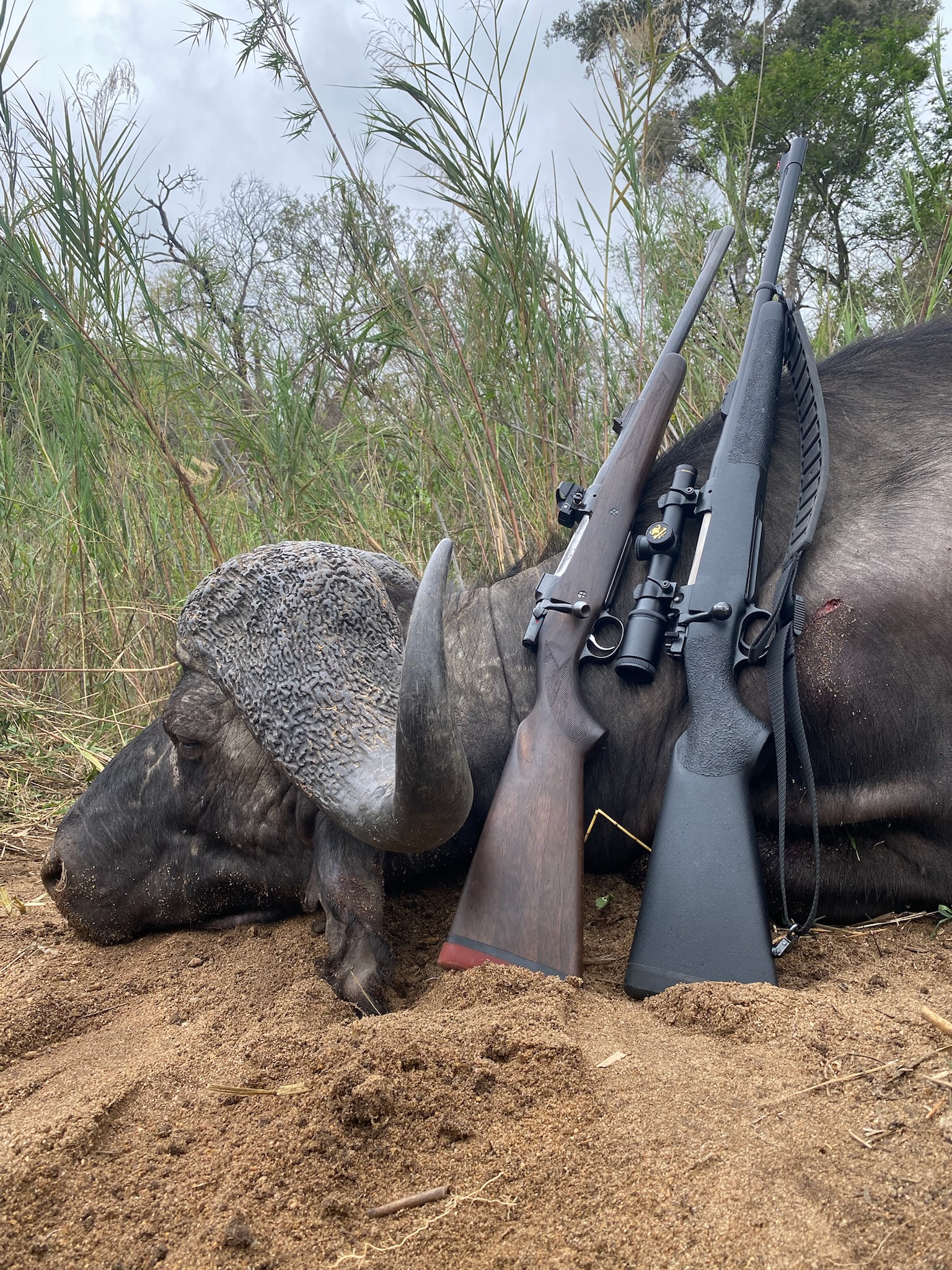
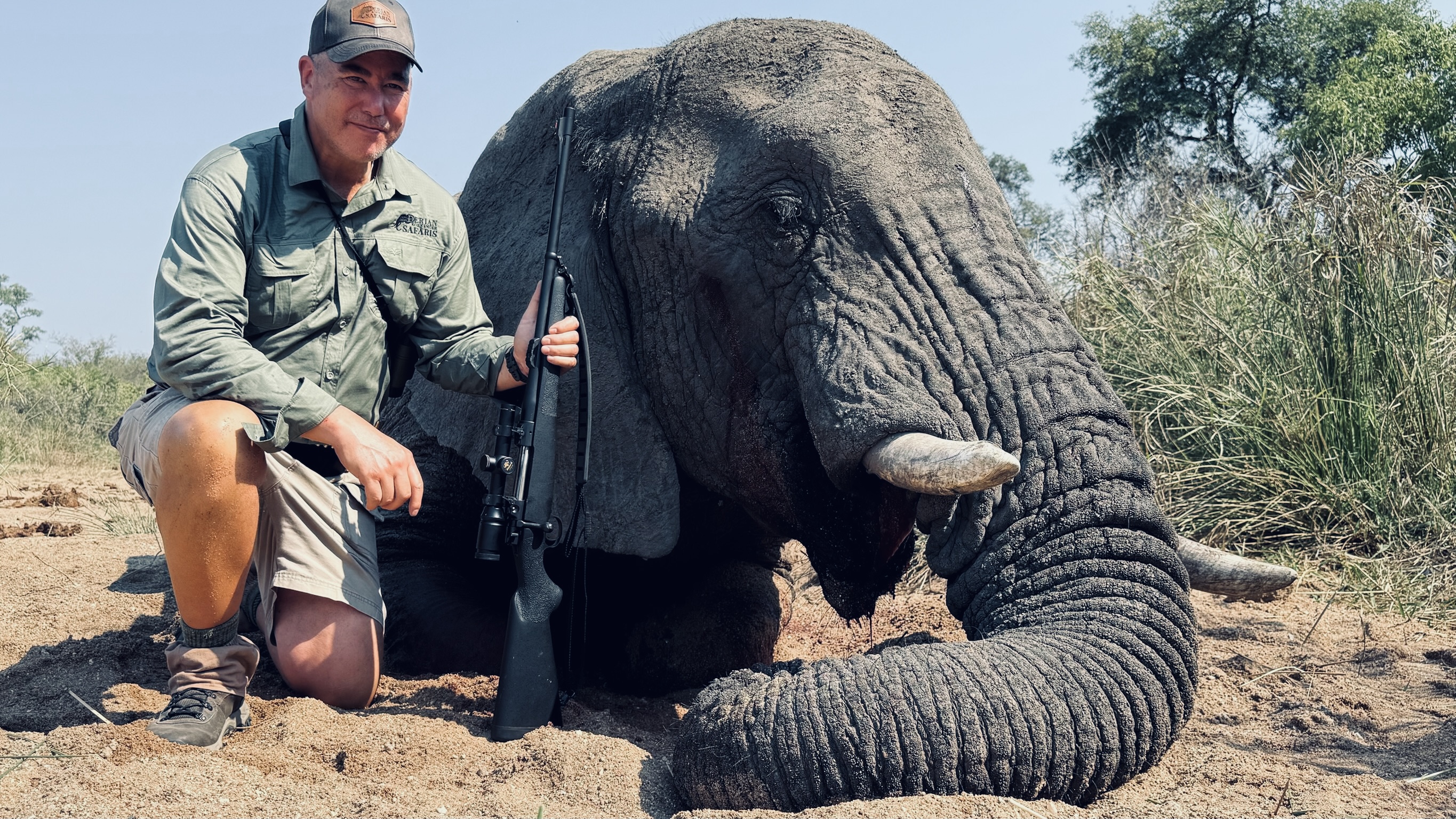
My custom Brno ZKK-602 AHR/Robar 458 Lott performed very well on elephant and buffalo.
IMG_0060.jpeg


IMG_2578.jpeg
 
Nobody can argue that the 500Jeffery throws out a bigger bullet and I have neve heard anyone complain about it's stopping power. I have yet to use it on a buff, but if it wasn't for my PH's 500J I am sure we would have had a tragedy. Which is better I can't say, but I can say the 500J works just fine.
 
That is a difficult question to answer, because there is not much stopping of DG involved in the life of an African hunter. A buffalo running in our direction to escape does not always need to be stopped. It simply needs to be shot. Somewhat older reports from highly experienced PH saw a distinct advantage of the cartridge 500 Jeffery, particularly when compared to the 458 Winchester Magnum, which was the standard back then. Other, somewhat younger PH have told me that they are very satisfied with the cartridge 458 Lott, as well as with modern factory loads of the cartridge 458 Winchester Magnum. Hardly any PH carry a rifle caliber 500 Jeffery, but a lot of them one caliber 458 Lott. Ultimately, therefore, it is a question that surely very difficult for a PH to answer and almost impossible for a client.

Fulfilling a childhood dream, I also own a rifle caliber 500 Jeffery, which has proven itself when hunting buffalo and elephant. However, other cartridges of slightly smaller caliber delivered the same performance.
 
.

Brendon, You just wanted to show off your ele & your buff! And why not ! Both great trophies !

But going along with your opening post, it would be the 500 for me, if for no other reason than nostalgia.

Cheers

.
 
Good question and certainly worth a close look for those seriously addicted to Africa dangerous game.

The cartridge .500 Jeffery has a case capacity of 158 gr H2O and is capable of exceeding 8,000 ft-lbs of kinetic energy. The cartridge .458 Lott has a case capacity of 110 gr H2O and is capable of +/- 6,000 ft-lbs.

Sectional Density (SD) is an important calculation to assist a sportsman. However, monometal bullets shed a different valuation on SD performance. Caliber has a critical role in terminal ballistics and a .510” caliber provides a margin of safety above a .458” caliber.
 
For commonly used cartridges for dangerous game, such as the .375 H&H and .416 Rem or Rigby, there is much empirical data gained from experiences of thousands of hunters. This includes recent data from kills using the latest generation of expanding and solid bullets. These modern bullets are a key factor in determining the effectiveness of any cartridge to cleanly kill or stop a charge as compared to projectiles used as little as 25 or 30 years ago. For argument’s sake, let’s make that 50 years ago.

Peter Capstick’s Death in the Long Grass was published in 1977 based on his experiences (or imagination ?) of prior years. He and his fellow African professional hunters had nothing like a Barnes TSX, Swift A-Frame, or solids with the 67% meplat flat nose. Comparing yesteryears’ stopping effectiveness of this cartridge to that of today's is an apples to oranges comparison.

My point of the above paragraphs is considering shooting modern projectiles, there isn't much data for the .500 Jeffery or .505 Gibbs to compare it to the more common .458 Lott. For any available data, were the shots well placed for the Lott vs the Jeffery? Any advantage of more powerful cartridges is shown when shots are less than perfect!

For an African PH is a .500 Jeffery more effective than a .458 Lott? Considering that our PH’s often do not have access to the most modern bullets for handloading, or that handloading may be illegal in some countries, many PH’s may from time to time have to shoot the ammunition that is available. In those cases, bigger bores are likely better.

For the experienced dangerous game hunter who can accurately shoot high recoiling rifles such as a .500 anything, with the proper loads a .500 Jeffery for the worse case shots should be more effective. What is a worse case shot? How about stopping a charging buffalo where shot placement may not be perfect?

The table below lists loads for .500 Jeffery at 2,200 and 2,350 fps. Considering Taylor’s Knock Out factors the lighter 2,200 fps Jeffery load has a 17% increase in effectiveness over the .458 Lott. The difference increases to 22% more effectiveness a maximum load at 2,350 fps. This load was from the Barnes Reloading Manual #4. Taylor’s Knock Out factors may be outdated when considering modern bullets but it is useful for comparison.

Many head of dangerous game have fallen to the venerable .375 H&H. We have Africa Hunting members who swear by it and have trophy rooms full of evidence of its effectiveness. With very good shot placement, the .375 is golden. Taylor’s Knock Out factors were not derived for perfect shots. No sir, knock out for Taylor meant if an elephant’s brain is missed by an inch or two, which cartridges will stun a 10,000+ pound animal for longer periods of time?

Because if you are not measuring you are only guessing, here's the data,

1787653208026.png
 
Last edited:
There’s no replacement for displacement.

Bigger isn’t always better, but when it comes to stopping cartridges I’d have to argue that bigger is better. Provided the shooter is capable of handling the recoil and placing an accurate shot.

Which brings up another question. Recovery time from shot to shot. How quickly one can handle the recoil and get back on target for another shot should also be a consideration. Yes, it should only take one…but if another is needed. :unsure:
 
There’s no replacement for displacement.

Bigger isn’t always better, but when it comes to stopping cartridges I’d have to argue that bigger is better. Provided the shooter is capable of handling the recoil and placing an accurate shot.

Which brings up another question. Recovery time from shot to shot. How quickly one can handle the recoil and get back on target for another shot should also be a consideration. Yes, it should only take one…but if another is needed. :unsure:

Exactly! Recovery time and time between shots is why I don't favor my .450 Rigby over my trusty .458 Win! Every shooter is different but how fast can we hit center at xx range with progressively higher recoiling cartridges?

I've discussed with @Altitude sickness and @abnhog videoing us shooting various dangerous game rifles. The videos will not only show our shooting positions and recoil recovery, but will also provide accurate time between shots.
 
@Mark A Ouellette - I'll be doing videos myself once I heal from shoulder surgery. Once I'm tuned up with the 375H&H, I might be borrowing a 416RM and 458WIN to give them a try. I know, they aren't stopping cartridges, but it's the best I can do.
 
Were I a dangerous game professional hunter in Africa, I would likely own a .458 in one guise or another. If I could afford it, most can't, I would own a .500 of some sort. I am not. As a client, I have exactly one job. Put the first round in exactly the right place. I personally do that most competently with a .375. 500 gr of displacement in the wrong place is rather less useful than 300 gr in exactly the right place.
 
IMO, both kill very effectively. The 500 J will possibly get you a little more punch in a stopping situation but at the behest of about 20% + more recoil. Is the juice worth the squeeze? If you are a shooter that can practice, master, and afford the 500 jeffery, which few can; but if you can, you should, it's a magnificent cartridge. With the big magnums, the rifle fit, weight, everything becomes more important. I personnally have had 2 - 500J. I wouldn't own another one unless it was built for me to my dimensions and weighed 11.5-12 lbs. (basically the weight of a double). Both of mine were 10.25 lb guns which was too light for the massive recoil. By comparison, you can run numbers front and sideways, but the 458 lott loaded right will generate 75 ish ft-lbs of recoil with a 500 grain bullet, the 500J with a 535 gr bullet loaded to 2250 will be about 95-100 ft-lbs in the same weight rifle. I can't explain how all that works but it must have something to do with the amount of powder, because with the 458 Lott you will burn around 80 grains, 500J around 100+. Weight of the rifle becomes very important. I've sold off everything over 458 in my kit,....any big game hunts I have from here on out will be with a 416 or a 404 that weight 10 lbs. Easier to carry and very effective from my experience.
 
once you are shooting any 45 cal and 50 cal bullets weights 500-600 grs the question should be answered as shot placement the energy factor of 5000-6000 ft/lbs also plays into the equation but its all about where the projectile travels cns/vitals vs non vitals hits
 
Excellent responses gents! Thanks for the data @Mark A Ouellette ,very insightful. @Charlie64 haha, well of course that goes without saying! :) @BeeMaa hope your shoulder heals up soon.

This is no thread to bash the venerable 500 Jeffery which which has a wider diameter bullet and usually heavier bullet than the 458 Lott, which should give an advantage but in similar bullet weights which would be very heavy for caliber in a 458 Lott, it makes me wonder? A 458 Lott launching a 550 grain to 600 grain would be formidable IMO.

I cannot know for sure but I wouldn’t be surprised if the 458 Lott is one of the more popular backup rifles for PH’s in Africa backing clients on large DG.

This isn’t really a comparison in regard to cartridge design, but I would state the 458 Lott is the better design since the 500 Jeffery does have a rebated rim making it more finicky to feed reliably.

Clearly I’m a big fan of the 458 Lott but in a couple of months I’ll find myself carrying a 416 Rigby instead hunting buffalo in the Greater Kruger, Umbabat. Hey, I can like more than one DG cartridge! My personal favorites being the 375 H&H, 416 Rigby and 458 Lott.

It’s unlikely I’ll acquire a 500 Jeffery but I wouldn’t rule it out. If I did, it would be a steel receiver Blaser R8 500 Jeffery
 
The .458 Lott has a frontal area of 0.2097 square inches and the .500 Jeff 0.2601 square inches. That is a 24% increase in frontal area. The sectional density of a .458 500g bullet is 9% greater- .341 vs .313 than the 570 grain .510 calibre bullets.
All else being equal in terms of bullet design and velocity, I would expect the .458 Lott to penetrate a bit deeper but the .500 to transfer greater force, shock or whatever we want to call it per unit of time.
 
IMO, both kill very effectively. The 500 J will possibly get you a little more punch in a stopping situation but at the behest of about 20% + more recoil. Is the juice worth the squeeze? If you are a shooter that can practice, master, and afford the 500 jeffery, which few can; but if you can, you should, it's a magnificent cartridge. With the big magnums, the rifle fit, weight, everything becomes more important. I personnally have had 2 - 500J. I wouldn't own another one unless it was built for me to my dimensions and weighed 11.5-12 lbs. (basically the weight of a double). Both of mine were 10.25 lb guns which was too light for the massive recoil. By comparison, you can run numbers front and sideways, but the 458 lott loaded right will generate 75 ish ft-lbs of recoil with a 500 grain bullet, the 500J with a 535 gr bullet loaded to 2250 will be about 95-100 ft-lbs in the same weight rifle. I can't explain how all that works but it must have something to do with the amount of powder, because with the 458 Lott you will burn around 80 grains, 500J around 100+. Weight of the rifle becomes very important. I've sold off everything over 458 in my kit,....any big game hunts I have from here on out will be with a 416 or a 404 that weight 10 lbs. Easier to carry and very effective from my experience.
This is correct.

I own all 3 and have taken buffs with all of them. They all get the job done but the 500 Jeff and 505 Gibbs have a bit more punch with an additional 20% recoil. The Lott often carries 4-5 bullets in the magazine as opposed to 3 for the 50 cals.

HH
 
There have been several references to recoil here and I just wanted to say that I think that rifle design is extremely important. I shot a 458 Lott out of an old wooden stocked Mauser 98 type rifle and the felt recoul was brutal, quite unpleasant. My experience so far with my Blaser R8 500J synthetic PH stock is that it is stout to be sure, but more of a shove. What I would imagine driving a 427 Cobra would be like, hold on and enjoy the ride.
 
Caliber matters, especially when shooting solids. Bigger bullets make bigger holes.
The Taylor KO of the 500 with a 570 at 2150 is 89, the 458 with a 500 at 2300 is 75.
I do t know how much stock to put into the Taylor KO system, but it does figure in caliber and not just foot pounds of energy.
To get a 500 grain 458 bullet to 89 on the TKO scale it must exceed 2700 fps.
 
Last edited:
Too many are stuck on old original ballistics and 535gr bullets for the 500 Jeff....I do not use them and dont know anyone else who does for backup....we use 570 and 600gr premium bullets.....

The 500 Jeff with the right bullets and in the hands of a competent shooter is devastatingly effect in any situation on any dg....

Yes not all can handle it but the ones who can and who use them for dg follow up wont use anything less.....

As for the ones thinking smaller caliber dg rifles are just as effective are unfortuanately speaking of no practical experience....

Nothing wrong with a 458 Lott for dg backup but it cannot compare to the performance of the 500 Jeff.....
 

Forum statistics

Threads
69,797
Messages
1,556,834
Members
165,209
Latest member
PatriciaPhil


Latest posts

Latest profile posts

Member of the South African Hunters and Game Conservation Association
supergrizzly wrote on AZDAVE's profile.
Dave, I could use both of them if still available. I just picked up a new .22 mag and a .22 pump that they would be perfect on.
MHYOUNG 375 wrote on DLSJR's profile.
Dan who is C. W. Richter? He seems to not be a fan of myself!
MHYOUNG 375 wrote on DLSJR's profile.
Who's this C. W. Richter? Seems to have a chip on his shoulder.
 
Top