

- Joined
- Aug 21, 2009
- Messages
- 402
- Reaction score
- 162
- Website
- www.africanindaba.co.za
- Media
- 70
- Articles
- 182
- Member of
- CIC, Rowland Ward, B&C, DSC, German Hunting Association, KZN Hunting Association, Wild Sheep Foundation
- Hunted
- Western US, Western Canada, Alaska, Colombia, Tajikistan, Russian Federation, China, Iran, Austria, Germany, Spain, Czech Republic, UK, Indonesia, South Africa, Zambia, Zimbabwe, Congo, Tanzania, Uganda, Botswana, Namibia
Managing the Conflicts Between People and Lion
Introduction by Philippe Chardonnet
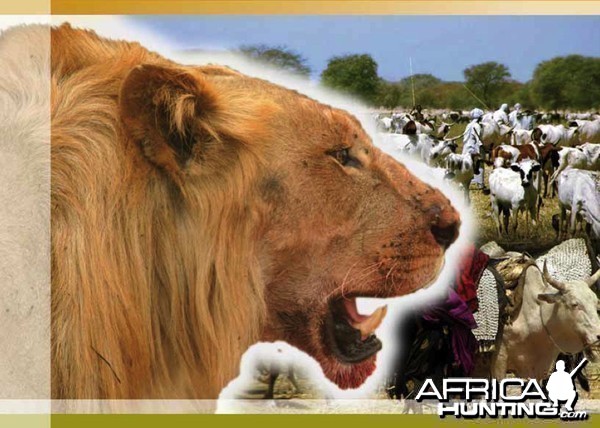
Download the entire paper at View attachment 2264.
Not long ago, when large mammals harmed people we talked of accidents; when they damaged people's assets we referred to incidents. Nowadays, human/wildlife conflicts are regarded as common occurrences. It seems that what were once considered exceptional or abnormal events have become normal or usual. Whether this is a result of higher frequency and amplitude is not clear, because we do not have reliable statistics to make accurate comparisons.
Similarly, human-eating and livestock-raiding lions might be seen as normal lions expressing their carnivorous nature in particular circumstances. Contemporary lions are not wilder or crueller or more dangerous than before: it is just that these particular circumstances seem to be recorded more frequently. Also, communication is now instant and universal: news of a casualty in a remote wilderness can be reported at once on the internet, spreading the information worldwide. Furthermore, a problem lion seems to have a greater psychological impact than a problem crocodile: a crocodile victim disappears, but a lion victim is more likely to be noticed; also, according to B. Soto, a lion incident might be perceived as an intrusion into the human environment, whereas a crocodile incident might be viewed as a human intrusion into the crocodile environment. The result is that the lion might be regarded as more at fault than the crocodile, even though the consequences are the same.
In any case, the interface between humans and wildlife is increasing: growing human population and encroachment into lion habitat have simply augmented the incidence of contact between people and lions. Similarly, the harvesting of wildlife has increased, leaving less natural prey for lions.
Obviously, the probability of clashes between people and lions now tends to be higher. Long established traditional ways of deterring fierce, fully-grown lions might become partly ineffective, and lethal methods are not always acceptable by modern standards. Triggers for human eaters and cattle raiders are being investigated, and knowledge of behavioral factors is improving. New methods to protect people and livestock from lions are being tested in a number of risk situations; these methods are also designed to conserve the lion itself from eradication over its natural range.
Conservation of the lion is now a topical concern because our ancestors, the hunted humans (Ehrenreich, 1999) of the past who were chased by predators have become hunting humans and predators themselves.
Interestingly, this study was undertaken during a period of rising general interest in conservation of the lion. Two regional strategies for the conservation of the African lion have been developed under the auspices of the Cat Specialist Group of the World Conservation Union/Species Survival Commission, one for West and Central Africa, the other for Eastern and Southern Africa.1 And moreand more lion-range states are developing national action plans. This provides evidence of the effort invested in tackling the diverse issues related to lion conservation. By focusing on the human/lion interactions, the present study is complementary to the work of the World Conservation Union. This study also echoes the dynamic forum facilitated by the African Lion Working Group.2 We hope that this review will contribute to the challenge of long-term conservation of the African lion. Success will be attained when the lion changes from being perceived as vermin or a pest to being regarded as a wealth or an asset.
Download the entire paper at View attachment 2264.
Introduction by Philippe Chardonnet
Download the entire paper at View attachment 2264.
Not long ago, when large mammals harmed people we talked of accidents; when they damaged people's assets we referred to incidents. Nowadays, human/wildlife conflicts are regarded as common occurrences. It seems that what were once considered exceptional or abnormal events have become normal or usual. Whether this is a result of higher frequency and amplitude is not clear, because we do not have reliable statistics to make accurate comparisons.
Similarly, human-eating and livestock-raiding lions might be seen as normal lions expressing their carnivorous nature in particular circumstances. Contemporary lions are not wilder or crueller or more dangerous than before: it is just that these particular circumstances seem to be recorded more frequently. Also, communication is now instant and universal: news of a casualty in a remote wilderness can be reported at once on the internet, spreading the information worldwide. Furthermore, a problem lion seems to have a greater psychological impact than a problem crocodile: a crocodile victim disappears, but a lion victim is more likely to be noticed; also, according to B. Soto, a lion incident might be perceived as an intrusion into the human environment, whereas a crocodile incident might be viewed as a human intrusion into the crocodile environment. The result is that the lion might be regarded as more at fault than the crocodile, even though the consequences are the same.
In any case, the interface between humans and wildlife is increasing: growing human population and encroachment into lion habitat have simply augmented the incidence of contact between people and lions. Similarly, the harvesting of wildlife has increased, leaving less natural prey for lions.
Obviously, the probability of clashes between people and lions now tends to be higher. Long established traditional ways of deterring fierce, fully-grown lions might become partly ineffective, and lethal methods are not always acceptable by modern standards. Triggers for human eaters and cattle raiders are being investigated, and knowledge of behavioral factors is improving. New methods to protect people and livestock from lions are being tested in a number of risk situations; these methods are also designed to conserve the lion itself from eradication over its natural range.
Conservation of the lion is now a topical concern because our ancestors, the hunted humans (Ehrenreich, 1999) of the past who were chased by predators have become hunting humans and predators themselves.
Interestingly, this study was undertaken during a period of rising general interest in conservation of the lion. Two regional strategies for the conservation of the African lion have been developed under the auspices of the Cat Specialist Group of the World Conservation Union/Species Survival Commission, one for West and Central Africa, the other for Eastern and Southern Africa.1 And moreand more lion-range states are developing national action plans. This provides evidence of the effort invested in tackling the diverse issues related to lion conservation. By focusing on the human/lion interactions, the present study is complementary to the work of the World Conservation Union. This study also echoes the dynamic forum facilitated by the African Lion Working Group.2 We hope that this review will contribute to the challenge of long-term conservation of the African lion. Success will be attained when the lion changes from being perceived as vermin or a pest to being regarded as a wealth or an asset.
Download the entire paper at View attachment 2264.
Last edited by a moderator:


