
VBTHunting
New member
Where: Kilombero Valley, Tanzania (Ruhudji camp)
When: August 28 – September 12, 2026 | 16 days
Outfitter: Kilombero North Safaris
PH: Ryan Swart
Cameraman: Steven Hall
Rifles: Rigby Big Game .375 H&H (300gr Nosler Partition) and Heym 88B .470 NE
Taken: Lion, Leopard, Crocodile, 2 Hippos, 2 Waterbuck, 2 Warthog, Zebra, Lichtenstein’s Hartebeest, Puku, Reedbuck, Baboon
Full disclosure: I was a full-paying client and have no affiliation with Kilombero North Safaris beyond hunting with them.
I met Ryan Swart and the Kilombero North Safaris team earlier this year at the DSC convention in Atlanta. What stood out immediately was how confident Ryan was. He clearly knew what he was doing, but never tried to oversell anything or make unrealistic promises. He convinced me Kilombero Valley was the right place for a lion hunt, in large part because of the amount of bait available. He laid out the approach, explained how we needed to get baits down early, and told me we’d have a hippo for bait on day one. He delivered on that, and on everything else he told me.
Ryan also knew I wanted the entire safari filmed, so he brought in Steven Hall from South Africa. Steven ended up being a great addition to the team. The dude has the steadiest hands I’ve ever seen and never flinched when the shots went off. He’s also a professional hunter, which was a huge bonus because he understood exactly what was happening and where he needed to be without ever getting in the way of the hunt. If you’re thinking about having your safari filmed, he’s world class and I’d recommend him to anyone.
This was my first African safari, and hunting a wild lion had been a dream of mine for as long as I can remember. I wanted the whole experience to feel truly wild, and that’s ultimately why Kilombero appealed to me so much. You’re hunting on a couple million acres of country that feels about as far removed from civilization as you can get. You’ve got tsetse flies, mosquitoes, tall grass, mud, heat, plenty of walking, and some long stalks. The Valley is going to make you work for it, especially with the grass up, but that’s also what makes it special. There were times it felt like we were hunting a place completely untouched by the outside world, which was exactly what I was after.
That wilderness is also absolutely loaded with game. We saw a ton of buffalo, hippos, crocodiles, waterbuck, Lichtenstein’s hartebeest, and sable, plus a good number of elephants. Lion activity was constant. We glassed up a lioness on the very first day, and looking at her through the binos was surreal. Their eyes stare down your soul. We saw tracks all over, heard roaring at night, and more than once stumbled onto lions in broad daylight, both driving and on foot. There were plenty of leopard tracks too, and we had a couple of females on bait in addition to the male I eventually took.
All of that activity made getting the baiting operation going early even more important. The first few days were largely about getting bait, hanging baits, checking tracks and baits, and figuring out where the lions were moving. In addition to our vehicle, we had a separate baiting vehicle with apprentice PH Liam Miller and his crew. If you’re going specifically to hunt cats, I’d highly recommend having an extra baiting vehicle if it’s an option. It allowed us to cover a lot more ground and expand the area where we could hang and check baits. Liam and the guys on the baiting truck were a huge help throughout the hunt. There always seemed to be a plan, and Ryan and the team were constantly adjusting based on what we were seeing on the ground.
That work started paying off quickly. Ryan is absolutely relentless when it comes to hunting cats, and he’s a magician with the baits. We had a hippo down for bait on day one, just like he said we would, and from there we ran more than ten bait lines. The baiting operation started producing quickly, and by day five we had multiple mature male lions feeding.
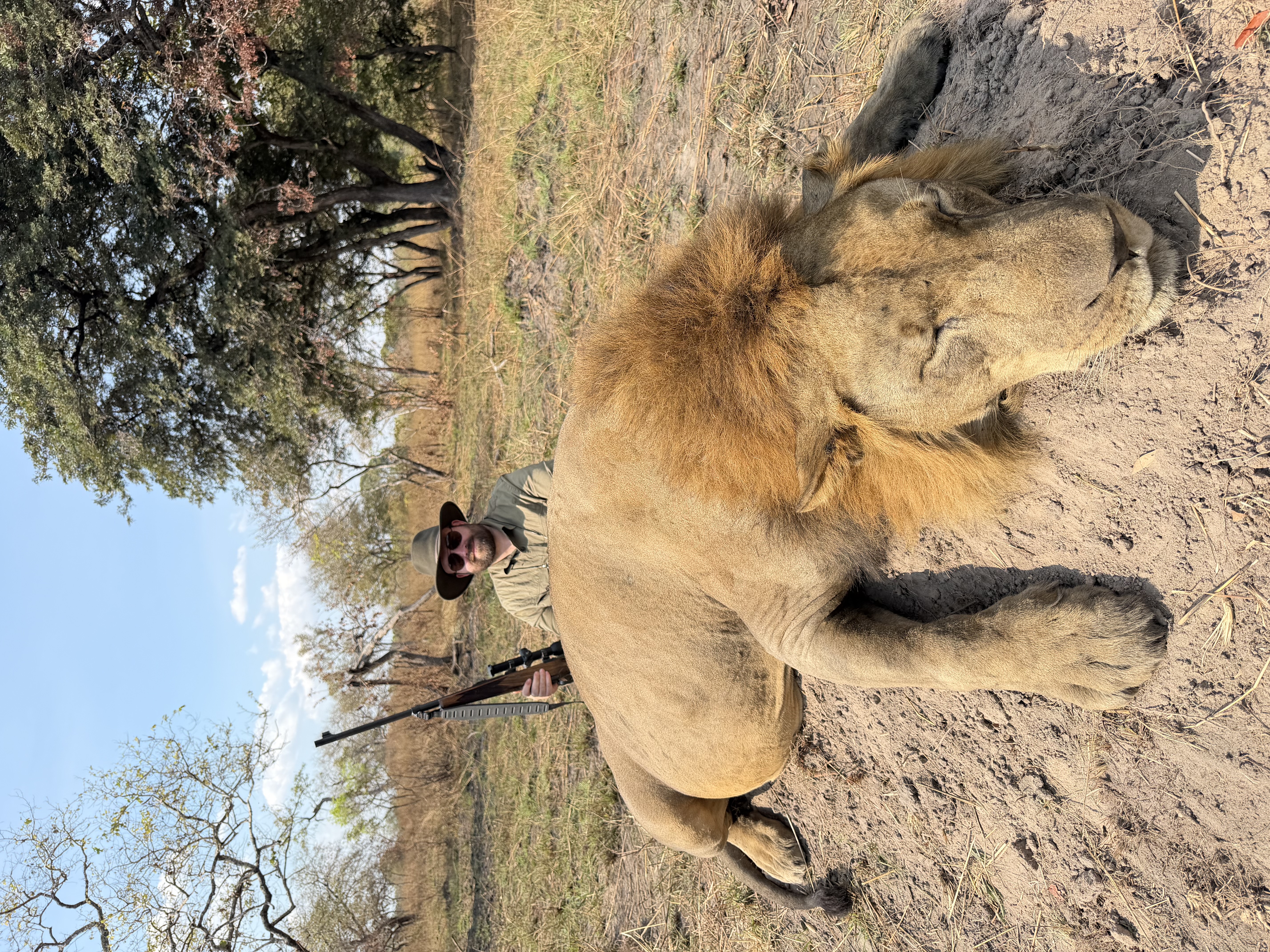
On the afternoon of day seven, we got our chance. He was at 88 yards. He took a 300-grain Nosler Partition from the Rigby .375, ran about 15 yards, and dropped. A massive, mature lion with a 25-inch skull (15 inches long by 10 inches wide).
With the lion down, we were able to turn our attention to some of the other animals on the list, starting with crocodile. We sat a blind over bait one day and nothing hit it, so the next day we changed tactics, got in the boat, and started running up and down the river. We spotted a massive one on a ledge and got off the boat a few hundred yards downriver.
The stalk in was probably my favorite stalk of the entire safari. We worked our way through thick brush and tall grass along the riverbank, crossing obvious crocodile slides and spots where they had been lying up along the water. It definitely got the heart rate going. You knew there were big crocs all through that stretch of river, but in the tall grass you had no idea what might be around the next corner or just a few yards away. At one point I was down on my hands and knees crawling through it.
We finally got to about 70 yards, and I shot him sitting on my butt with the Rigby. Good shot, and he was down on impact. A 13-footer, on day 11. We had to really work for that one, which made it that much more memorable.
Three days later came the leopard. He hit a bait that morning, and we rushed over to build a blind. Ryan and the crew put together a homemade blind that was very well done, and we sat it that same afternoon. With a few minutes of light left, the leopard came in and circled the blind, and a baboon right above us freaked out. Then he ran and jumped up into the tree. Watching that cat come up the tree in the last light was a majestic thing, and the Rigby did the rest.
By that point, we had accomplished what I had primarily come to Tanzania to do. Add in two hippos and a good run of plains game, and it was a full 16 days. If you’re looking at lion and leopard, Kilombero Valley is an incredible place to hunt them. Between the cat activity and the amount of bait available, it’s hard to beat.
We spent the final couple of days focused on buffalo. We saw huge herds and plenty of dagga boys. With the grass still tall, I was determined to use the .470 double, and we never quite got the close-range opportunity I wanted. Had I carried the scoped Rigby on those stalks, I think the outcome would have been different. The cats were always the focus of this trip, but there was certainly no shortage of buffalo.
As good as the hunting was, the experience back at camp was a big part of the trip too. Camp sits right on the river, and at night you hear crocs and hippos, tigerfish crashing on the surface, and lions roaring in the distance. The entire staff could not have been more welcoming. The celebrations when we returned to camp after taking the lion and later the leopard were very cool and something I’ll always remember. The trackers were phenomenal throughout the hunt and deserve a ton of credit.
The day-to-day camp setup was also great. Laundry was done every day, which means you really don’t need to overpack clothes for a 16-day safari. We even had Wi-Fi on the hunting truck, which felt like a luxury given how remote we were.
The tents themselves were excellent too. I didn’t see a single bug or mosquito inside mine the entire stay. The food was great, especially considering how remote we were, although I was definitely craving some Mexican food by the end of the trip. And a special shoutout to the chef for the deviled eggs. Those things were damn good.
Some of my favorite memories from the Valley had nothing to do with pulling the trigger. We saw two black mambas while hanging baits, which definitely got the heart racing. Running the boat through the narrower canals was a blast too. Crocodiles would launch into the water as we came through, and one day a hippo even bumped the boat. Thankfully, the motor stayed on.
Getting halfway around the world with two rifles was something I had spent a lot of time thinking about before the trip. I flew Turkish from DFW through Istanbul to Dar with a Rigby Big Game .375 H&H and a Heym 88B .470 NE double. I used Gracy Travel for the flights and firearm paperwork and highly recommend them. They made the entire process easy and seamless, and their team was extremely responsive anytime I had a question. With everything arranged ahead of time, getting the rifles through Istanbul and cleared in Dar was straightforward.
Once we were hunting, the Rigby ended up doing most of the work. I shot pretty much everything with it and 300-grain Nosler Partitions, and I was very happy with them. Everything I took dropped within 15 or so yards of the shot, and the croc never moved. If I could go back in time, I’d have brought fewer solids and more softs, especially since we weren’t hunting elephant.
That wasn’t the only gear lesson I came home with. I had a Swarovski Z8i 1-8x24 on the Rigby .375, and looking back I would have gone with something that gave me a little more range, probably something like the Z8i 1.7-13.3x42. For anything that required a close follow-up, we had the .470 double, so I think I could have given myself more capability on the other end with the .375. For my next hunt, I’m also leaning toward a Gunwerks Skuhl .375 with the carbon-fiber stock. It would be lighter and more versatile for something like Alaska than the all-wood Rigby.
I’d also bring different soft rifle cases. I used Boyt Harness scoped rifle cases and wasn’t impressed. The handles were terrible and I definitely regretted buying them.
Clothing was a mixed bag too. I primarily wore Westley Richards Lightweight Expedition Shirts and Safari Trousers. The shirts were great. The trousers were a different story. Buttons kept falling off, and by the end of the safari a few pairs were pretty much done. My Courteney Selous boots and Darn Tough socks, on the other hand, were excellent. My feet held up really well over 16 days of walking and stalking.
Probably the most underrated piece of gear I brought was my ESP Apex hearing protection. I kept the earbuds tied to my shirt, and anytime we started a stalk or looked like we might be getting close to a shot, I’d put them in. They worked extremely well and made it easy to actually use hearing protection in the field instead of leaving it back at camp.
One thing that surprised me was how much I enjoyed the tiger fishing. Camp sits on one of the best tigerfish rivers in Tanzania, and on the last day we finally made some time for it. We caught a handful within an hour or so, and the strike is violent. If I could go back, I’d have allocated a lot more time to fishing. That’s one of the easiest changes I’d make on the next trip.
It was also a fitting way to finish a safari that had checked just about every box I came to Tanzania hoping to check. I went there wanting to hunt a wild, free-range lion in a place that still felt truly wild. That’s exactly what Kilombero gave me.
Ryan knew how much this hunt meant to me, and I couldn’t have asked for a better PH to experience it with. From the first conversation in Atlanta through the last day in camp, Ryan and the entire KNS team lived up to every expectation I had. The best endorsement I can give is that before I’d even left Tanzania, I already knew I wanted to come back and hunt with them again.
I’m already planning to do exactly that, hopefully for elephant in the next year or two. If you’re looking at a hunt in Tanzania, I can’t recommend Ryan & KNS enough. Happy to answer questions on the area, gear, flying rifles through Istanbul and Dar, or anything else.
When: August 28 – September 12, 2026 | 16 days
Outfitter: Kilombero North Safaris
PH: Ryan Swart
Cameraman: Steven Hall
Rifles: Rigby Big Game .375 H&H (300gr Nosler Partition) and Heym 88B .470 NE
Taken: Lion, Leopard, Crocodile, 2 Hippos, 2 Waterbuck, 2 Warthog, Zebra, Lichtenstein’s Hartebeest, Puku, Reedbuck, Baboon
Full disclosure: I was a full-paying client and have no affiliation with Kilombero North Safaris beyond hunting with them.
--
The Hunt
I met Ryan Swart and the Kilombero North Safaris team earlier this year at the DSC convention in Atlanta. What stood out immediately was how confident Ryan was. He clearly knew what he was doing, but never tried to oversell anything or make unrealistic promises. He convinced me Kilombero Valley was the right place for a lion hunt, in large part because of the amount of bait available. He laid out the approach, explained how we needed to get baits down early, and told me we’d have a hippo for bait on day one. He delivered on that, and on everything else he told me.
Ryan also knew I wanted the entire safari filmed, so he brought in Steven Hall from South Africa. Steven ended up being a great addition to the team. The dude has the steadiest hands I’ve ever seen and never flinched when the shots went off. He’s also a professional hunter, which was a huge bonus because he understood exactly what was happening and where he needed to be without ever getting in the way of the hunt. If you’re thinking about having your safari filmed, he’s world class and I’d recommend him to anyone.
This was my first African safari, and hunting a wild lion had been a dream of mine for as long as I can remember. I wanted the whole experience to feel truly wild, and that’s ultimately why Kilombero appealed to me so much. You’re hunting on a couple million acres of country that feels about as far removed from civilization as you can get. You’ve got tsetse flies, mosquitoes, tall grass, mud, heat, plenty of walking, and some long stalks. The Valley is going to make you work for it, especially with the grass up, but that’s also what makes it special. There were times it felt like we were hunting a place completely untouched by the outside world, which was exactly what I was after.
That wilderness is also absolutely loaded with game. We saw a ton of buffalo, hippos, crocodiles, waterbuck, Lichtenstein’s hartebeest, and sable, plus a good number of elephants. Lion activity was constant. We glassed up a lioness on the very first day, and looking at her through the binos was surreal. Their eyes stare down your soul. We saw tracks all over, heard roaring at night, and more than once stumbled onto lions in broad daylight, both driving and on foot. There were plenty of leopard tracks too, and we had a couple of females on bait in addition to the male I eventually took.
All of that activity made getting the baiting operation going early even more important. The first few days were largely about getting bait, hanging baits, checking tracks and baits, and figuring out where the lions were moving. In addition to our vehicle, we had a separate baiting vehicle with apprentice PH Liam Miller and his crew. If you’re going specifically to hunt cats, I’d highly recommend having an extra baiting vehicle if it’s an option. It allowed us to cover a lot more ground and expand the area where we could hang and check baits. Liam and the guys on the baiting truck were a huge help throughout the hunt. There always seemed to be a plan, and Ryan and the team were constantly adjusting based on what we were seeing on the ground.
That work started paying off quickly. Ryan is absolutely relentless when it comes to hunting cats, and he’s a magician with the baits. We had a hippo down for bait on day one, just like he said we would, and from there we ran more than ten bait lines. The baiting operation started producing quickly, and by day five we had multiple mature male lions feeding.
On the afternoon of day seven, we got our chance. He was at 88 yards. He took a 300-grain Nosler Partition from the Rigby .375, ran about 15 yards, and dropped. A massive, mature lion with a 25-inch skull (15 inches long by 10 inches wide).
With the lion down, we were able to turn our attention to some of the other animals on the list, starting with crocodile. We sat a blind over bait one day and nothing hit it, so the next day we changed tactics, got in the boat, and started running up and down the river. We spotted a massive one on a ledge and got off the boat a few hundred yards downriver.
The stalk in was probably my favorite stalk of the entire safari. We worked our way through thick brush and tall grass along the riverbank, crossing obvious crocodile slides and spots where they had been lying up along the water. It definitely got the heart rate going. You knew there were big crocs all through that stretch of river, but in the tall grass you had no idea what might be around the next corner or just a few yards away. At one point I was down on my hands and knees crawling through it.
We finally got to about 70 yards, and I shot him sitting on my butt with the Rigby. Good shot, and he was down on impact. A 13-footer, on day 11. We had to really work for that one, which made it that much more memorable.
Three days later came the leopard. He hit a bait that morning, and we rushed over to build a blind. Ryan and the crew put together a homemade blind that was very well done, and we sat it that same afternoon. With a few minutes of light left, the leopard came in and circled the blind, and a baboon right above us freaked out. Then he ran and jumped up into the tree. Watching that cat come up the tree in the last light was a majestic thing, and the Rigby did the rest.
By that point, we had accomplished what I had primarily come to Tanzania to do. Add in two hippos and a good run of plains game, and it was a full 16 days. If you’re looking at lion and leopard, Kilombero Valley is an incredible place to hunt them. Between the cat activity and the amount of bait available, it’s hard to beat.
We spent the final couple of days focused on buffalo. We saw huge herds and plenty of dagga boys. With the grass still tall, I was determined to use the .470 double, and we never quite got the close-range opportunity I wanted. Had I carried the scoped Rigby on those stalks, I think the outcome would have been different. The cats were always the focus of this trip, but there was certainly no shortage of buffalo.
Camp & Life in the Valley
As good as the hunting was, the experience back at camp was a big part of the trip too. Camp sits right on the river, and at night you hear crocs and hippos, tigerfish crashing on the surface, and lions roaring in the distance. The entire staff could not have been more welcoming. The celebrations when we returned to camp after taking the lion and later the leopard were very cool and something I’ll always remember. The trackers were phenomenal throughout the hunt and deserve a ton of credit.
The day-to-day camp setup was also great. Laundry was done every day, which means you really don’t need to overpack clothes for a 16-day safari. We even had Wi-Fi on the hunting truck, which felt like a luxury given how remote we were.
The tents themselves were excellent too. I didn’t see a single bug or mosquito inside mine the entire stay. The food was great, especially considering how remote we were, although I was definitely craving some Mexican food by the end of the trip. And a special shoutout to the chef for the deviled eggs. Those things were damn good.
Some of my favorite memories from the Valley had nothing to do with pulling the trigger. We saw two black mambas while hanging baits, which definitely got the heart racing. Running the boat through the narrower canals was a blast too. Crocodiles would launch into the water as we came through, and one day a hippo even bumped the boat. Thankfully, the motor stayed on.
Travel & Rifles
Getting halfway around the world with two rifles was something I had spent a lot of time thinking about before the trip. I flew Turkish from DFW through Istanbul to Dar with a Rigby Big Game .375 H&H and a Heym 88B .470 NE double. I used Gracy Travel for the flights and firearm paperwork and highly recommend them. They made the entire process easy and seamless, and their team was extremely responsive anytime I had a question. With everything arranged ahead of time, getting the rifles through Istanbul and cleared in Dar was straightforward.
Once we were hunting, the Rigby ended up doing most of the work. I shot pretty much everything with it and 300-grain Nosler Partitions, and I was very happy with them. Everything I took dropped within 15 or so yards of the shot, and the croc never moved. If I could go back in time, I’d have brought fewer solids and more softs, especially since we weren’t hunting elephant.
Gear & What I’d Do Differently
That wasn’t the only gear lesson I came home with. I had a Swarovski Z8i 1-8x24 on the Rigby .375, and looking back I would have gone with something that gave me a little more range, probably something like the Z8i 1.7-13.3x42. For anything that required a close follow-up, we had the .470 double, so I think I could have given myself more capability on the other end with the .375. For my next hunt, I’m also leaning toward a Gunwerks Skuhl .375 with the carbon-fiber stock. It would be lighter and more versatile for something like Alaska than the all-wood Rigby.
I’d also bring different soft rifle cases. I used Boyt Harness scoped rifle cases and wasn’t impressed. The handles were terrible and I definitely regretted buying them.
Clothing was a mixed bag too. I primarily wore Westley Richards Lightweight Expedition Shirts and Safari Trousers. The shirts were great. The trousers were a different story. Buttons kept falling off, and by the end of the safari a few pairs were pretty much done. My Courteney Selous boots and Darn Tough socks, on the other hand, were excellent. My feet held up really well over 16 days of walking and stalking.
Probably the most underrated piece of gear I brought was my ESP Apex hearing protection. I kept the earbuds tied to my shirt, and anytime we started a stalk or looked like we might be getting close to a shot, I’d put them in. They worked extremely well and made it easy to actually use hearing protection in the field instead of leaving it back at camp.
Tiger Fishing & Final Thoughts
One thing that surprised me was how much I enjoyed the tiger fishing. Camp sits on one of the best tigerfish rivers in Tanzania, and on the last day we finally made some time for it. We caught a handful within an hour or so, and the strike is violent. If I could go back, I’d have allocated a lot more time to fishing. That’s one of the easiest changes I’d make on the next trip.
It was also a fitting way to finish a safari that had checked just about every box I came to Tanzania hoping to check. I went there wanting to hunt a wild, free-range lion in a place that still felt truly wild. That’s exactly what Kilombero gave me.
Ryan knew how much this hunt meant to me, and I couldn’t have asked for a better PH to experience it with. From the first conversation in Atlanta through the last day in camp, Ryan and the entire KNS team lived up to every expectation I had. The best endorsement I can give is that before I’d even left Tanzania, I already knew I wanted to come back and hunt with them again.
I’m already planning to do exactly that, hopefully for elephant in the next year or two. If you’re looking at a hunt in Tanzania, I can’t recommend Ryan & KNS enough. Happy to answer questions on the area, gear, flying rifles through Istanbul and Dar, or anything else.


