

Jack Stevens
AH fanatic
A Rifle for Africa.

It was the mid-1990s. Hunting Africa one day was the goal of a younger man, and I wanted to find the right rifle to take there. For a long time before that I tried to read every article in the gun magazines about African rifles and their large magnum cartridges and the animals taken with them. Along the way that came to include ‘Pondoro’ Taylor’s old book and some older pieces by Jack Lott.
Among the cartridges frequently praised by veteran hunters of the African game fields was the .375 H&H. The legal minimum round for dangerous game in several countries, it was a storied classic that could be loaded with a versatile array of bullet-weights. Mainly it was the one African cartridge I figured I could learn to shoot well. So the .375 it was. After that, the issue was finding a rifle I could afford.
By then a few hunting rifles had come my way as family hand-me-downs, the prize being a 1942 Winchester M70 in .30-06. That one, a much-used deer rifle, had been my grandfather’s. Since I was familiar with the Winchester pre-’64 platform I started looking for one chambered in .375 H&H. Unfortunately, the few my area came with high-dollar price tags and so were out of reach.
Finding the BRNO ZKK 602.
At some point I recalled reading a piece by a fellow who took a .375 rifle to Africa that wasn’t a M70. Looking back through my stash of gun-zines, I found it. A 1992 article by Jon Sundra, it was a detailed and mostly positive rundown on the Czech BRNO ZKK 602s then being imported by Philadelphia-based Action Arms Ltd. They came chambered in .375 H&H and .458 Winchester Magnum. The positives included the bomb-proof double square bridge magnum receiver, a CRF bolt with non-rotating extractor, extended capacity magazine, and integral receiver dovetails for mounting an optic.
Sundra’s only negative comment pertained to the Euro-style walnut stock. The too-high droopy comb, when combined with the “drastic” negative pitch, displaced the angle of the butt surface (when shouldered) relative to the rifle’s boreline. This disparity, he wrote, made for uncomfortable shooting in large magnum calibers.
Still, one of Sundra’s comments stayed with me: “Even with its few rough edges here and there, those can be fixed and you still have less money invested than with other options.” Full retail price for a 602 (in mid-‘90s dollars) was about $780.00 for the .375 and $795.00 for the .458 model. That seemed more in my price range, but I had no idea where to find one.
It was the early fall of 1996 and my hunting buddy back then, Joe, was a local cop and also an FFL. I asked Joe to check with his distributors and see if any might have a .375 BRNO 602 in stock. Sure enough, Joe called back and said he’d found one distributor with some, but only a few rifles were left - “the last of the BRNOs!” was the quote. He quickly ordered a .375 model and a week or so later BRNO ZKK 602, serial # 184XX, arrived at his shop.
I had already bought some guns through Joe and since we were close, he gifted me by charging only his dealer cost, the shipping fee and sales tax, and a $15.00 transfer fee. Joe’s dealer cost on a .375 BRNO 602 at the time was $520.00. Adding the other charges, my all-in cost for the rifle was just under $590.00.
Original factory box. Ironically, it pictures a much earlier ZKK 602 model with the Monte Carlo stock and the "pop-up" peep sight in the rear bridge.

My rifle, # 184XX, was a 1991 build, as stamped on the barrel and receiver. Above the ser. # is the Action Arms import mark.


Included with the rifle were the instruction manual, inspection card, and an undated 100-meter test target. Also included but not shown was a box containing two medium-height factory ring mounts.

Three test shots at a claimed 100-meters measured 1.2 inches. I always assumed that was done with the iron sights.

Out of the box, with its 25” barrel and irons-only, the 9.2lb rifle seemed reasonably well-balanced. But it was also every bit the no-frills “working man’s” rifle. When shouldered firmly the butt pad felt like a brick, and there were tool marks on the receiver and on the bolt rails. The checkering on the foreend and the pistol grip was rough and uneven. The stock’s finish could best be described as “East Bloc lacquer.”
Before the BRNO arrived, I had purchased several boxes of .375 H&H ammo - Winchester 270grn SPs and a couple of boxes of Hornady 300grn FMJ ammo. After cleaning the barrel, I headed to our club’s range to get the irons sighted in and do some familiarity-shooting. While the rifle shot decently and without jams, the action felt rough when cycling the bolt and it took only seven or eight rounds to confirm what Sundra was talking about. The “hog-back” stock grew increasingly pain-inflicting to shoot off the bench. It was less so from standing or when shooting off sticks.
Discovering the BRNO Conversion.
After a few more outings with the rifle, I was in our club’s main building one day and saw that someone had left a box of old gun magazines on a table. Going through them, I came across a 1994 article by Joe Coogan entitled, “The Ultimate .375.” But it was the subtitle that caught my eye: “BRNO’s Magnum Mauser Provides The Foundation For A Classic, Custom .375 H&H.” This article appeared in “Rifles and Cartridges for Big Game,” a special-issue magazine released by Guns & Ammo in the fall of that year.

Coogan’s piece highlighted the custom work performed on his BRNO 602 by a master rifle-smith named Lon Paul at his shop in Mountain Center, CA. This “BRNO conversion,” as Coogan termed it, consisted of very detailed stock work and significant metal work which he listed in a sidebar in the article. After a few months in Lon’s hands, a rough utilitarian BRNO returned to Coogan looking the style of a very fine English express rifle on the Rigby pattern. It was more balanced and refined than before, and it fit Coogan better for practical field shooting. But the real cost-saver in the project had been Lon’s ability to radically transform the factory stock rather than re-stocking the rifle with fancy-grade wood. The stock was slimmer overall and, with the buttstock’s comb and pitch reshaped, felt-recoil had been significantly reduced.
Finding Lon Paul.
Unfortunately, I was then two years down the road from Coogan’s article and had no idea whether Lon Paul was even doing these BRNO conversions anymore. I quickly sent Lon a letter and a week or so later he replied (handwritten on “Tanglewood Ranch Custom Guns” stationary!) that he was indeed still doing them. He quoted a price for the same work that wasn’t much higher than what Coogan had paid, and indicated a turn-round time of 4-to-6 months.
Lon invited me to call him if I had any questions. I didn’t, but called him anyway to acknowledge receiving his letter and to say that my BRNO would be shipping out to him within the week if that was okay, along with a deposit to get the work started.
That was in December of 1996. True to his timeline, Lon returned my rifle in late May 1997. It came out of the shipping box a totally different 602 than the one I had sent him. It was noticeably trimmer and lighter in weight by at least a pound; the bolt-cycling was much smoother; the trigger-pull was lighter; and the metal-bluing and the oil-rubbed walnut stock looked just beautiful. Off the bench, felt-recoil was noticeably less with the same ammo than before Lon’s stock magic. The well-fitted decelerator pad certainly helped. With a much-improved trigger, the rifle also shot tighter groups with an inch shorter barrel.
Lon’s final bill for the work (the deposit included) was $1,323.00. Counting my original cost of $590.00, I now had all of $1,913.00 invested in my first custom rifle.
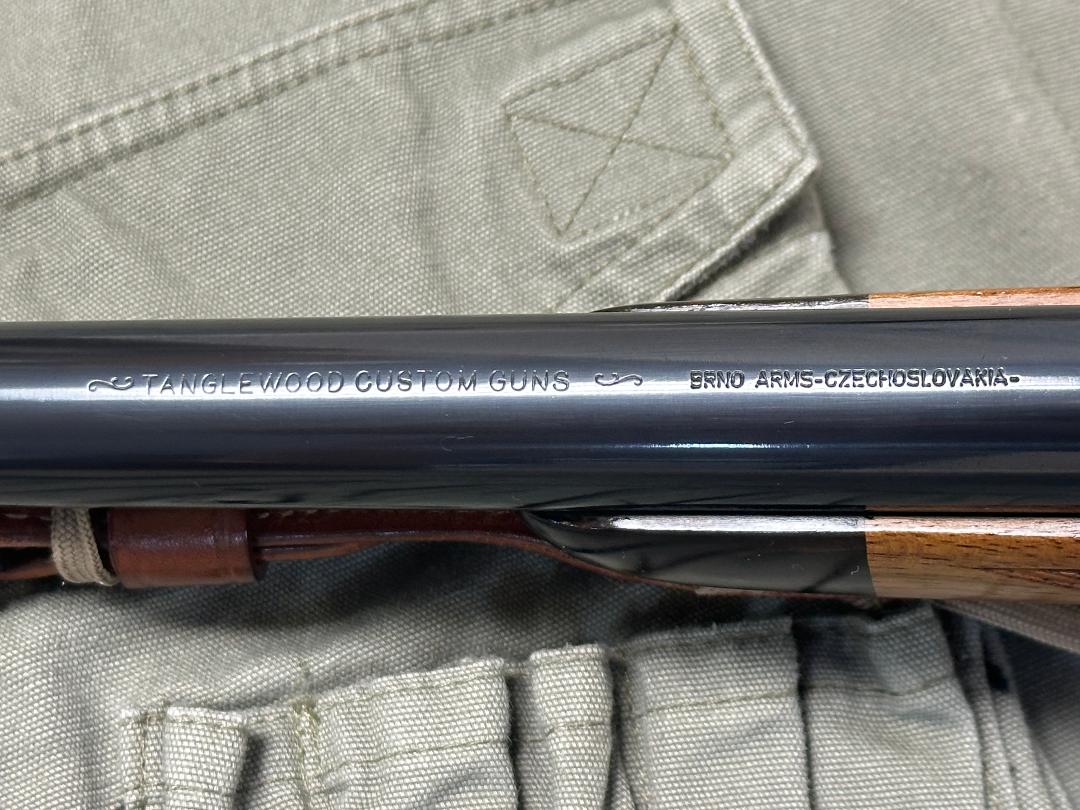

Below, with some pictures interspersed, is the checklist of Lon’s impressive work on the rifle:
Stock Work.
* Original finish completely stripped and factory checkering sanded off.
* Re-carve comb and re-cut the buttstock to lessen downward pitch.
* Slim down/reshape forearm and cut a beveled relief (Rigby style) around magazine port.

* Thin and reshape pistol grip.
* Fit Dressel steel pistol-grip cap.

* Re-checker pistol grip and foreend at 22lpi.


* Fit Pachmayr Decelerator pad.

* Glass-bed stock.
* Refinish stock in oil.
Metal Work.
* Cut and recrown barrel at 24” and reset front sight.

* Highlight rear-sight leaves with silver lines.

* Install Talley barrel-band sling swivel.
* Remove factory safety and weld closed the recess in the receiver.
* Fit Wisner 3-position wing safety on bolt.

* Straighten bolt handle, fill in hole in handle knob.
* Replace factory set trigger with a single-stage trigger. Adjust for smooth pull without creep.
* Remove factory blue, dehorn metal, eliminate machining marks.
* Polish bolt rails, feed-ramp, and magazine follower.
* Re-blue all metal in a low-luster polish.
Additional Upgrades.
* Ebony tip added to stock foreend.

* Recessed cross bolts.

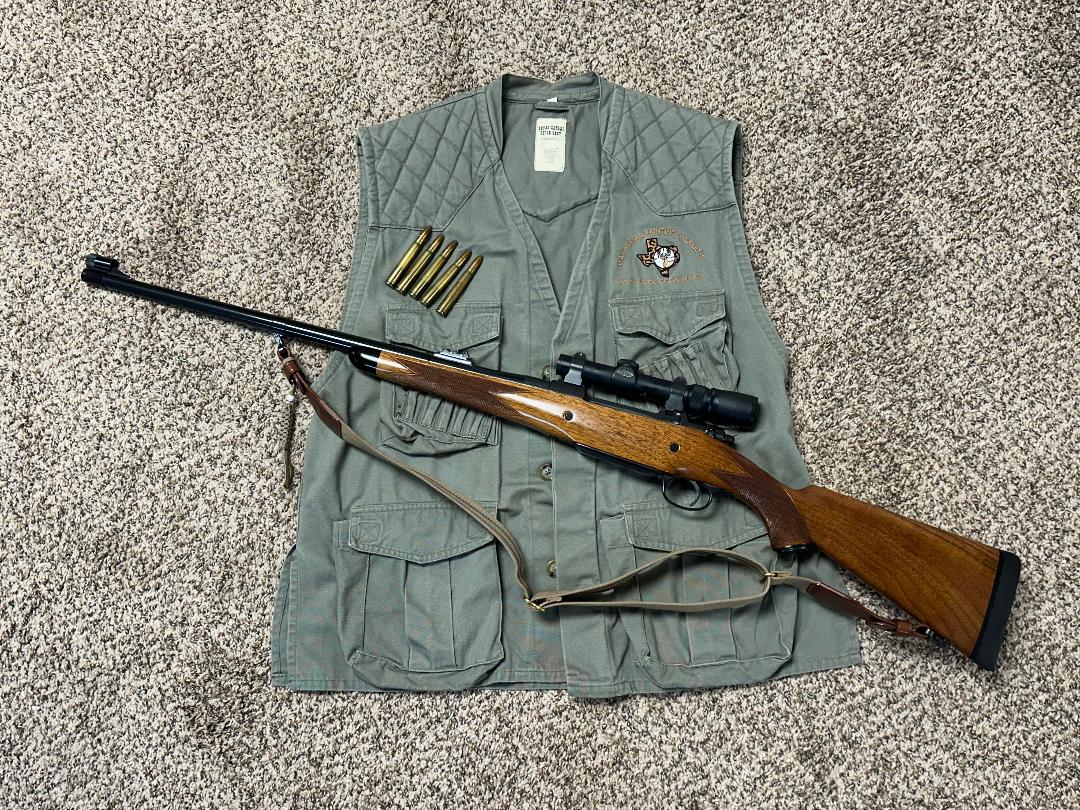
As shown above with Weaver 1-3x scope, Talley low 1" ring mounts, and Trader Keith rifle strap, unloaded weight is 9.8lbs.

Africa waits …
In the almost 30 years since it returned from Lon’s shop, I’ve shot my BRNO extensively with virtually every .375 bullet-weight I could handload or find in factory ammo. For dropping Midwest deer at moderate velocities, I developed accurate loads using Varget and a stash of old 210grn X bullets and 235grn Speer Hot-cores. For the big critters in Africa I hoped to hunt, the rifle showed a real preference for Federal’s premium safari ammo loaded with 300grn bonded bullets. I stocked up on ten boxes of those while they were available, enough for a couple of safaris.
But the buffalo and the eland and the leopard are still waiting. Life, family, and a career intervened and the stars never really aligned to hunt Africa until recently. I have the time and money now that a younger man didn’t, and intend to book a trip for next year. So that part of my BRNO’s story remains to be told, a final chapter for another day.

It was the mid-1990s. Hunting Africa one day was the goal of a younger man, and I wanted to find the right rifle to take there. For a long time before that I tried to read every article in the gun magazines about African rifles and their large magnum cartridges and the animals taken with them. Along the way that came to include ‘Pondoro’ Taylor’s old book and some older pieces by Jack Lott.
Among the cartridges frequently praised by veteran hunters of the African game fields was the .375 H&H. The legal minimum round for dangerous game in several countries, it was a storied classic that could be loaded with a versatile array of bullet-weights. Mainly it was the one African cartridge I figured I could learn to shoot well. So the .375 it was. After that, the issue was finding a rifle I could afford.
By then a few hunting rifles had come my way as family hand-me-downs, the prize being a 1942 Winchester M70 in .30-06. That one, a much-used deer rifle, had been my grandfather’s. Since I was familiar with the Winchester pre-’64 platform I started looking for one chambered in .375 H&H. Unfortunately, the few my area came with high-dollar price tags and so were out of reach.
Finding the BRNO ZKK 602.
At some point I recalled reading a piece by a fellow who took a .375 rifle to Africa that wasn’t a M70. Looking back through my stash of gun-zines, I found it. A 1992 article by Jon Sundra, it was a detailed and mostly positive rundown on the Czech BRNO ZKK 602s then being imported by Philadelphia-based Action Arms Ltd. They came chambered in .375 H&H and .458 Winchester Magnum. The positives included the bomb-proof double square bridge magnum receiver, a CRF bolt with non-rotating extractor, extended capacity magazine, and integral receiver dovetails for mounting an optic.
Sundra’s only negative comment pertained to the Euro-style walnut stock. The too-high droopy comb, when combined with the “drastic” negative pitch, displaced the angle of the butt surface (when shouldered) relative to the rifle’s boreline. This disparity, he wrote, made for uncomfortable shooting in large magnum calibers.
Still, one of Sundra’s comments stayed with me: “Even with its few rough edges here and there, those can be fixed and you still have less money invested than with other options.” Full retail price for a 602 (in mid-‘90s dollars) was about $780.00 for the .375 and $795.00 for the .458 model. That seemed more in my price range, but I had no idea where to find one.
It was the early fall of 1996 and my hunting buddy back then, Joe, was a local cop and also an FFL. I asked Joe to check with his distributors and see if any might have a .375 BRNO 602 in stock. Sure enough, Joe called back and said he’d found one distributor with some, but only a few rifles were left - “the last of the BRNOs!” was the quote. He quickly ordered a .375 model and a week or so later BRNO ZKK 602, serial # 184XX, arrived at his shop.
I had already bought some guns through Joe and since we were close, he gifted me by charging only his dealer cost, the shipping fee and sales tax, and a $15.00 transfer fee. Joe’s dealer cost on a .375 BRNO 602 at the time was $520.00. Adding the other charges, my all-in cost for the rifle was just under $590.00.
Original factory box. Ironically, it pictures a much earlier ZKK 602 model with the Monte Carlo stock and the "pop-up" peep sight in the rear bridge.
My rifle, # 184XX, was a 1991 build, as stamped on the barrel and receiver. Above the ser. # is the Action Arms import mark.
Included with the rifle were the instruction manual, inspection card, and an undated 100-meter test target. Also included but not shown was a box containing two medium-height factory ring mounts.
Three test shots at a claimed 100-meters measured 1.2 inches. I always assumed that was done with the iron sights.
Out of the box, with its 25” barrel and irons-only, the 9.2lb rifle seemed reasonably well-balanced. But it was also every bit the no-frills “working man’s” rifle. When shouldered firmly the butt pad felt like a brick, and there were tool marks on the receiver and on the bolt rails. The checkering on the foreend and the pistol grip was rough and uneven. The stock’s finish could best be described as “East Bloc lacquer.”
Before the BRNO arrived, I had purchased several boxes of .375 H&H ammo - Winchester 270grn SPs and a couple of boxes of Hornady 300grn FMJ ammo. After cleaning the barrel, I headed to our club’s range to get the irons sighted in and do some familiarity-shooting. While the rifle shot decently and without jams, the action felt rough when cycling the bolt and it took only seven or eight rounds to confirm what Sundra was talking about. The “hog-back” stock grew increasingly pain-inflicting to shoot off the bench. It was less so from standing or when shooting off sticks.
Discovering the BRNO Conversion.
After a few more outings with the rifle, I was in our club’s main building one day and saw that someone had left a box of old gun magazines on a table. Going through them, I came across a 1994 article by Joe Coogan entitled, “The Ultimate .375.” But it was the subtitle that caught my eye: “BRNO’s Magnum Mauser Provides The Foundation For A Classic, Custom .375 H&H.” This article appeared in “Rifles and Cartridges for Big Game,” a special-issue magazine released by Guns & Ammo in the fall of that year.
Coogan’s piece highlighted the custom work performed on his BRNO 602 by a master rifle-smith named Lon Paul at his shop in Mountain Center, CA. This “BRNO conversion,” as Coogan termed it, consisted of very detailed stock work and significant metal work which he listed in a sidebar in the article. After a few months in Lon’s hands, a rough utilitarian BRNO returned to Coogan looking the style of a very fine English express rifle on the Rigby pattern. It was more balanced and refined than before, and it fit Coogan better for practical field shooting. But the real cost-saver in the project had been Lon’s ability to radically transform the factory stock rather than re-stocking the rifle with fancy-grade wood. The stock was slimmer overall and, with the buttstock’s comb and pitch reshaped, felt-recoil had been significantly reduced.
Finding Lon Paul.
Unfortunately, I was then two years down the road from Coogan’s article and had no idea whether Lon Paul was even doing these BRNO conversions anymore. I quickly sent Lon a letter and a week or so later he replied (handwritten on “Tanglewood Ranch Custom Guns” stationary!) that he was indeed still doing them. He quoted a price for the same work that wasn’t much higher than what Coogan had paid, and indicated a turn-round time of 4-to-6 months.
Lon invited me to call him if I had any questions. I didn’t, but called him anyway to acknowledge receiving his letter and to say that my BRNO would be shipping out to him within the week if that was okay, along with a deposit to get the work started.
That was in December of 1996. True to his timeline, Lon returned my rifle in late May 1997. It came out of the shipping box a totally different 602 than the one I had sent him. It was noticeably trimmer and lighter in weight by at least a pound; the bolt-cycling was much smoother; the trigger-pull was lighter; and the metal-bluing and the oil-rubbed walnut stock looked just beautiful. Off the bench, felt-recoil was noticeably less with the same ammo than before Lon’s stock magic. The well-fitted decelerator pad certainly helped. With a much-improved trigger, the rifle also shot tighter groups with an inch shorter barrel.
Lon’s final bill for the work (the deposit included) was $1,323.00. Counting my original cost of $590.00, I now had all of $1,913.00 invested in my first custom rifle.
Below, with some pictures interspersed, is the checklist of Lon’s impressive work on the rifle:
Stock Work.
* Original finish completely stripped and factory checkering sanded off.
* Re-carve comb and re-cut the buttstock to lessen downward pitch.
* Slim down/reshape forearm and cut a beveled relief (Rigby style) around magazine port.
* Thin and reshape pistol grip.
* Fit Dressel steel pistol-grip cap.
* Re-checker pistol grip and foreend at 22lpi.
* Fit Pachmayr Decelerator pad.
* Glass-bed stock.
* Refinish stock in oil.
Metal Work.
* Cut and recrown barrel at 24” and reset front sight.
* Highlight rear-sight leaves with silver lines.
* Install Talley barrel-band sling swivel.
* Remove factory safety and weld closed the recess in the receiver.
* Fit Wisner 3-position wing safety on bolt.
* Straighten bolt handle, fill in hole in handle knob.
* Replace factory set trigger with a single-stage trigger. Adjust for smooth pull without creep.
* Remove factory blue, dehorn metal, eliminate machining marks.
* Polish bolt rails, feed-ramp, and magazine follower.
* Re-blue all metal in a low-luster polish.
Additional Upgrades.
* Ebony tip added to stock foreend.
* Recessed cross bolts.
As shown above with Weaver 1-3x scope, Talley low 1" ring mounts, and Trader Keith rifle strap, unloaded weight is 9.8lbs.
Africa waits …
In the almost 30 years since it returned from Lon’s shop, I’ve shot my BRNO extensively with virtually every .375 bullet-weight I could handload or find in factory ammo. For dropping Midwest deer at moderate velocities, I developed accurate loads using Varget and a stash of old 210grn X bullets and 235grn Speer Hot-cores. For the big critters in Africa I hoped to hunt, the rifle showed a real preference for Federal’s premium safari ammo loaded with 300grn bonded bullets. I stocked up on ten boxes of those while they were available, enough for a couple of safaris.
But the buffalo and the eland and the leopard are still waiting. Life, family, and a career intervened and the stars never really aligned to hunt Africa until recently. I have the time and money now that a younger man didn’t, and intend to book a trip for next year. So that part of my BRNO’s story remains to be told, a final chapter for another day.
Last edited:


