

- Joined
- Feb 2, 2024
- Messages
- 1,376
- Reaction score
- 4,727
- Location
- Oklahoma
- Website
- www.dksafaris.co.za
- Media
- 56
- Member of
- NRA
- Hunted
- South Africa (North West, Limpopo & Greater Kruger), Mozambique Save River Region, BC Canada, Alaska and Lower 48 U.S.
.458 Lott vs. .450 Rigby
A Practical Comparison
This has, of course, been discussed before, but as the owner of a .458 Lott, I thought it would be
interesting to compare the .458 Lott and .450 Rigby from a practical standpoint. Much has previously been written right here on AH comparing the two. Honestly, reading those old posts and threads saddens me a bit, some members are no longer here or contributing anymore. At least their opinions and knowledge are still here to read, I’m grateful for that. There are plenty of ballistic comparisons out there, but sometimes the numbers don't tell the whole story.
Pressure and Case Capacity
The .458 Lott operates at a higher maximum pressure than the .450 Rigby.
Cartridge Maximum Pressure Typical Factory Load
.458 Lott ~62,000 PSI 500 gr. at ~2,300 fps
.450 Rigby ~58,000 PSI / 4,000 bar 500 gr. at ~2,350 fps
Heat and Pressure
One of the arguments made for the .450 Rigby is that its lower operating pressure gives it an advantage in very hot conditions. The theory is that lower working pressure provides more margin against pressure increases caused by high temperatures and potentially reduces the possibility of sticky extraction. That's certainly a legitimate consideration.
However, I have to look at this from my own experience as well as others. I've routinely shot my .458 Lott in the Oklahoma sun when temperatures were over 100 degrees Fahrenheit. I've also hunted Africa with it for both elephant and buffalo in blistering 100-degree weather. I've experienced zero pressure related issues with my 458 Lott. I may be a sadist because I actually like hunting Africa during the late season when it's hot!
Factory Ammunition
From a factory-ammunition standpoint, the two cartridges are remarkably close. A typical .458 Lott factory load will launch a 500-grain bullet at around 2,300 fps, while a .450 Rigby will generally run around 2,350 fps with a 500-grain bullet. 50 fps is a very small difference. No elephant or buffalo is going to know the difference between 2,300 and 2,350 fps when hit properly with either. There is one exception however.
I’ve seen factory loaded 450 Rigby ammo, loaded by Norma which offers a Woodleigh 550 grain SP and FMJ solid at 2100 fps, very close to a 500 Jeffery. I don’t see that available in the states though. I think if I owned a 450 Rigby and used factory ammo only, I’d want to use this Norma ammo loaded with the heavier bullets. The .450 Rigby does have considerably more case capacity and that's where things get interesting for the handloader.
The Handloader's Advantage:
The .450 Rigby has a definite advantage for the handloader. There is a tremendous amount of case capacity to work with, and it gives the handloader considerable flexibility. With appropriate components and load data, you can build loads ranging from 458 Lott power to loads to velocity up to 460 Weatherby level and anything in between.
It's interesting to me that factory .450 Rigby ammunition with 500-grain bullets are generally held around 2,350 fps when the cartridge has the capacity to go considerably faster. In my opinion, it makes more sense to have factory 450 Rigby load with a 500 grain bullet in the 2400-2450 fps range, giving it an advantage over the 458 Lott in power.
Whether you actually need it is another question. Personally, I don't think an elephant or buffalo requires the additional velocity when 2,300–2,350 fps with a good 500-grain bullet is already doing the job extremely well.
Magazine Capacity
Here's another area where I think the .458 Lott has a practical advantage. My custom Brno ZKK-602 will hold five rounds in the magazine and one in the chamber, giving me six rounds total. A CZ 550 will typically hold five rounds in the magazine as well.
The .450 Rigby is generally going to give you fewer rounds in the magazine because of its larger case diameter and overall dimensions. Three rounds in the magazine is fairly typical, with four possible with an extended magazine. Some custom rifles may accommodate five. For a dangerous-game rifle, I personally like having that extra capacity. It's not that I expect to need six rounds, but when you're dealing with dangerous game, I don't see a downside to having them available.
Ammunition Availability
This is probably one of the biggest practical differences between the two. The .458 Lott has a major advantage when it comes to factory ammunition and brass availability. It's cheaper, more common, and considerably easier to find. The same would also apply to rifles chambered in 458 Lott, much more available. The .450 Rigby is much less common and significantly more expensive when you can find it. Sometimes it seems like .450 Rigby ammunition is being hoarded!
Companies such as Hendershot's Custom Ammunition will load .450 Rigby and offer some excellent bullet options. That's a great option for someone who doesn't reload, although availability of brass can sometimes be an issue.The ammunition is out there—you just have to look harder and generally pay considerably more for it.
The .458 Lott also has another practical advantage: you can use .458 Winchester Magnum ammunition in a pinch. That's a nice feature plus 458 Lott and 458 Win Mag ammo is much more available in Africa should your ammo get lost in transit. I think you'd have a very difficult time finding .450 Rigby ammunition in many parts of Africa.
Rifles
This is where the .450 Rigby starts getting really interesting to me. I think it's a very cool cartridge, and I honestly wish it were chambered in more rifles. The Rigby Big Game and PH rifles are excellent rifles and a perfect platform for the 450 Rigby. Used Dakota 76 rifles chambered in 450 Rigby are another beautiful option and Parkwest will build one in .450 Rigby.
But outside of the Rigby rifles, it seems to become more of a custom-rifle proposition. I've seen several very nice custom CZ 550s chambered in .450 Rigby, and they make a lot of sense to me. Maybe when CZ was still producing the Safari Magnum rifles, the .450 Rigby was available through their custom shop? I'm not certain about that, but I've certainly seen some very nice CZ 550s chambered for it.
So Which One?
For factory ammunition performance wise, I don't think there is enough practical difference between the two to matter on an elephant or buffalo hunt. The .450 Rigby gives you lower operating pressure and substantially more case capacity. The .458 Lott gives you greater ammunition availability, lower cost, more magazine capacity in many rifles and the ability to fall back on .458 Winchester Magnum ammunition if necessary.
The .450 Rigby certainly has much more potential as a handloading platform, and I think a 500-grain bullet at 2,400–2,450 fps would make for an impressive factory load. But with that comes additional recoil, and I'm not convinced the animal would notice the difference.
I've personally had zero issues with the .458 Lott in extremely hot conditions, including African hunts for elephant and buffalo. So for me, the pressure difference is more interesting on paper than it has been in the field.
Final Thoughts
I would never turn my back on a Rigby PH in .450 Rigby. In fact, Cabela's has some nice ones right now, and if I didn't already own a .458 Lott, I'd certainly be tempted. If you already own a good .458 Lott, I just don't see a compelling practical reason to add a .450 Rigby.
That doesn't mean I don't want one. There's a difference between needing a .450 Rigby and wanting a .450 Rigby. And I'm pretty sure most of us who are interested in one understand that distinction!
The .458 Lott is the practical choice for me. The .450 Rigby is the rifle I'd buy because I simply think it's cool. And honestly, that’s not a bad reason to own one either!
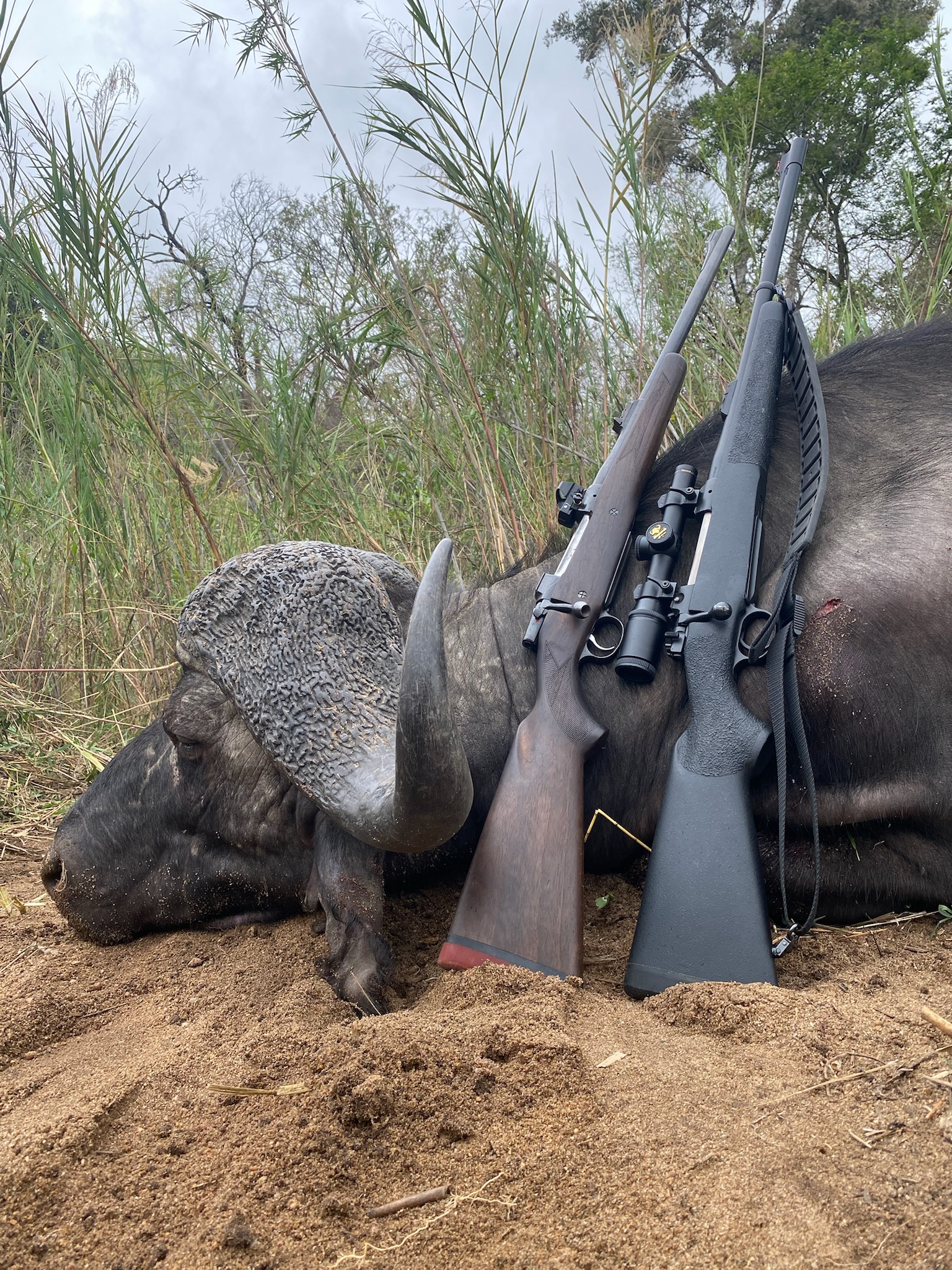
My custom Brno ZKK-602 458 Lott on the right and PH’s CZ 550 458 Lott on the left.

A Practical Comparison
This has, of course, been discussed before, but as the owner of a .458 Lott, I thought it would be
interesting to compare the .458 Lott and .450 Rigby from a practical standpoint. Much has previously been written right here on AH comparing the two. Honestly, reading those old posts and threads saddens me a bit, some members are no longer here or contributing anymore. At least their opinions and knowledge are still here to read, I’m grateful for that. There are plenty of ballistic comparisons out there, but sometimes the numbers don't tell the whole story.
Pressure and Case Capacity
The .458 Lott operates at a higher maximum pressure than the .450 Rigby.
Cartridge Maximum Pressure Typical Factory Load
.458 Lott ~62,000 PSI 500 gr. at ~2,300 fps
.450 Rigby ~58,000 PSI / 4,000 bar 500 gr. at ~2,350 fps
Heat and Pressure
One of the arguments made for the .450 Rigby is that its lower operating pressure gives it an advantage in very hot conditions. The theory is that lower working pressure provides more margin against pressure increases caused by high temperatures and potentially reduces the possibility of sticky extraction. That's certainly a legitimate consideration.
However, I have to look at this from my own experience as well as others. I've routinely shot my .458 Lott in the Oklahoma sun when temperatures were over 100 degrees Fahrenheit. I've also hunted Africa with it for both elephant and buffalo in blistering 100-degree weather. I've experienced zero pressure related issues with my 458 Lott. I may be a sadist because I actually like hunting Africa during the late season when it's hot!
Factory Ammunition
From a factory-ammunition standpoint, the two cartridges are remarkably close. A typical .458 Lott factory load will launch a 500-grain bullet at around 2,300 fps, while a .450 Rigby will generally run around 2,350 fps with a 500-grain bullet. 50 fps is a very small difference. No elephant or buffalo is going to know the difference between 2,300 and 2,350 fps when hit properly with either. There is one exception however.
I’ve seen factory loaded 450 Rigby ammo, loaded by Norma which offers a Woodleigh 550 grain SP and FMJ solid at 2100 fps, very close to a 500 Jeffery. I don’t see that available in the states though. I think if I owned a 450 Rigby and used factory ammo only, I’d want to use this Norma ammo loaded with the heavier bullets. The .450 Rigby does have considerably more case capacity and that's where things get interesting for the handloader.
The Handloader's Advantage:
The .450 Rigby has a definite advantage for the handloader. There is a tremendous amount of case capacity to work with, and it gives the handloader considerable flexibility. With appropriate components and load data, you can build loads ranging from 458 Lott power to loads to velocity up to 460 Weatherby level and anything in between.
It's interesting to me that factory .450 Rigby ammunition with 500-grain bullets are generally held around 2,350 fps when the cartridge has the capacity to go considerably faster. In my opinion, it makes more sense to have factory 450 Rigby load with a 500 grain bullet in the 2400-2450 fps range, giving it an advantage over the 458 Lott in power.
Whether you actually need it is another question. Personally, I don't think an elephant or buffalo requires the additional velocity when 2,300–2,350 fps with a good 500-grain bullet is already doing the job extremely well.
Magazine Capacity
Here's another area where I think the .458 Lott has a practical advantage. My custom Brno ZKK-602 will hold five rounds in the magazine and one in the chamber, giving me six rounds total. A CZ 550 will typically hold five rounds in the magazine as well.
The .450 Rigby is generally going to give you fewer rounds in the magazine because of its larger case diameter and overall dimensions. Three rounds in the magazine is fairly typical, with four possible with an extended magazine. Some custom rifles may accommodate five. For a dangerous-game rifle, I personally like having that extra capacity. It's not that I expect to need six rounds, but when you're dealing with dangerous game, I don't see a downside to having them available.
Ammunition Availability
This is probably one of the biggest practical differences between the two. The .458 Lott has a major advantage when it comes to factory ammunition and brass availability. It's cheaper, more common, and considerably easier to find. The same would also apply to rifles chambered in 458 Lott, much more available. The .450 Rigby is much less common and significantly more expensive when you can find it. Sometimes it seems like .450 Rigby ammunition is being hoarded!
Companies such as Hendershot's Custom Ammunition will load .450 Rigby and offer some excellent bullet options. That's a great option for someone who doesn't reload, although availability of brass can sometimes be an issue.The ammunition is out there—you just have to look harder and generally pay considerably more for it.
The .458 Lott also has another practical advantage: you can use .458 Winchester Magnum ammunition in a pinch. That's a nice feature plus 458 Lott and 458 Win Mag ammo is much more available in Africa should your ammo get lost in transit. I think you'd have a very difficult time finding .450 Rigby ammunition in many parts of Africa.
Rifles
This is where the .450 Rigby starts getting really interesting to me. I think it's a very cool cartridge, and I honestly wish it were chambered in more rifles. The Rigby Big Game and PH rifles are excellent rifles and a perfect platform for the 450 Rigby. Used Dakota 76 rifles chambered in 450 Rigby are another beautiful option and Parkwest will build one in .450 Rigby.
But outside of the Rigby rifles, it seems to become more of a custom-rifle proposition. I've seen several very nice custom CZ 550s chambered in .450 Rigby, and they make a lot of sense to me. Maybe when CZ was still producing the Safari Magnum rifles, the .450 Rigby was available through their custom shop? I'm not certain about that, but I've certainly seen some very nice CZ 550s chambered for it.
So Which One?
For factory ammunition performance wise, I don't think there is enough practical difference between the two to matter on an elephant or buffalo hunt. The .450 Rigby gives you lower operating pressure and substantially more case capacity. The .458 Lott gives you greater ammunition availability, lower cost, more magazine capacity in many rifles and the ability to fall back on .458 Winchester Magnum ammunition if necessary.
The .450 Rigby certainly has much more potential as a handloading platform, and I think a 500-grain bullet at 2,400–2,450 fps would make for an impressive factory load. But with that comes additional recoil, and I'm not convinced the animal would notice the difference.
I've personally had zero issues with the .458 Lott in extremely hot conditions, including African hunts for elephant and buffalo. So for me, the pressure difference is more interesting on paper than it has been in the field.
Final Thoughts
I would never turn my back on a Rigby PH in .450 Rigby. In fact, Cabela's has some nice ones right now, and if I didn't already own a .458 Lott, I'd certainly be tempted. If you already own a good .458 Lott, I just don't see a compelling practical reason to add a .450 Rigby.
That doesn't mean I don't want one. There's a difference between needing a .450 Rigby and wanting a .450 Rigby. And I'm pretty sure most of us who are interested in one understand that distinction!
The .458 Lott is the practical choice for me. The .450 Rigby is the rifle I'd buy because I simply think it's cool. And honestly, that’s not a bad reason to own one either!
My custom Brno ZKK-602 458 Lott on the right and PH’s CZ 550 458 Lott on the left.
Last edited:


 I limit my practice sessions with my 458 Lott to no more than 10 rounds a shooting session, this works best for me.


