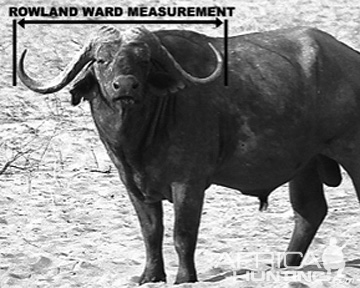
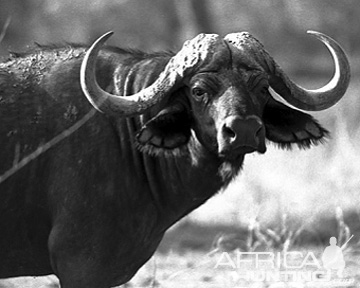
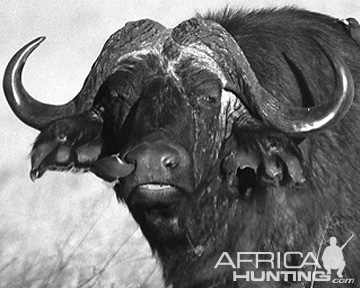
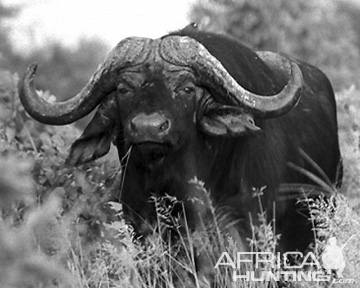
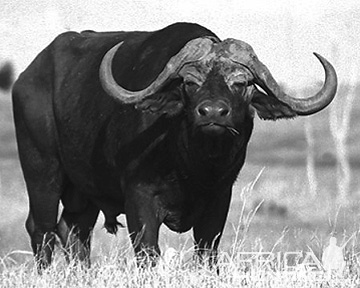
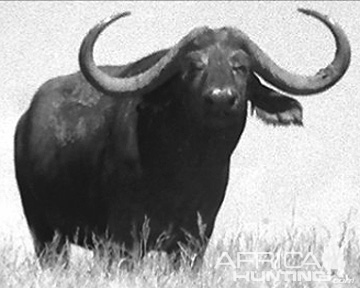
Judging Cape Buffalo

Far right laying down is the best buff imo. His body shows some white patches indicating age and his tips look worn. He is also the second widest buff in the group. The buff in the middle looks to be the widest but also looks to be very young.

IMG_8880.jpeg
 
Last edited by a moderator:
I would want a little more context and, in particular, I would want to see the one lying down in front look at me…
I would NOT shoot the front one looking at you. He is very narrow.
The one standing in middle is quite nice but sort of “flat”
The two lying down on right both look nice
But.,,, it’s TZ… whack three of them and ground check them
 
Field Aging Buffalo Bulls

The recent Rigby competition and numerous comments at the trade shows, has led me to believe that very few clients know how to judge the age of a buffalo bull in the field. As we at Ndumo Safaris really go out of our way to target older than 12-year buffs, I thought some of you may find my pointers interesting.

First off, let me just say that the only way to determine a buffalo’s age with approaching 100% accuracy, is to measure wear on the back molars. People like Kevin Robertson has done great work in developing a graph that can be used to accurately plot a bull’s age against the wear on his back molars. Since this is difficult to do on a wild buffalo, here’s what I consider for when looking over a potential bull. (Like in anything else, there are some exceptions, and I will handle them under each pointer.)

Hard bosses

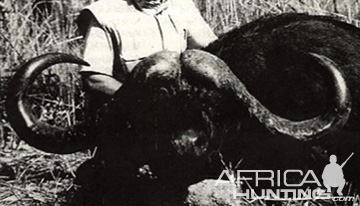
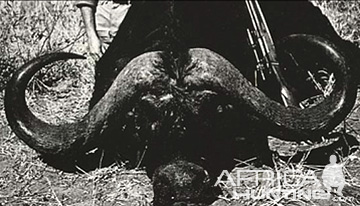
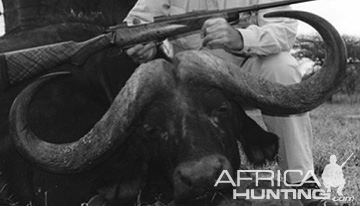
A fully mature bull obviously has a completely hard boss. And here I have to digress for a moment, as even this is not as clear cut as it seems. When talking to potential hunters at the trade show, it becomes clear that there is a general misconception to the definition of what a completely hard and solid boss is. Quite a few thinks that for a buffalo to have a solid boss, the two bosses must be fused together without any gap between them. Not so at all. Most mature bulls with completely hard and solid bosses have a split between the 2 bosses. Very few develop completely hard bosses that fuse when they are fully mature. What you should rather be looking for is soft tissue that has not yet developed into a hard, solid boss, especially on the front edges of the bosses. Also, between the bosses, while the bosses are still developing, there tend to be a lot of hair. Bulls younger that around 5 years, are just starting to become hard, and at around 7 to 8 years, most of the boss tissue becomes hard, with just the edges remaining soft. Thus, a fused boss is no indicator of age.

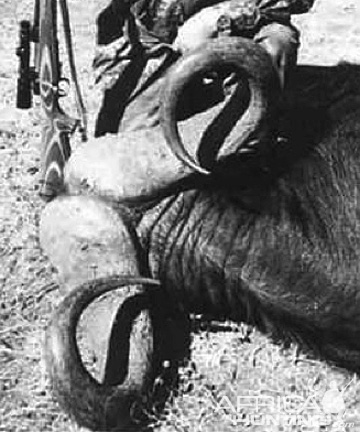
Here is a bull in the 12 years plus bracket with a “fused “boss, and a bull that looks like there is no gap between the horns, but in fact is only 6 to 7 years old. This bull was shot many moons ago in my uninformed days.
View attachment 447133View attachment 447136View attachment 447137View attachment 447125

An example of an old bull with a clear gap between the bosses:
View attachment 447128


Exampes of an immature bulls, note the slight white between the bosses, and the front edges of the second buffalo's bosses, indicating a bull that's around 7 years old.
View attachment 447134View attachment 447135

So now we can at least determine when a bull is older than 8 years old, but is that old enough?

Body mass and dewlap

At the age of around 7 to 9 years old, bulls become breeding bulls and in an ideal world should be left to breed. They start developing big, muscular necks and bodies from around 10 years old, especially in the early season with plenty of green grass available. They are easily distinguishable from the younger 7 to 8-year-old bulls, just by sheer size and muscular looks, the older bulls, around 12 years and older, also develop a distinct dewlap and a curved “Roman” nose. They stop breeding at around the age of 12 years, so tend to hang more with bachelor groups or prefer their own company. This is not to say that all bulls in a bachelor group are mature or old, as younger bulls also join these groups. Also, real old bulls may not be in a herd, but they may satellite a breeding herd for the added security. In dry areas, that they may have to walk far for grazing and water, they slim down quite a lot towards the end of the dry season. As they approach the age of around 15 years in such areas, they start losing body condition and are either killed by predators or just die of old age and general wear and tear. In wetter areas, they may live longer.

Example of Roman nose and dew lap clearly visible on these bulls:
View attachment 447141View attachment 447143View attachment 447144


Horn shape and wear

Horn tips that sweep back, horns that has not yet dropped at the bottom curve and sharp horn tips are all indications of younger bulls. Old, past breeding bulls tend to have blunt horn tips, the drop of the curve tend to be lower, the horn tips tend to not point above the bosses. This is not cast in stone, as genetics also play a role, and may be used as an indication only. At the age of around 12 years and older, they also start wearing their bosses smooth. You can clearly see the shine on the bosses as they become more and more polished and less and less of the grooves on the bosses becomes visible. This happens more in wooded areas than swamp areas, as the bulls wear their bosses smoother if there are more trees and shrubs in an area.

Examples of older worn horn bulls. Look at the blunt tips, and the smooth bosses:
View attachment 447142View attachment 447126View attachment 447127View attachment 447131View attachment 447139

Examples of bulls that are too young, note the sweeping horns, the high tips and the rough bosses. (Last 2 were shot as management buffalo).
View attachment 447124View attachment 447145View attachment 447146

Facial hair and ears

Really old bulls start losing facial hair, especially around the eyes and boss bases. Some areas (like again the swampy areas typical,) this is not so pronounced. I have seen bulls lose their facial hair at a younger age in Uganda, making it easier to make a mistake. Older bulls also tend to have more tattered ears.

Examples of facial hair loss:
View attachment 447132View attachment 447138View attachment 447130View attachment 447140


Here's a bull from Uganda, that I aged at under 10 years old, note the amount of hair loss already seen on him:
View attachment 447129


As I mentioned, there are exceptions to all of the above. For instance, I have seen buffalo hunted by my colleague’s on South Africa’s ranch land that was aged at 16 years plus, which had rough bosses, sweeping horns, and no hair loss, making them look a lot younger. Remember that a lot of ranch buffalo are micro chipped when released, so the owners have a very good indication of how old they are without having to look at the molars of a dead bull. I contribute this to the fact that they obviously have a much easier life, having feed and water always available, and within short distance, plus no predators to speak of.
I know that these old bulls are not everyone's cup of tea, and when you are paying for the hunt, you do have a choice in what you want to hunt, but I really believe that all of us should target these old real dagga boys exclusively as trophies. They are not only cool looking, they are wiser, more difficult to hunt, and more cantankerous.
If you consider all of the above, and again, this is slightly area specific, you should be able to at least be able to determine that a bull is over 12 years old. Which, again, is the type of bulls we should all strive to hunt.
Very educational. Thanks for taking the time to put a post like this together.
 
Cape Buffalo: Is the SCI Trophy Scoring System Wrong?

Here below is an article called Cape Buffalo: Is the SCI Trophy Scoring System Wrong? posted by AFRICAN INDABA in the Hunting Stories & Articles section of AH.

Cape Buffalo: Is the SCI Trophy Scoring System Wrong?
by Dr. Kevin Robertson, South Africa

There can be no doubt. Syncerus caffer caffer, the Southern buffalo is by far Africa’s most popular dangerous trophy game species. In fact, the demand for sport-hunting these formidable black bovines seems almost insatiable. So much so that most reputable safari operators offering buffalo are sold out years in advance. Buffalo hunting is not cheap. Even for a two on one hunt (this is two hunters with one PH), a hunter can expect to pay at least $10,000 for the experience of securing a representative trophy. When spending this amount of money, it is perfectly understandable that hunters ‘want a good one’, that will ‘make it into the record book’.

Two well-known trophy recording systems exist. These are SCI Record of Trophy Animals, and the British originated system of Rowland Ward and their Records of Big Game. But with Americans representing approximately 80 % of the sport-hunters who visit Africa, the SCI system is by far the most popular. In fact it is these sportsmen who practically drive the whole African safari industry and one has only to visit Reno, for SCI’s annual convention to realize just how vast this aspect really is.

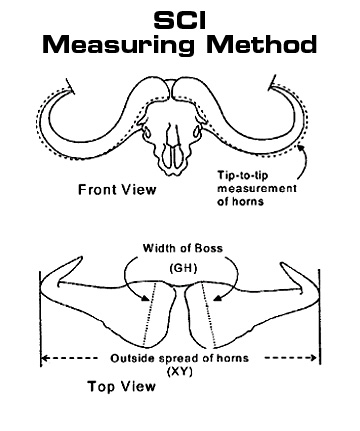
SCI is a huge, well-run organization and most Americans who desire to hunt in Africa are members. SCI has its own unique scoring system and with regards to Syncerus caffer caffer, the current SCI scoring method follows the white line depicted in the photo below.

measuring-buffalo-01.jpg

Photo 1: SCI Scoring System Measurements (white lines).

The length along the outside of the horn curl, from tip to tip, plus the straight-line width measurement of both bosses for a combined total score in inches. 100 inches is needed to qualify for record book entry.

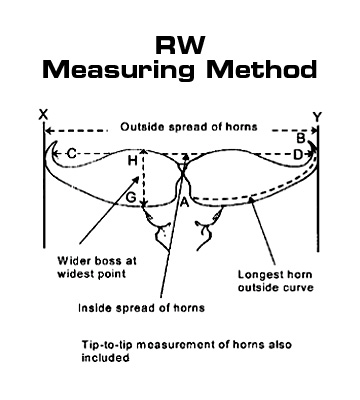
The Rowland Ward system is different in that it measures the greatest outside spread only, and 42 inches in the current requirement for record book entry.

measuring-buffalo-02.jpg

Photo 2: Rowland Ward Scoring System – Approx. 8 Yrs old bull. The boss is just about solid, and horn tips have dropped to boss level.

The current SCI scoring system exerts a tremendous influence on the type and consequently the ages of buffalo that are sport-hunted for trophy purposes. This is my opinion and also that of many PH’s and safari operators, Here are the facts:.

measuring-buffalo-03.jpg

Photo 3: Buffalo Bull 5 to 6 Yrs - Forehead still hairy and the horn tips are still sharp and sticking up above boss level.

Bull buffalo are sexually mature at approximately 5 to 6 years old. By this age, the horn tips are sharp and they will usually stick up well above the level of the forehead. The forehead will still be covered with course, spares hair. There will be no boss per se and PH’s will refer to this bull as being ‘green’. Bull buffalo fight for the right to breed. Such occasions are ‘push and shove’, ‘test of strength’, affairs.

The object of the exercise is simply to determine which bull is physically the stronger. Bulls do not try to kill each other on such occasions simply because mature buffalo bulls play a very necessary roll in the defense of the herd from lions.

Because such fights involve head clashing, a bull buffalo needs a hard or almost completely solid boss to enable it to compete effectively. The horn tips on such occasions are not used, and those which stick up above boss level are actually a disadvantage.

measuring-buffalo-04.jpg

Photo 4: Buffalo Bull approx. 8 Yrs. The boss is just about solid, and horn tips have dropped to boss level.

Buffalo bulls are usually old big and strong enough physically to challenge for the right to breed by their 8th year. By that age, their bosses will be sufficiently hard enough for them to head bash, while their horn tips will usually have dropped to or below boss level.

measuring-buffalo-05.jpg

Photo 5: Approx. 10 Yrs old breeding bull. Boss completely solid, horn tips well below boss level.

The peak breeding age for a buffalo bulls is their 9th and 10th years. Sometime in their 11th year, breeding bulls will usually be replaced by younger, stronger and fitter individuals.

measuring-buffalo-06.jpg

Photo 6: An exceptional, approximately 11Yrs old solid bossed buffalo bull.

Horn rubbing is an important part of dominant, breeding bull behavior. This wears the horn tips down. While not so important with regards to the Rowland Ward system of measurement, this practice, together with the fact that the horn tips drop as the bull matures, has a significant influence on a bull’s SCI measurement. In a nutshell, a bull, regardless of his initial horn size, will score less and ever less on the SCI system of measurement as he matures and progressed from a pre-breeding through to a breeding and then to a post-breeding bull. As I see it, this is the primary flaw with this measuring system.

The current top ranking SCI bull, and the current no’s 5, 10 and 17 were all pre-breeding, 6 to 7 year old bulls at the time they were collected.

measuring-buffalo-07.jpg

Photo 7: Current Number 1 SCI – The bull is soft bossed. A number of independent buffalo authorities have aged this bull to be 7 years old. The chances that he got to breed before being shot are remote.

measuring-buffalo-08.jpg

Photo 8: Current SCI Number 5 is of a similar age.

measuring-buffalo-09.jpg

Photo 9: Current SCI Number 10 is also a really young, pre-breeding soft-bossed bull.

measuring-buffalo-12.jpg

Photo 10: This exceptional 6 year old bull was the SCI no. 1. It now ranks no. 17. What a pity it never got to breed as it truly was a magnificent specimen.

One does not have to be Einstein to realize the long term effect of shooting genetically superior specimens before they have a chance to pass on their genes, and already this is becoming evident. Average trophy size in those countries where Southern buffalo are regularly hunted is dropping, and quickly. It is my belief that this is a direct result of this simple fact. A scoring system which places more emphasis on a bull’s boss development and encourages the shooting of old, post breeding-age bulls needs to be implemented, and the sooner the better. (At this point in time, one of the suggestions for a new method is to use the Rowland Ward, straight-line method, and add the ‘over the top’ measurement of both bosses for a final score.)

measuring-buffalo-10.jpg

Photo 11: This is a mature huntable Bull.

A scoring system which encourages the shooting of bulls like shown on photo 11 and leaves those like the one on photo 12 to breed, needs to be developed and implemented. I voiced my concerns on this matter in my first buffalo book, ‘Nyati’. Unfortunately, my requests for a revision of the SCI scoring system went unheard.

measuring-buffalo-11.jpg

Photo 12: This Bull should be left alone.

sci-measuring-method.jpg


rw-measuring-method.jpg


cic-measuring-method.jpg
This article and another by Taylor also in the AH articles collection are extremely informative and appear really important from the viewpoint of conservation of the bloodlines of these magnificent and worthy animals. Is there any resolution in prospect?
 
Sure, that is doable, but the hunting fees can then be tiered based on this scoring. This must therefore be done independently of the commercial hunting, only for scientific studies or at the request of the client.
 
Saw this one in the backyard last night before supper. Still too young but IDK how long he will last with a spread like that.
IMG_2060.jpeg
 
Many years ago, accompanied only by a tracker armed with a short billhook blade, after a long stalk and some frenetic excitement at the end I took a majestic buffalo bull. His horn span is something in the order of 51 inches according to the Rowland Ward method but, as I do not chase the tape measure, I have never bothered to have him formally measured. He was well over the breeding age and judging by his many battle scars had sown his wild oats as Nature had intended. A mature and chipped boss and worn horn tips marked him as a really mature old dagga boy and he lost his last battle in courageous style. These to me are the only measures by which I judge a worthy buffalo trophy. He still after all these years enjoys pride of place on my wall.
 

Forum statistics

Threads
70,265
Messages
1,571,025
Members
169,236
Latest member
ClydeRicke


Latest profile posts

Azklmsr wrote on MANKAZANA SAFARIS's profile.
Good Evening. I am very interested in you hunt for the spiral slam. March in 2028 would be fine for me

Couple of quick questions:

1) Can we add some additional species on
2) what do you want for a deposit?
3) how do you want me to sign up

I'm on whats app or email

Kurt Meister
480-410-1594
azklmsr462@gmail.com

have a great evening
autofire wrote on ThinAirHunter's profile.
I think forum prohibits making reference or giving personal references to PH/Outfitters that don't advertise on this forum.

But you can call me. I would be happy to discuss Cape Buffalo .

Bob 813-310-6992
MHYOUNG 375 wrote on Marley7x57's profile.
If you really are interested I 'll send some pix. I have quiet a few.
curt672 wrote on Robmill70's profile.
So What's the story on the 340 ??? thanks Curt
 
Top