

A. P. Walshe — A Life Among Rifles
Johannesburg and Pietersburg, South Africa, around the turn of the twentieth century
In the closing years of the nineteenth century, as the goldfields transformed Johannesburg from a rough mining settlement into one of southern Africa's most prosperous towns, a new class of sportsmen emerged. They wanted rifles capable of competing on the range, stalking game across the veld, and accompanying them into the African interior. Supplying these men required more than a shopkeeper; it demanded a knowledge of firearms, an understanding of the finest European gunmakers, and an eye for the equipment that serious riflemen prized.
A. P. Walshe appears to have occupied just such a position.
Walshe was associated with Johannesburg and Pietersburg, in the former Transvaal, and developed connections with some of Europe's distinguished rifle makers. During the 1890s, he acted as a South African agent for the Edinburgh firm of Alexander Henry, reportedly purchasing many of the firm's specialized two-position match rifles exported to the region. These were precision sporting arms intended for competitive shooting, Walshe's interests extended well beyond ordinary commercial firearms.
By the early twentieth century, the German firm of Mauser had become central to the evolution of the modern sporting rifle. John Rigby & Co. of London had secured exclusive distribution rights for Mauser rifles and components in Britain and its colonies, and Rigby developed sporting rifles around Mauser's increasingly sophisticated bolt-action designs. In 1899, Rigby had requested a lengthened action suitable for larger cartridges; this became the Magnum Mauser, a platform that would help redefine dangerous-game rifle design.
For a South African gun dealer and rifle enthusiast such as Walshe, these developments were difficult to ignore. He was already connected to the European sporting-rifle trade and familiar with the demands of serious riflemen. A finely made Mauser Sporting Magnum offered the combination of precision engineering, rapid repeat shots and substantial sporting-rifle performance that was more than enough to convince Walshe.
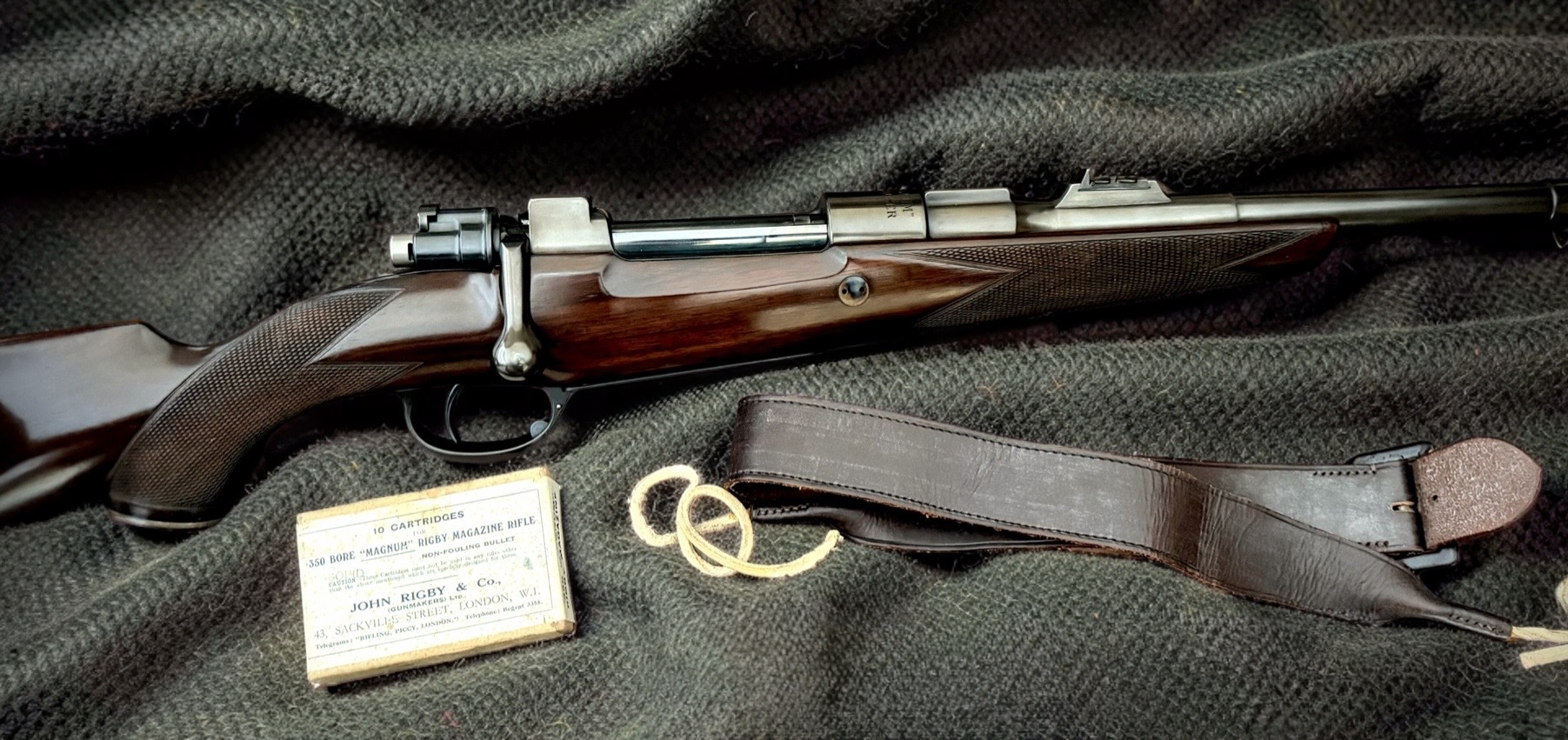
It is in this setting that we encounter the rifle recorded under his initials: 350 Magnum, Mauser Sporting Magnum, serial number 3912, entered on August 8, 1912. The recorded specifications describe his rifle weighing eight pounds eight ounces, with a 24-inch barrel, a 14 ½ -inch length of pull, and traps in the butt and grip.
The date is especially intriguing. 1912 was an especially significant year for the firm, A year in which the Rigby introduced the celebrated .416 Rigby.
Walshe's later reputation as a rifleman is consistent with a lifelong interest in the discipline. A. P. Walshe won the Yeoville Long Range Shooting Cup four consecutive times around 1923, after which his family donated the trophy to the shooting association. A. P. Walshe was a man who lived his life amongst rifles at a pivotal time in history, he connected South Africa’s shooting traditions with the finest European and British gun making of his era.
Below are some photographs of Mr. Walshe in his shop, a photo of his rifle, and an interesting photo of guns being removed from Walshe’s shop under police guard during the “Johannesburg miners’ strike of 1913”.


Johannesburg and Pietersburg, South Africa, around the turn of the twentieth century
In the closing years of the nineteenth century, as the goldfields transformed Johannesburg from a rough mining settlement into one of southern Africa's most prosperous towns, a new class of sportsmen emerged. They wanted rifles capable of competing on the range, stalking game across the veld, and accompanying them into the African interior. Supplying these men required more than a shopkeeper; it demanded a knowledge of firearms, an understanding of the finest European gunmakers, and an eye for the equipment that serious riflemen prized.
A. P. Walshe appears to have occupied just such a position.
Walshe was associated with Johannesburg and Pietersburg, in the former Transvaal, and developed connections with some of Europe's distinguished rifle makers. During the 1890s, he acted as a South African agent for the Edinburgh firm of Alexander Henry, reportedly purchasing many of the firm's specialized two-position match rifles exported to the region. These were precision sporting arms intended for competitive shooting, Walshe's interests extended well beyond ordinary commercial firearms.
By the early twentieth century, the German firm of Mauser had become central to the evolution of the modern sporting rifle. John Rigby & Co. of London had secured exclusive distribution rights for Mauser rifles and components in Britain and its colonies, and Rigby developed sporting rifles around Mauser's increasingly sophisticated bolt-action designs. In 1899, Rigby had requested a lengthened action suitable for larger cartridges; this became the Magnum Mauser, a platform that would help redefine dangerous-game rifle design.
For a South African gun dealer and rifle enthusiast such as Walshe, these developments were difficult to ignore. He was already connected to the European sporting-rifle trade and familiar with the demands of serious riflemen. A finely made Mauser Sporting Magnum offered the combination of precision engineering, rapid repeat shots and substantial sporting-rifle performance that was more than enough to convince Walshe.
It is in this setting that we encounter the rifle recorded under his initials: 350 Magnum, Mauser Sporting Magnum, serial number 3912, entered on August 8, 1912. The recorded specifications describe his rifle weighing eight pounds eight ounces, with a 24-inch barrel, a 14 ½ -inch length of pull, and traps in the butt and grip.
The date is especially intriguing. 1912 was an especially significant year for the firm, A year in which the Rigby introduced the celebrated .416 Rigby.
Walshe's later reputation as a rifleman is consistent with a lifelong interest in the discipline. A. P. Walshe won the Yeoville Long Range Shooting Cup four consecutive times around 1923, after which his family donated the trophy to the shooting association. A. P. Walshe was a man who lived his life amongst rifles at a pivotal time in history, he connected South Africa’s shooting traditions with the finest European and British gun making of his era.
Below are some photographs of Mr. Walshe in his shop, a photo of his rifle, and an interesting photo of guns being removed from Walshe’s shop under police guard during the “Johannesburg miners’ strike of 1913”.