

Mountaineous
AH senior member
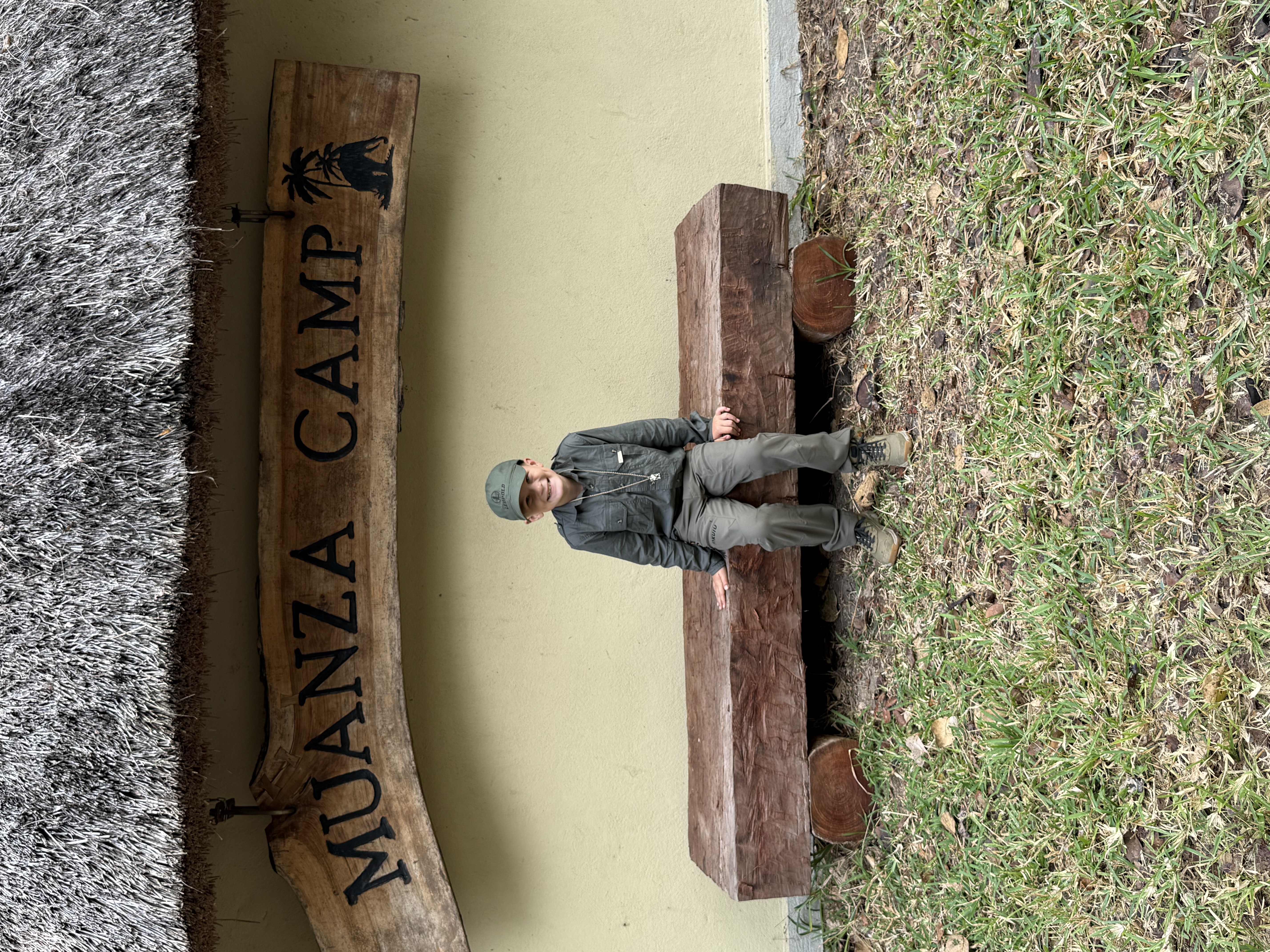
In late August of 2026, my eight-year-old son, Cole, and I spent two weeks hunting in Mozambique with Gavin Lipjes of @PANTHER TRACKERS . We hunted between the Muanza and Mupa camps, located in the Chinizuia Forests (southwest of the Zambezi Delta and just south of Coutada 12)
The trip included buffalo tracking, plains-game hunting, and several days of searching for a leopard with hounds. Cole accompanied me for most of the safari, although there were a few situations, particularly during the nighttime leopard hunt, where he remained with the vehicle or camp for safety.
Having him there changed the experience in ways I had not fully anticipated. Every stalk carried an added sense of responsibility, but it also gave the hunt a deeper meaning. I was not simply pursuing animals for myself; I was hunting for us both, and he shared in the excitement and disappointments of the hunts as if they were his own.
Our professional hunter was Gavin Lipjes. Willem and Lizelle managed the camps, and the trackers and camp staff were a major part of the experience.
Day 1 — Cape Buffalo
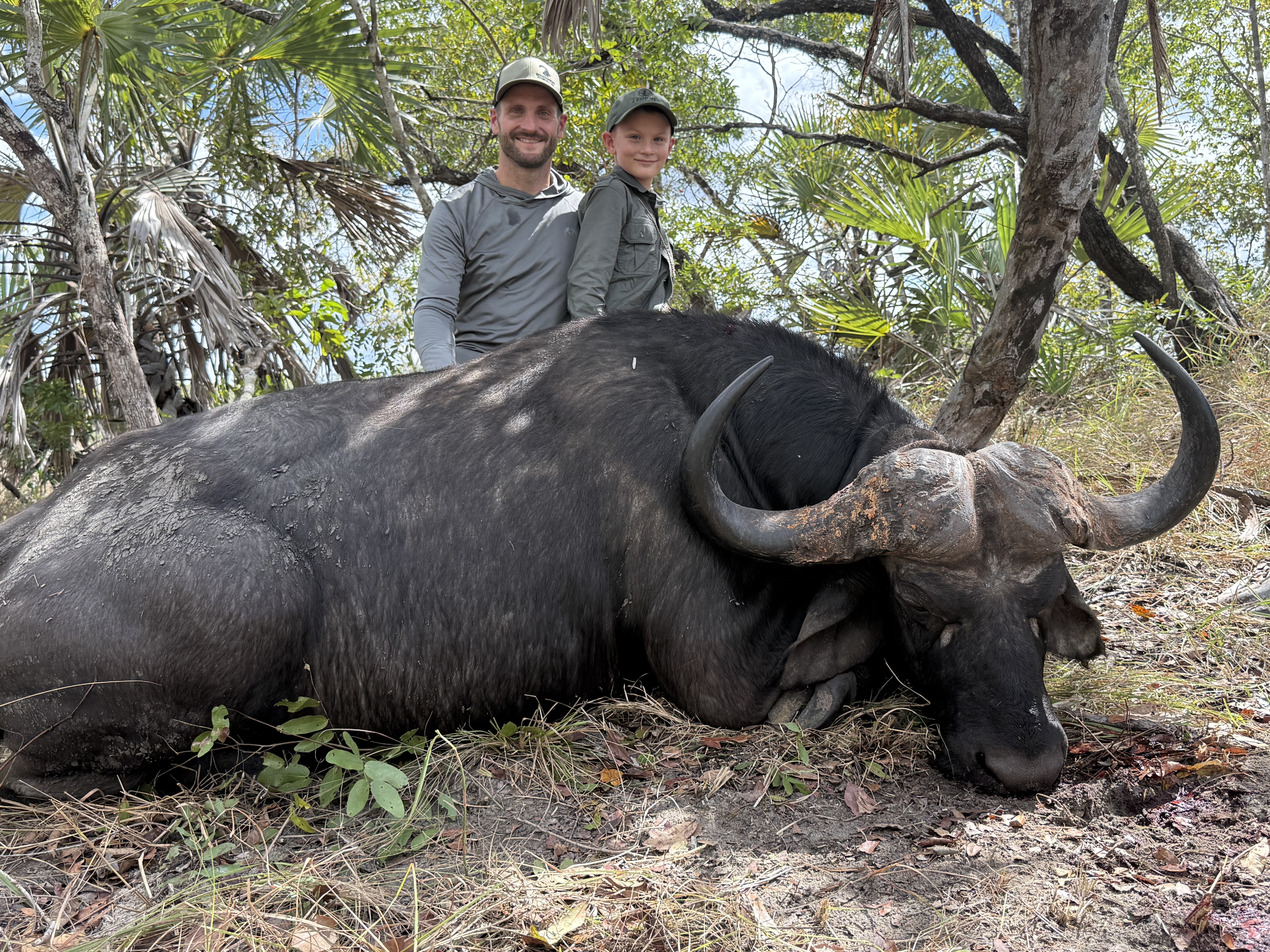
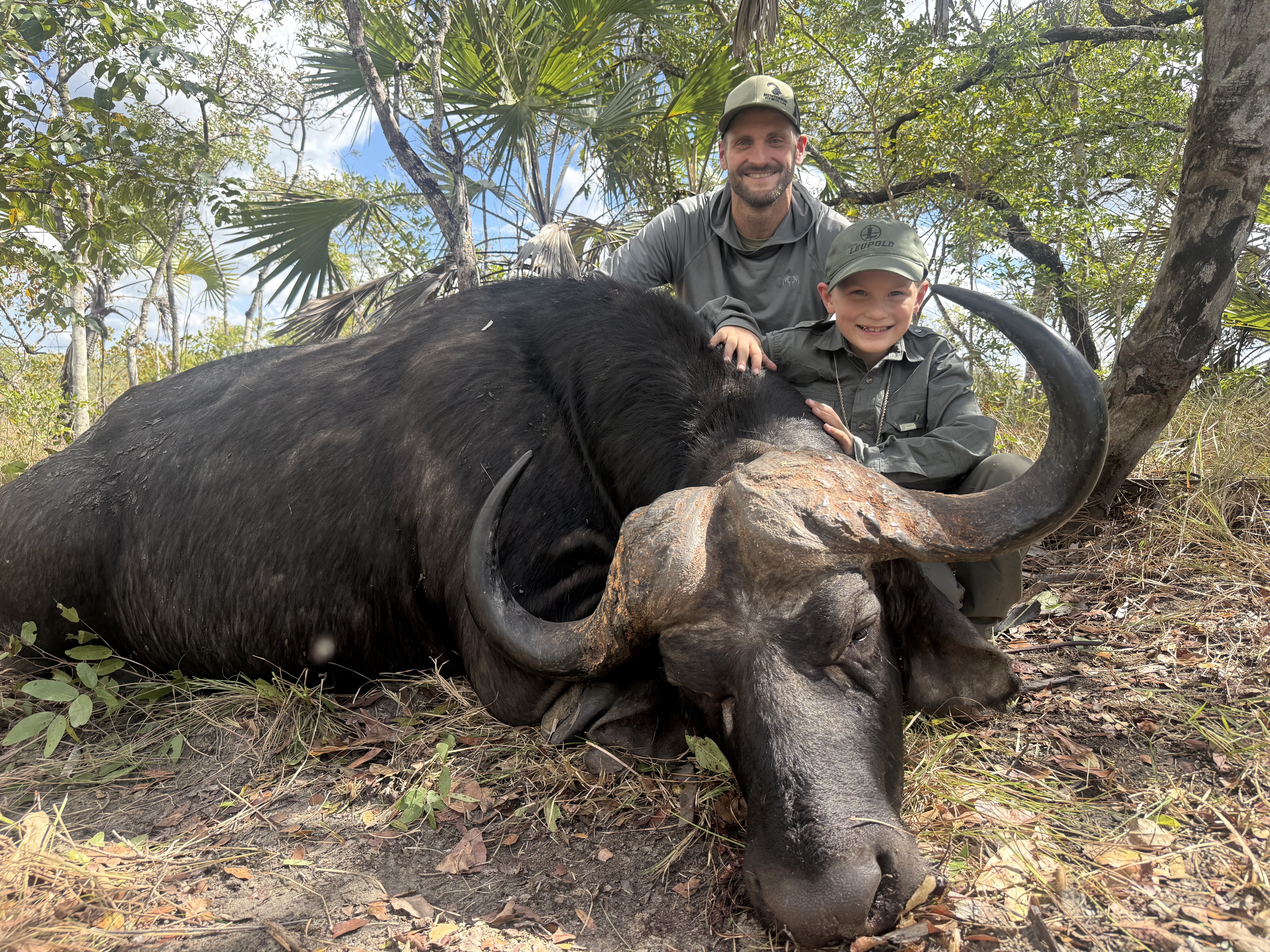
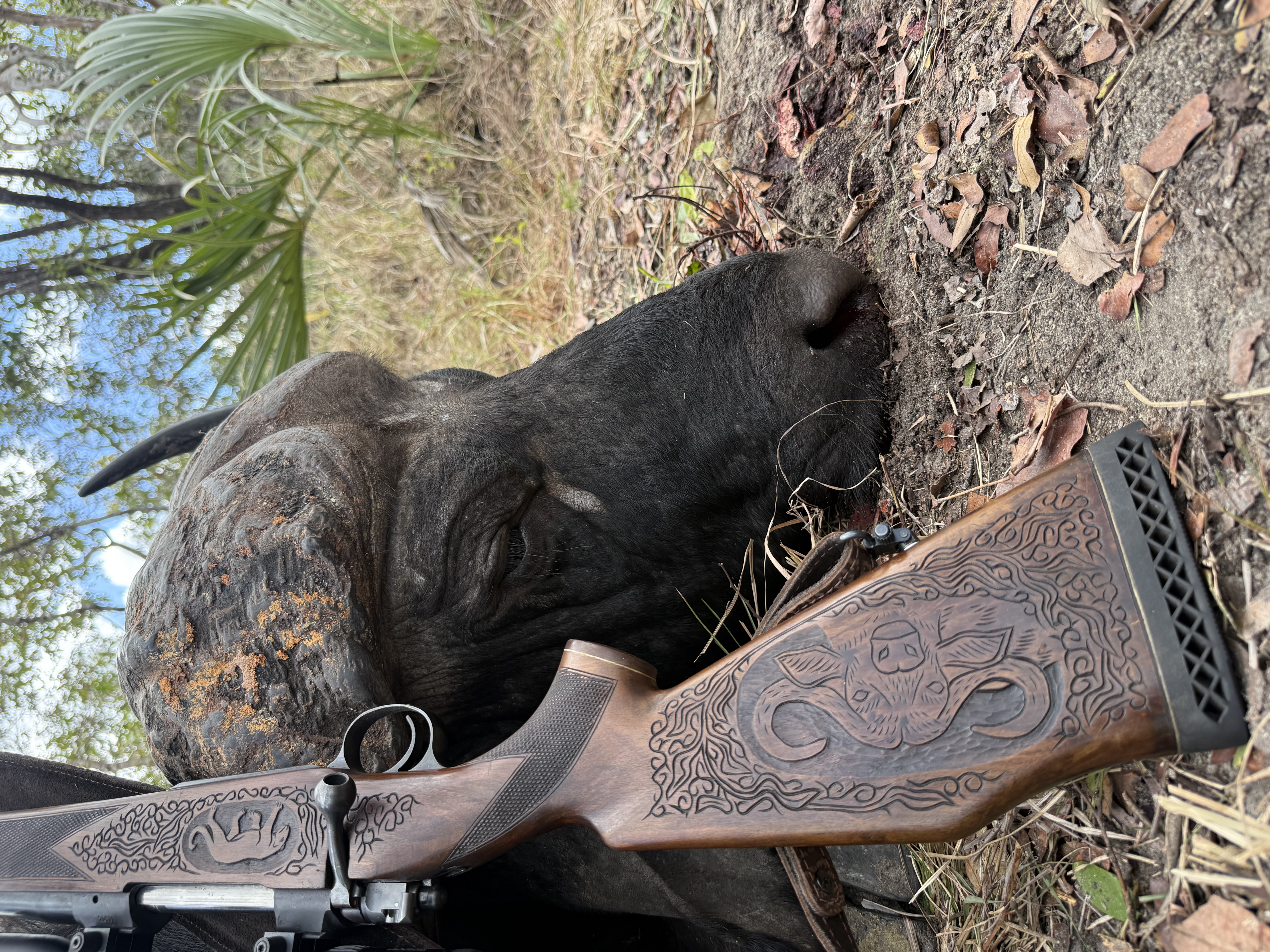
We began the safari by tracking Cape buffalo on foot from Muanza camp. On our first morning out, after following the herd for a couple of miles, we caught up with an old bull and were able to get into position. After a long standoff waiting for him to get up, I used a .375 H&H BRNO ZKK602, and made a clean shot. The bull went down shortly afterward, and the 300 grain Swift A-Frame was found under the hide on the opposite shoulder.
Cole was with me throughout the stalk and saw his first Cape buffalo on the first morning of the hunt. It was a special moment for me to take my first Cape Buffalo, but it was even more meaningful getting to share the excitement with my son. It was a good start to the safari.
Day 2 — Traveling to the Mupa Camp
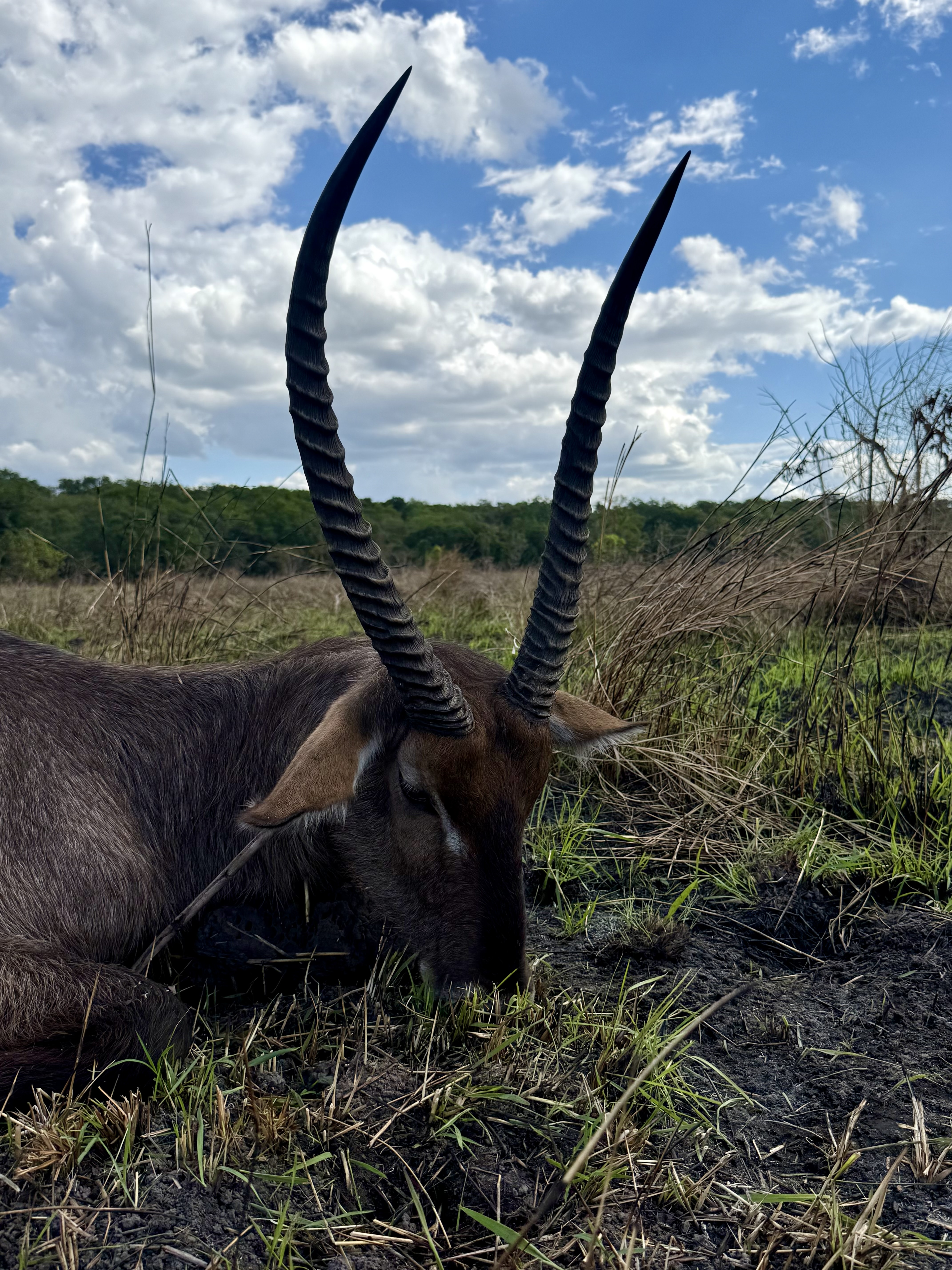
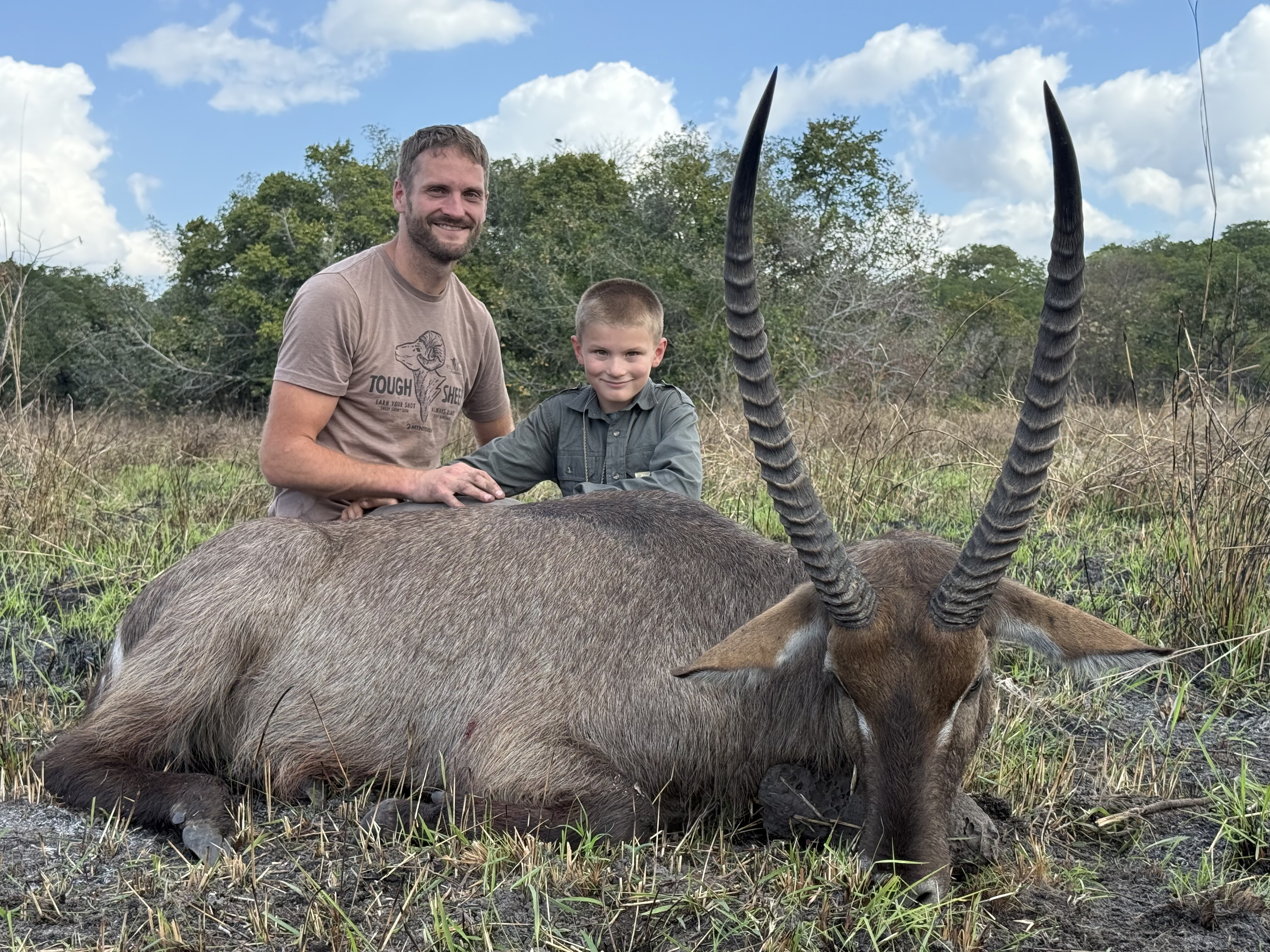
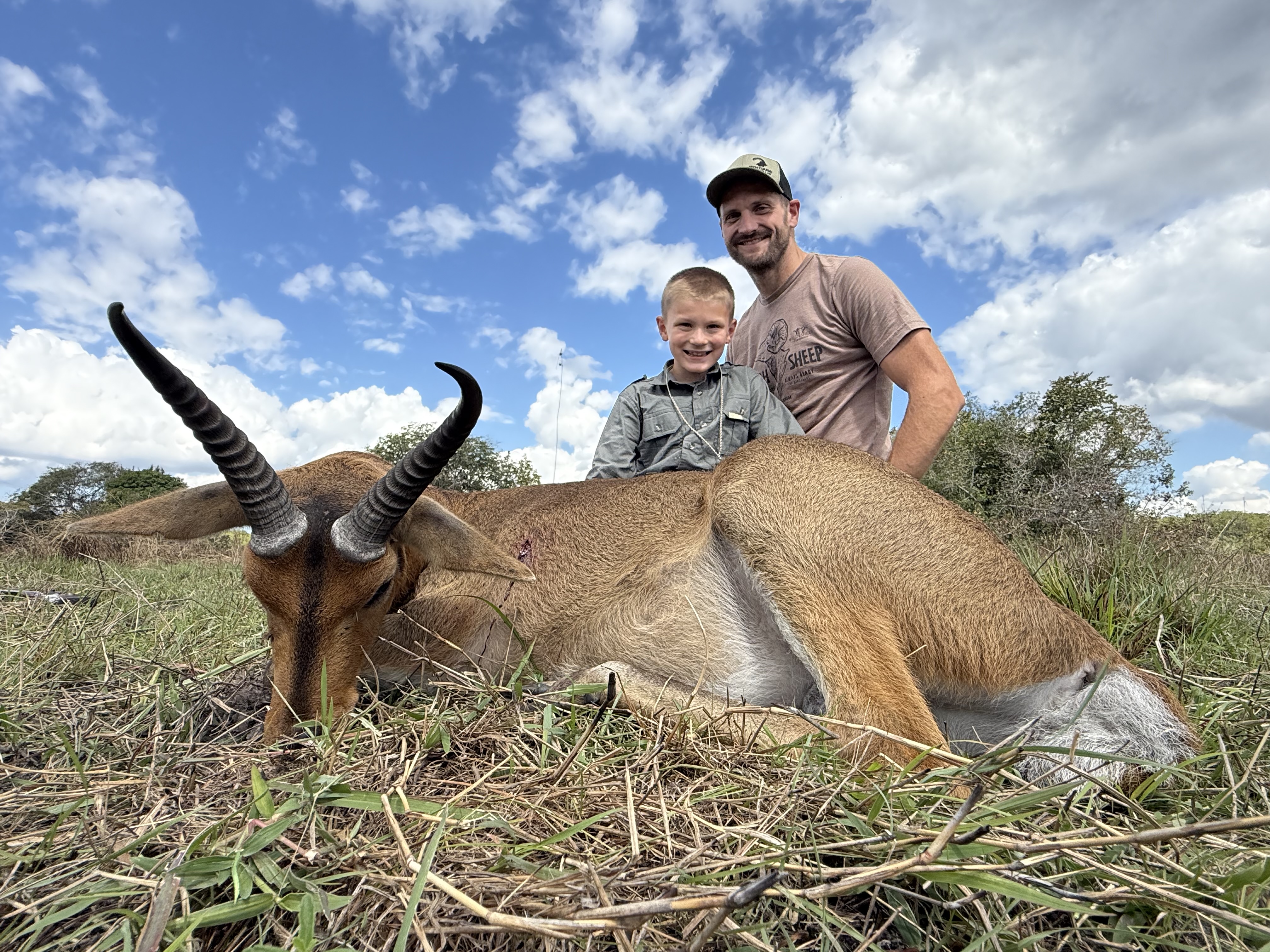
On the second day, we loaded our equipment and traveled with Gavin through the Chinizuia Forest toward a satellite camp on the Mupa River. The drive took a few hours. After arriving at camp, we hunted that afternoon and took a waterbuck and a reedbuck. In a stroke of luck, I was able to harvest them approximately 30 yards apart from each other. That evening, the focus shifted to leopard. The roads were dragged, and trackers were assigned to walk sections of riverbed at night. They would report any fresh tracks in the morning.
Day 3 — Sable and the First Leopard Track
We were out at approximately 2:00 a.m. checking sandy roads and meeting trackers returning from their nighttime walks. One tracker had found the track of a large male leopard crossing into our area. We confirmed the track, but by the time it was evaluated, too much daylight had passed to release the hounds safely. The tsetse flies were becoming active, and we decided not to risk the dogs. While I rested during the middle of the day, Cole went fishing in the Mupa River with Willem. They caught a few of the small robber fish.
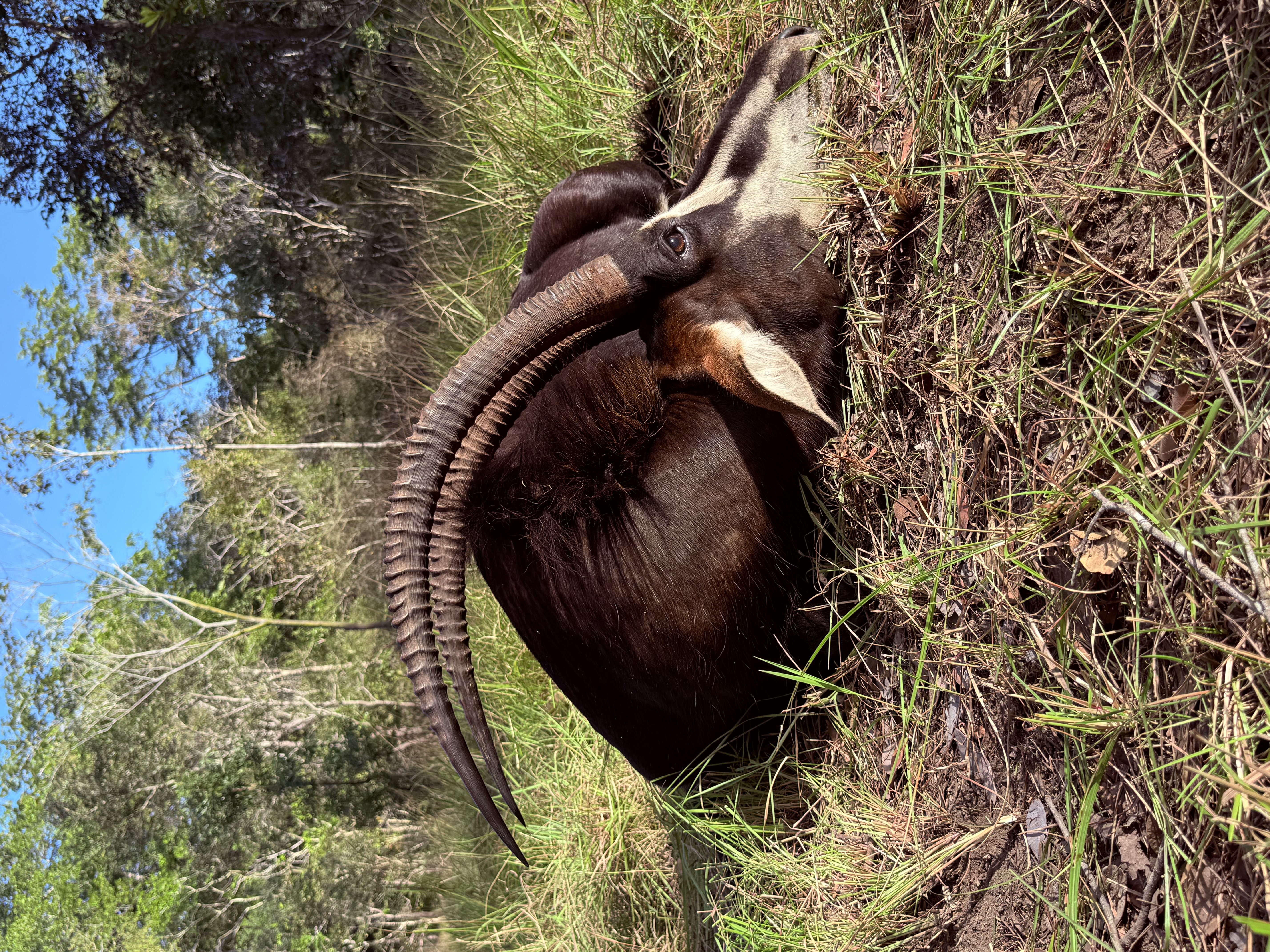
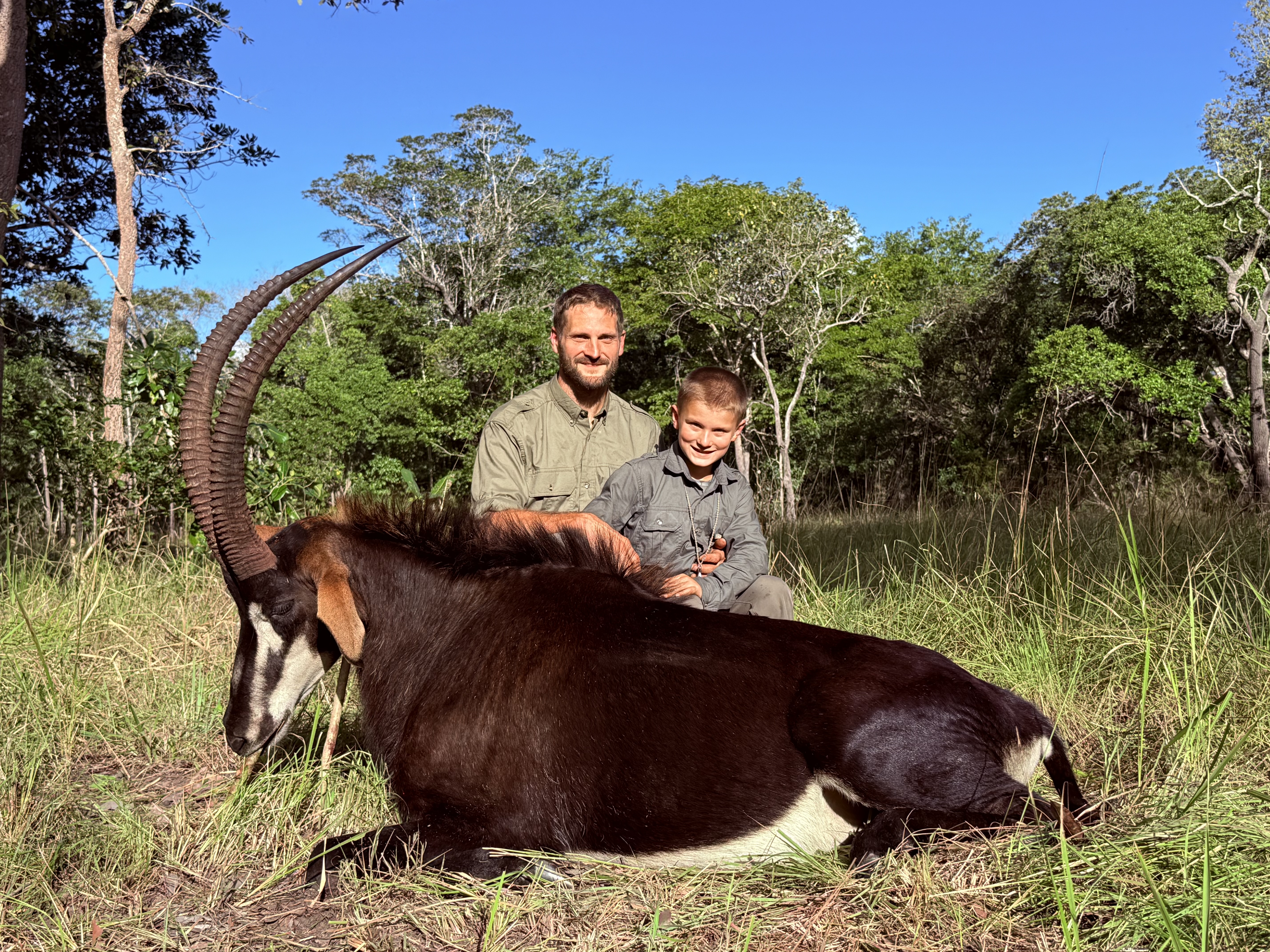
That afternoon, we hunted sable. We first saw several animals at a distance, then worked through the vegetation to get the wind in our favor. A few cows and a bull appeared close to us as we moved through the forest. I made a quick shot, and after a short track we recovered a Roosevelt’s sable bull. It was one of the animals I had most wanted to hunt in Mozambique, and Cole was with me when we found it. That night, we resumed looking for leopard tracks.
Days 4–6 — Leopard Hunting
Day 4 was spent canvassing the area for fresh leopard tracks. Late in the morning, we came across a promising set of tracks, and Gavin turned the eight hounds loose. We already knew the leopard was a female and were not expecting an opportunity at the big male we were pursuing. The purpose was to give the dogs some work and let them settle a leopard in a tree. After a little less than a mile, the dogs treed her. We worked through the vegetation to reach them and confirmed the identification. There was no opportunity at the male, so we observed her briefly and allowed the dogs to settle. Cole made it to the tree with me and was able to see the leopard. When she began to growl and come down, I grabbed Cole and we moved back toward the truck. He seemed unfazed and sang a mashup of “Welcome to the Jungle” and “Run Through the Jungle” as we went.
On Day 5, we did not find a mature male leopard track that we could work with. Shortly after daylight on Day 6, the trackers reported a fresh male leopard track in a riverbed. We went to the location and released the hounds. The dogs followed the track through the bush until it crossed a road. At that point, it appeared that the male had joined a female, so there was a chance the dogs could follow either leopard. The hounds soon treed one of them. When we reached the tree, it was the female. She came out with deep throaty growls and moved away, with the dogs following her. They treed her again, and the same thing happened. She eventually stayed in a third tree long enough for us to catch up and settle the dogs. We did not get an opportunity at the male that morning.
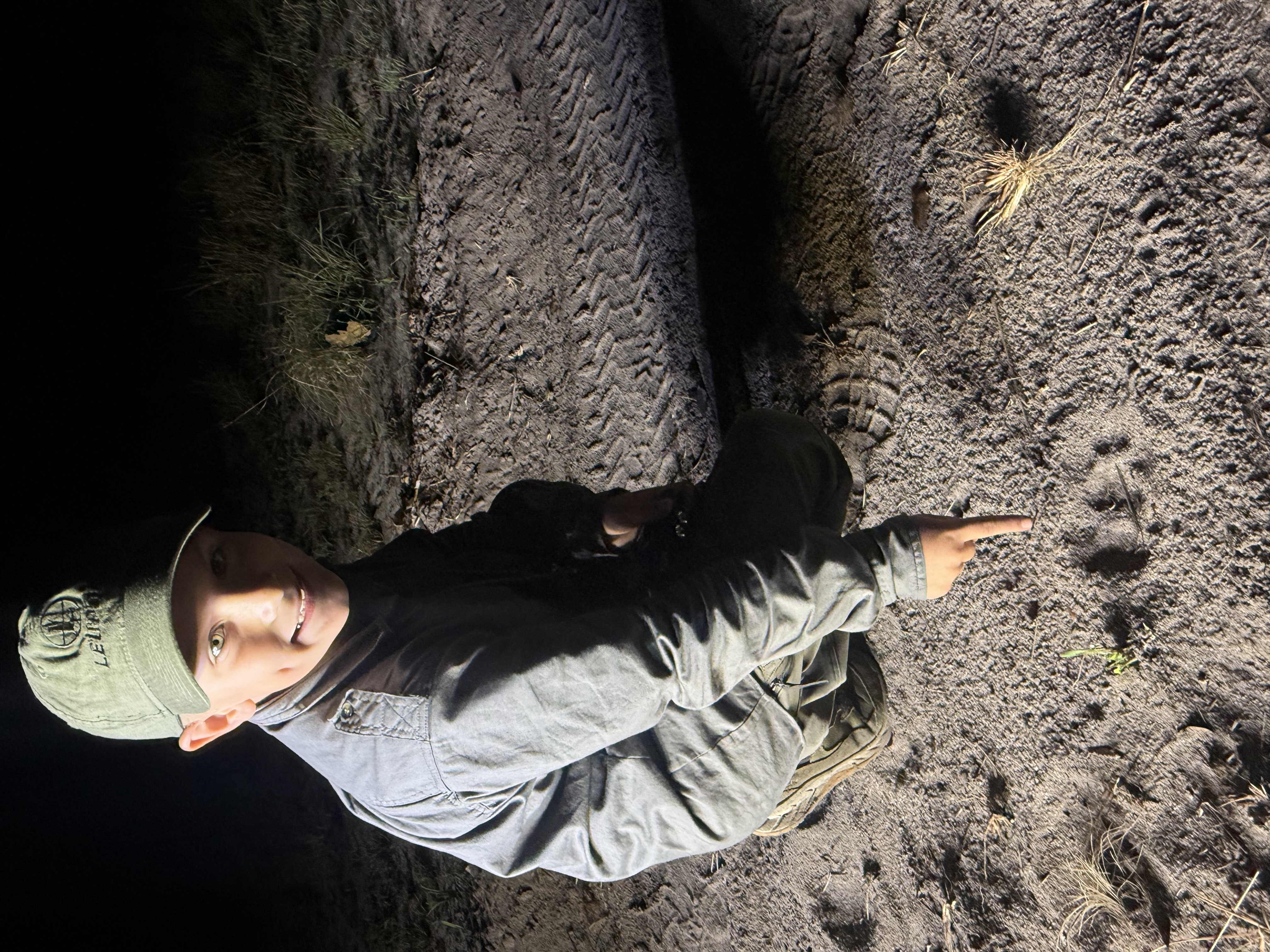
Day 6 — The Leopard
That evening, we returned to the roads and found very fresh tracks from the male. The female was still with him, so there was again a chance that the dogs would choose the wrong leopard. We released the hounds, and they followed the track for approximately half a mile before stopping at a tree. We moved toward the dogs and searched the branches with our lights, but initially could not see the leopard.
While scanning the nearby branches with the light, all of a sudden the small bushy tree behind us erupted in growls and started shaking wildly. The cat had been down low and concealed in the leaves maybe 10-20 yards behind us. It had lost its patience and was coming out. Based on our relative positions to each other, it had us dead to rights at that point. I jumped back, spun around, and shouldered my rifle. I was half expecting a cat in my lap before I could raise the rifle, but the leopard had taken off in the opposite direction with the dogs hot on the trail. It’s hard to describe the feeling in your stomach that comes from hearing the deep guttural roars of a leopard from a short distance behind you, while you are in the dark of night and mired in brush and vines.
The dogs eventually treed him again. This time we finally found him perched on a limb, and Gavin was able to identify him as the male we had been tracking. The shooting position was difficult because of the vegetation and limited room. One of the trackers, Felton, provided a shoulder rest. I used the rest, located the leopard through the branches, and fired.
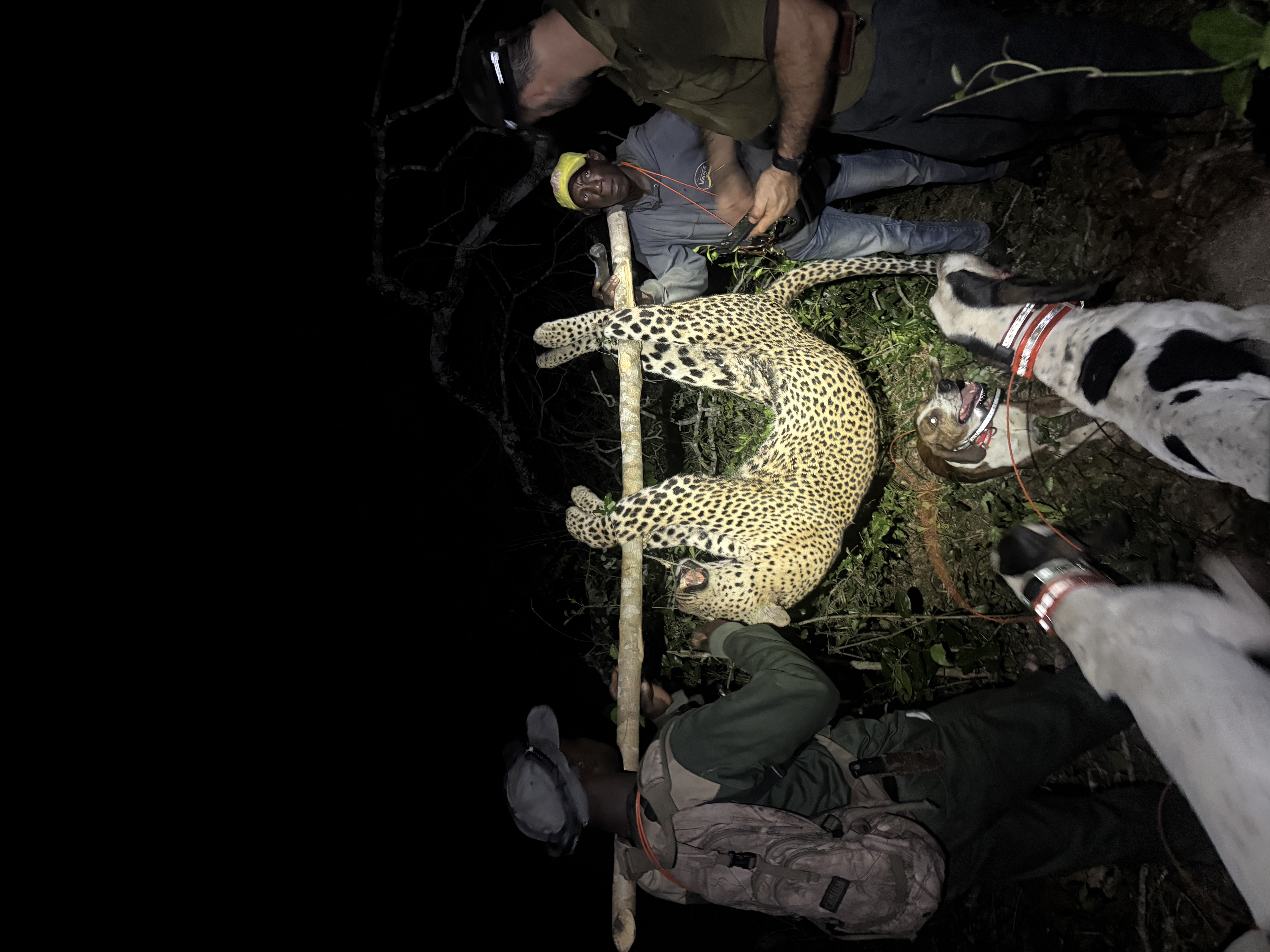
He died on the spot, wedged in the tree limb. One of our trackers, Batiste, had to scale the tree to push him out for us. After admiring him for a bit, and giving the hounds their praises, a pole was cut and the cat was fastened to it. Then we chopped our way back out of the dense forest.
Cole stayed in the vehicle during this part of the hunt. Because it involved a treed leopard in thick vegetation at night, I did not think it was appropriate for him to be on the ground with us. He was able to see the leopard and take part in the celebration that ensued in camp when we returned.
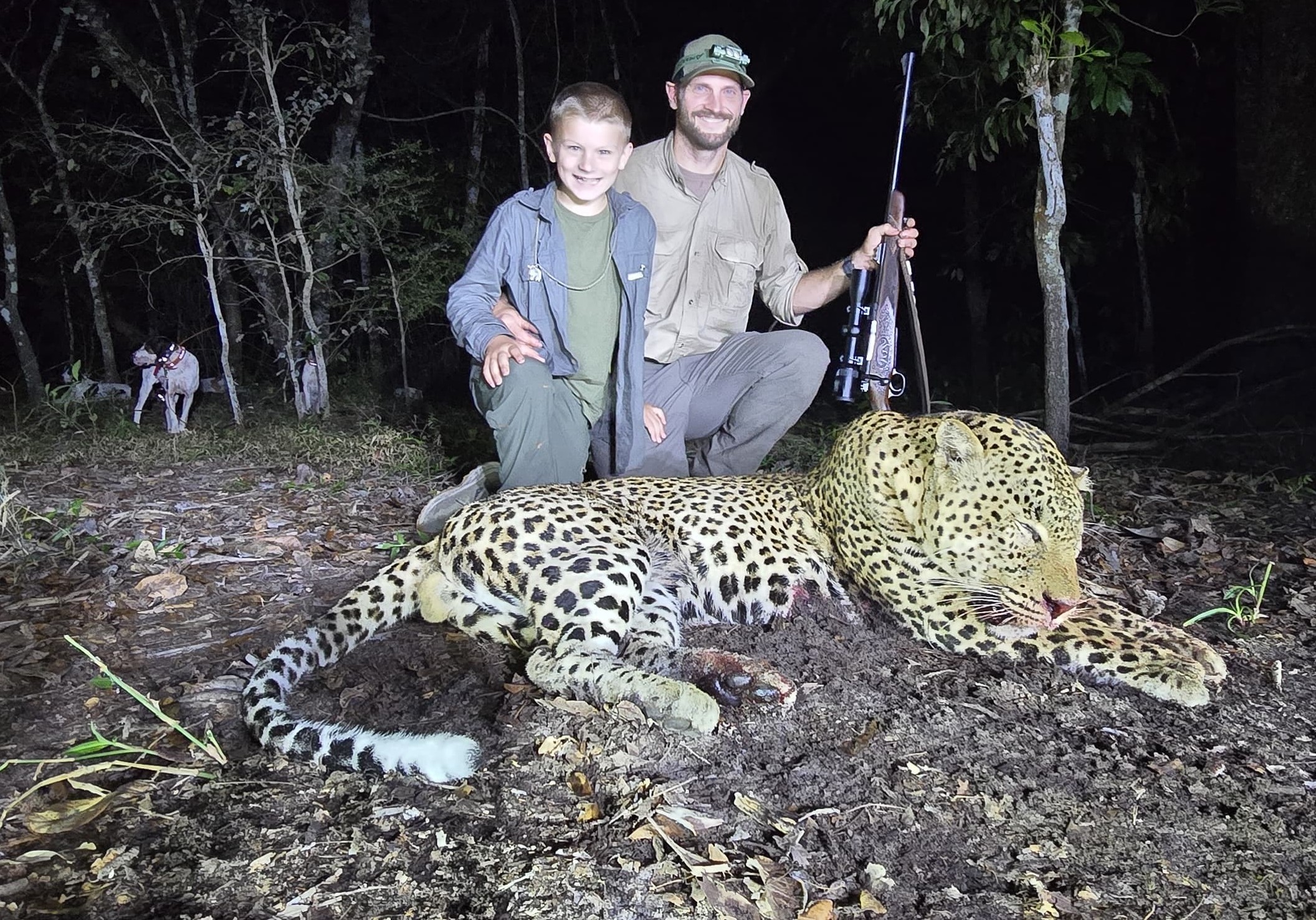
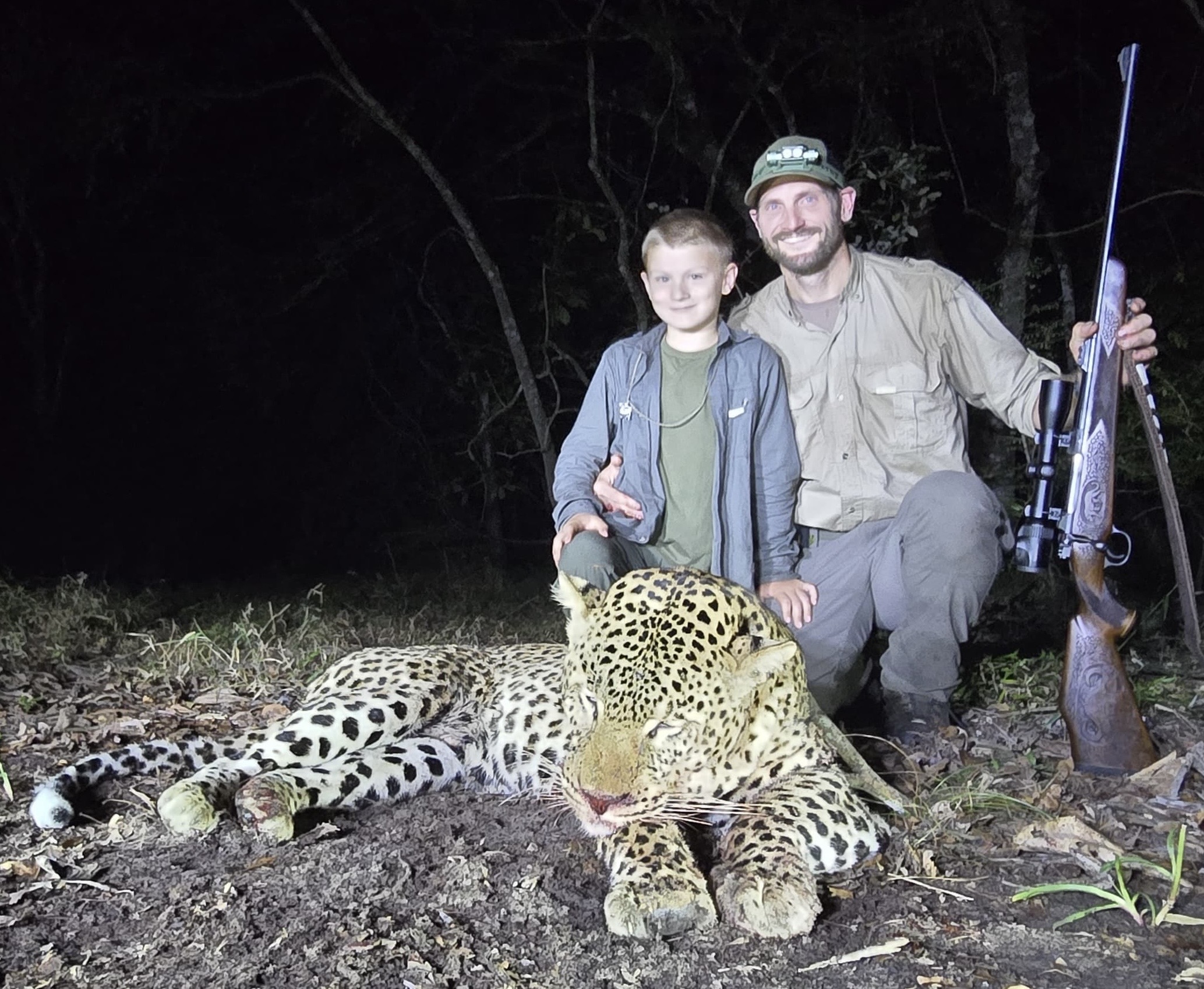
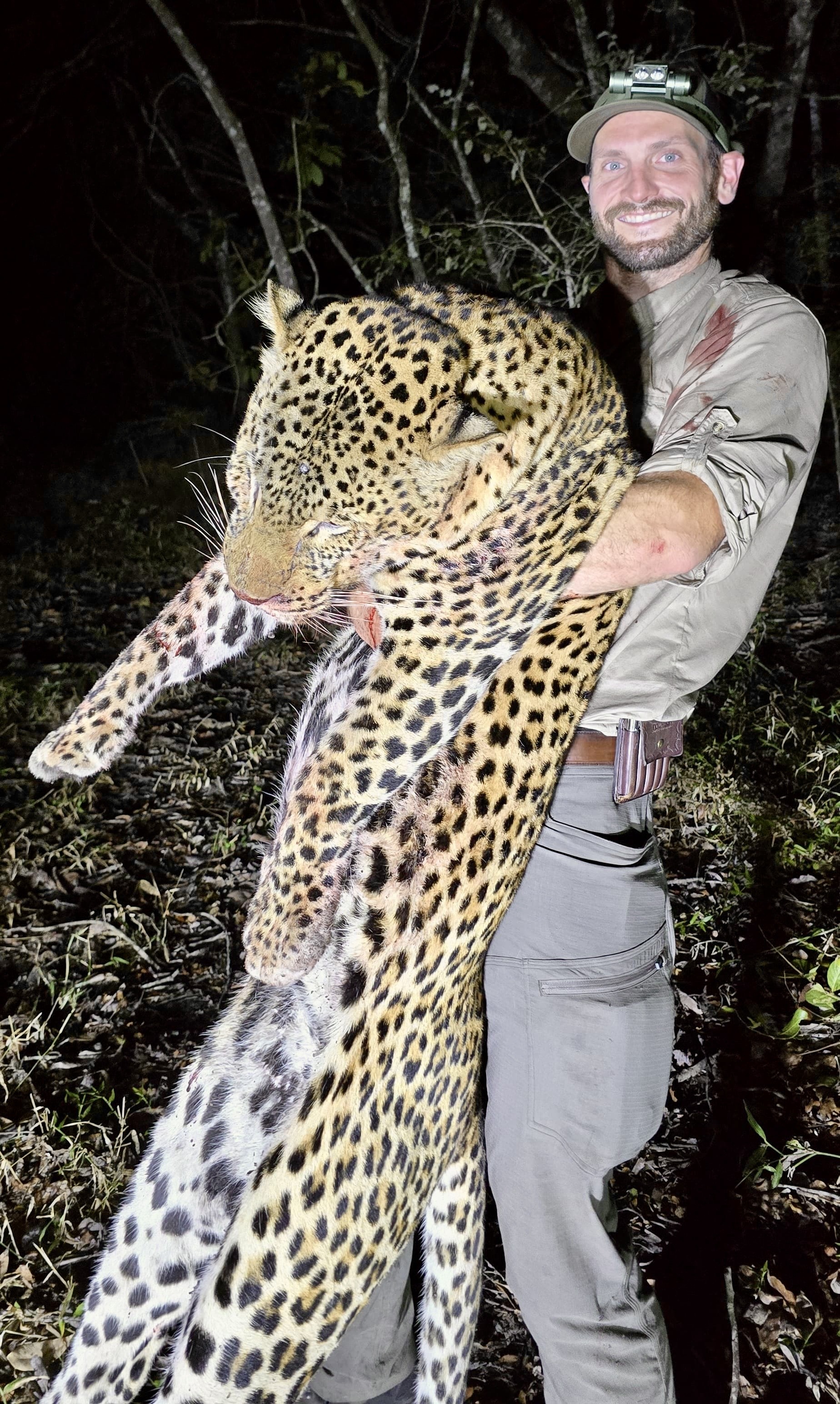
Day 7 — Back to Muanza
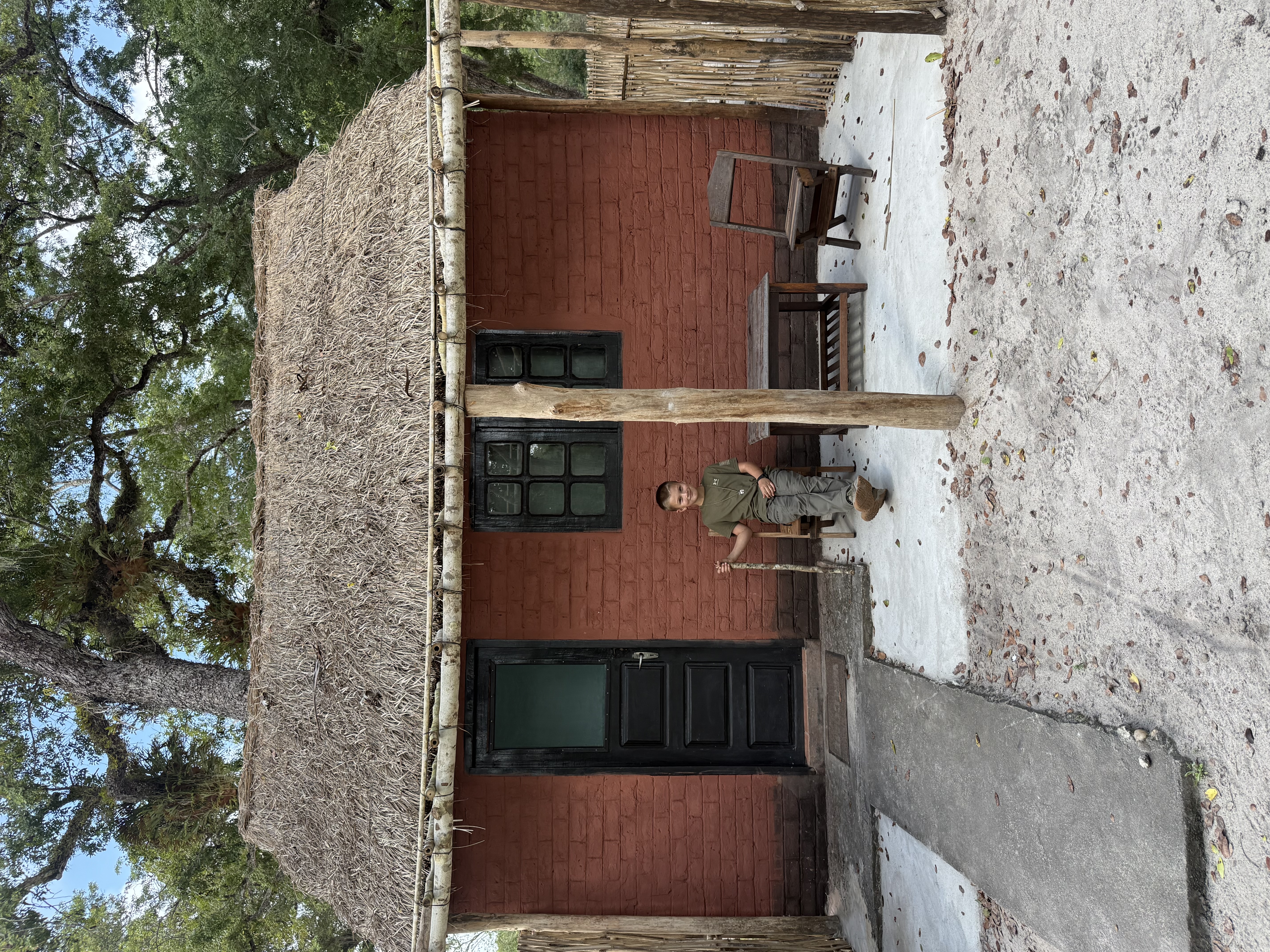
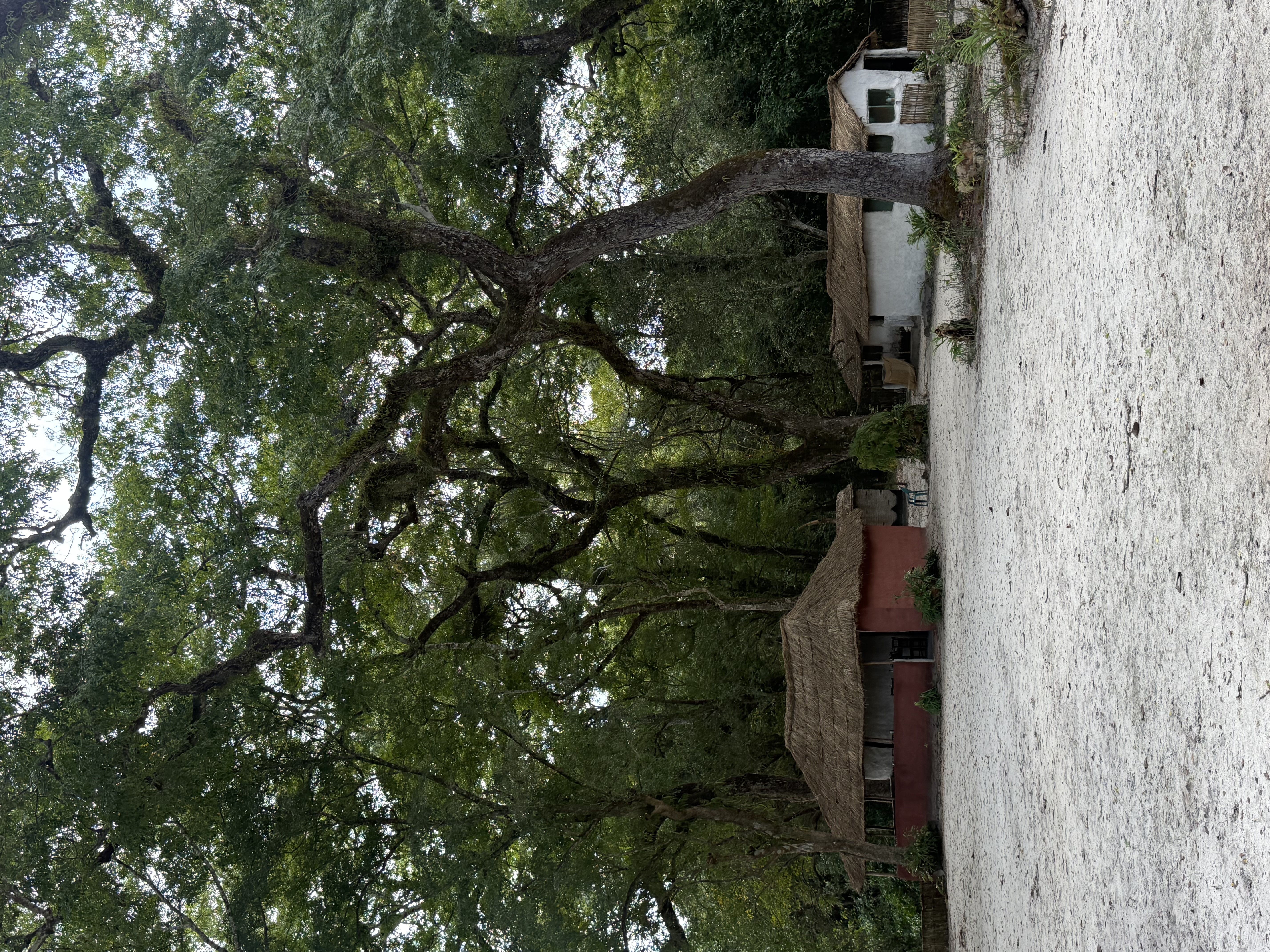
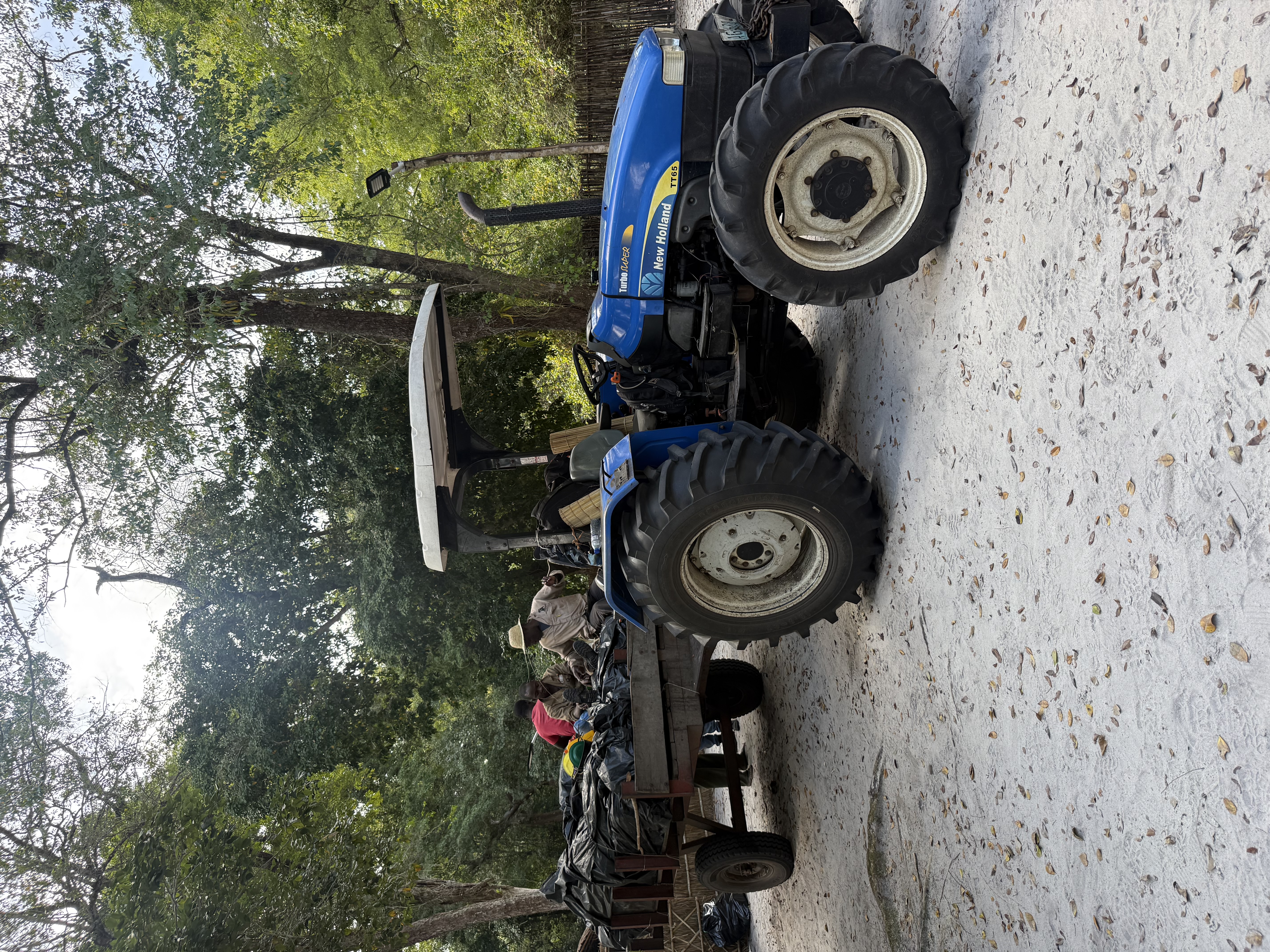
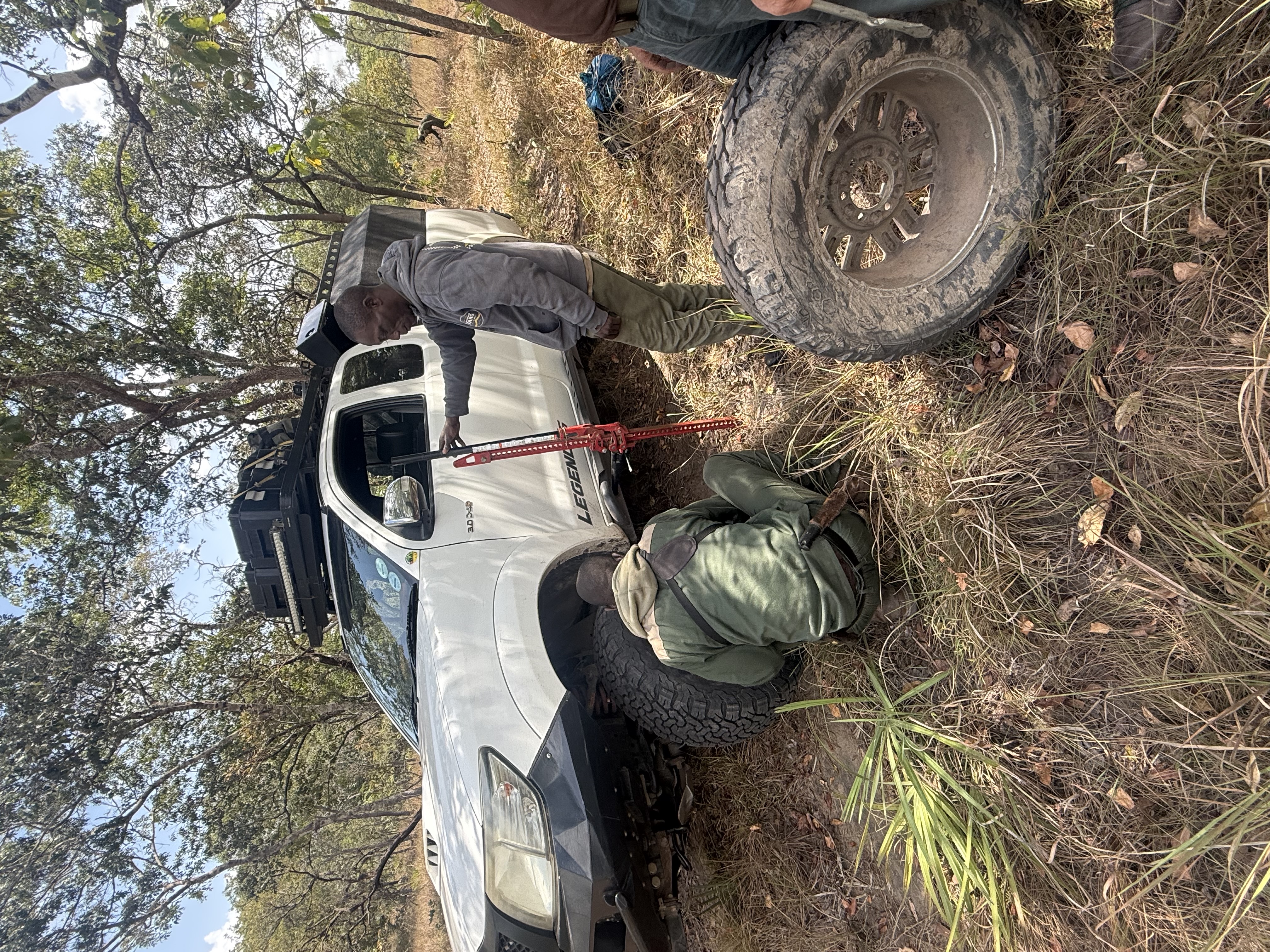
After the leopard hunt, Day 7 was a transition between the two halves of our safari. Before leaving Mupa Camp, Cole and I said goodbye to the place that had been our home during the leopard hunt. We checked on the biltong drying from our earlier harvests and looked over the camp’s hot-water system. Then we loaded up and began the journey southwest toward Muanza. Aside from a flat tire along the way, the trip was uneventful. By the time we arrived at Muanza Camp, the leopard hunt was behind us and we were ready to begin the second half of our 14-day safari.
Day 8 — Suni and Oribi
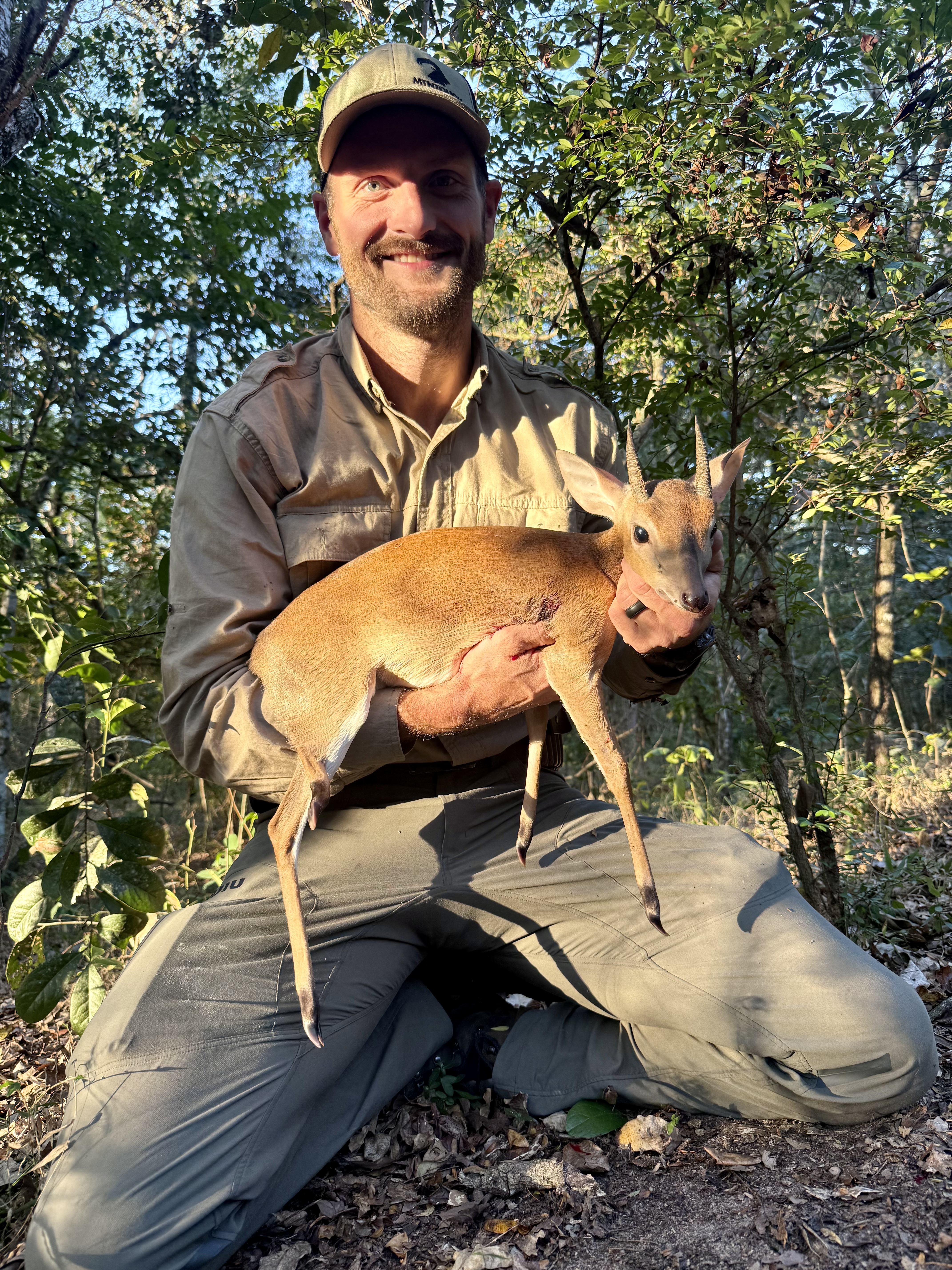
The following evening, we were slipping quietly through the forest when we caught a glimpse of a Livingstone’s suni. I was fortunate enough to take it, giving me my first member of Africa’s Tiny Ten.
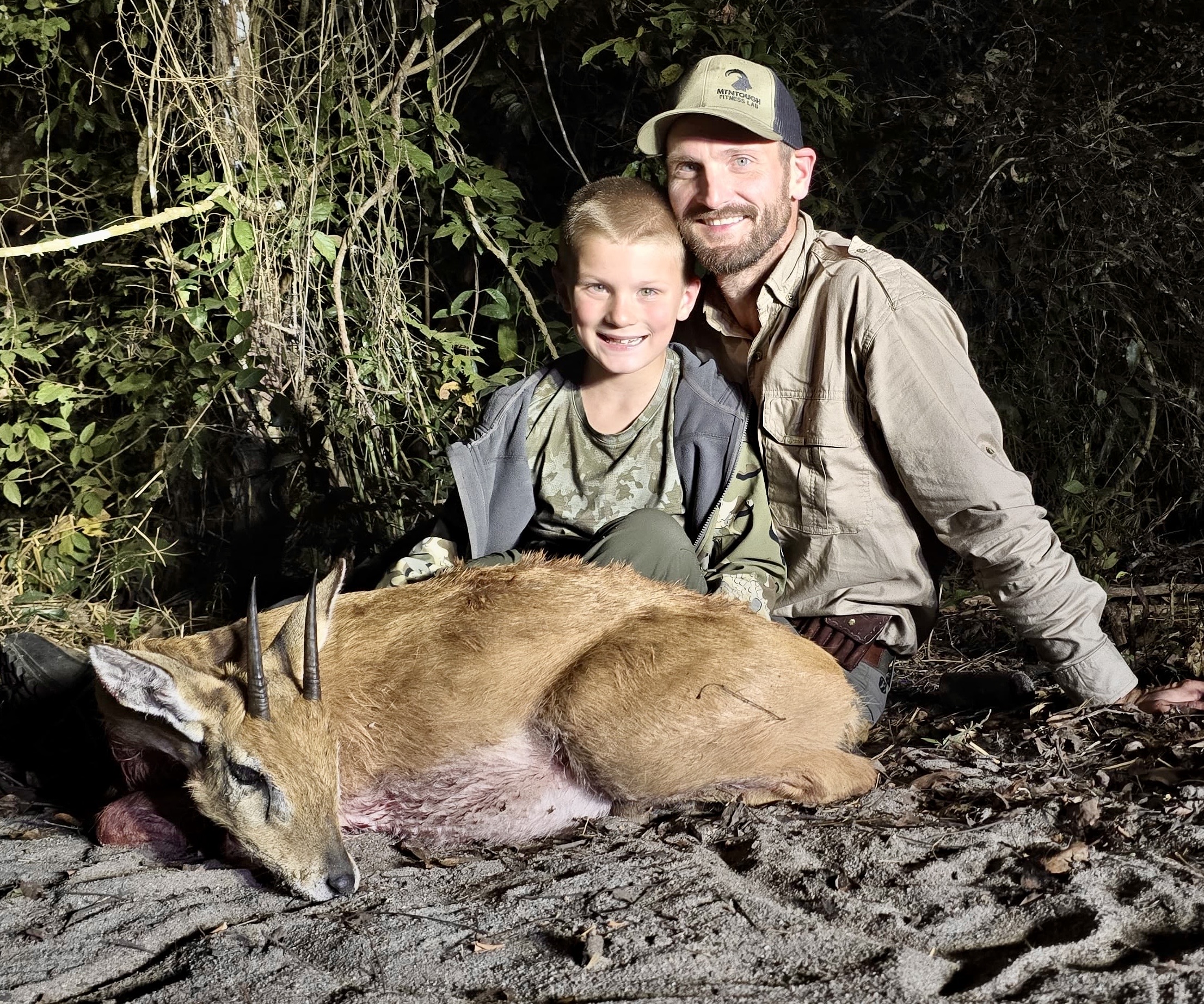
We continued hunting into the evening and soon encountered a pair of oribi. I was able to make a good shot on the male. After a short track through the tall grass, we found him. In one evening, I had added both Livingstone’s suni and oribi to the safari. It was a great way to cap off our first full day back at Muanza Camp. Both were shot with the 375 H&H shooting solids, and I was pleasantly surprised as the minimal damage it caused.
Days 9–10 — Livingstone Eland
Days 9 and 10 brought a little bit of everything. We spent Day 9 tracking Livingstone eland through several miles of wilderness. They proved difficult to approach, and we never managed to put everything together.
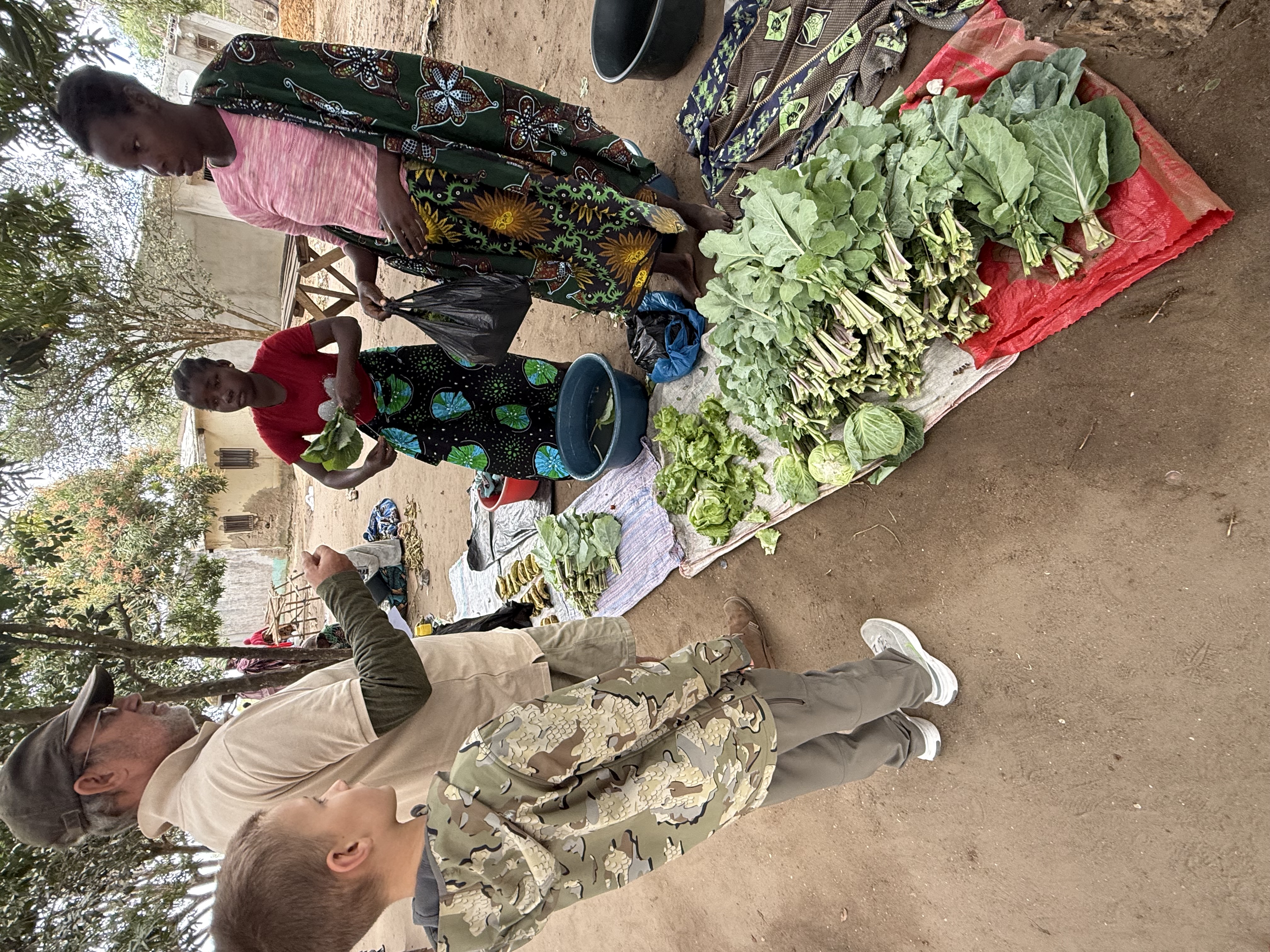
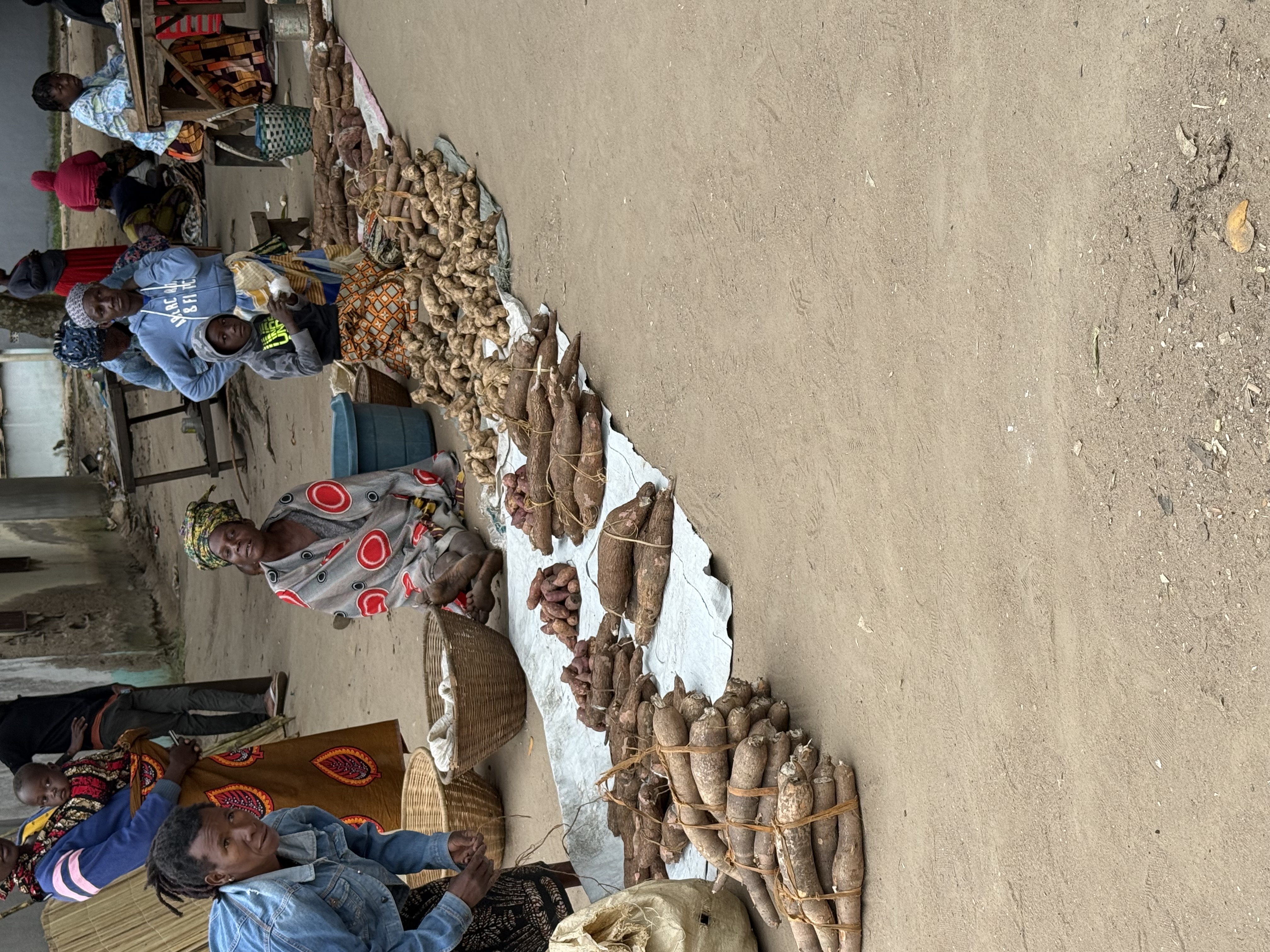
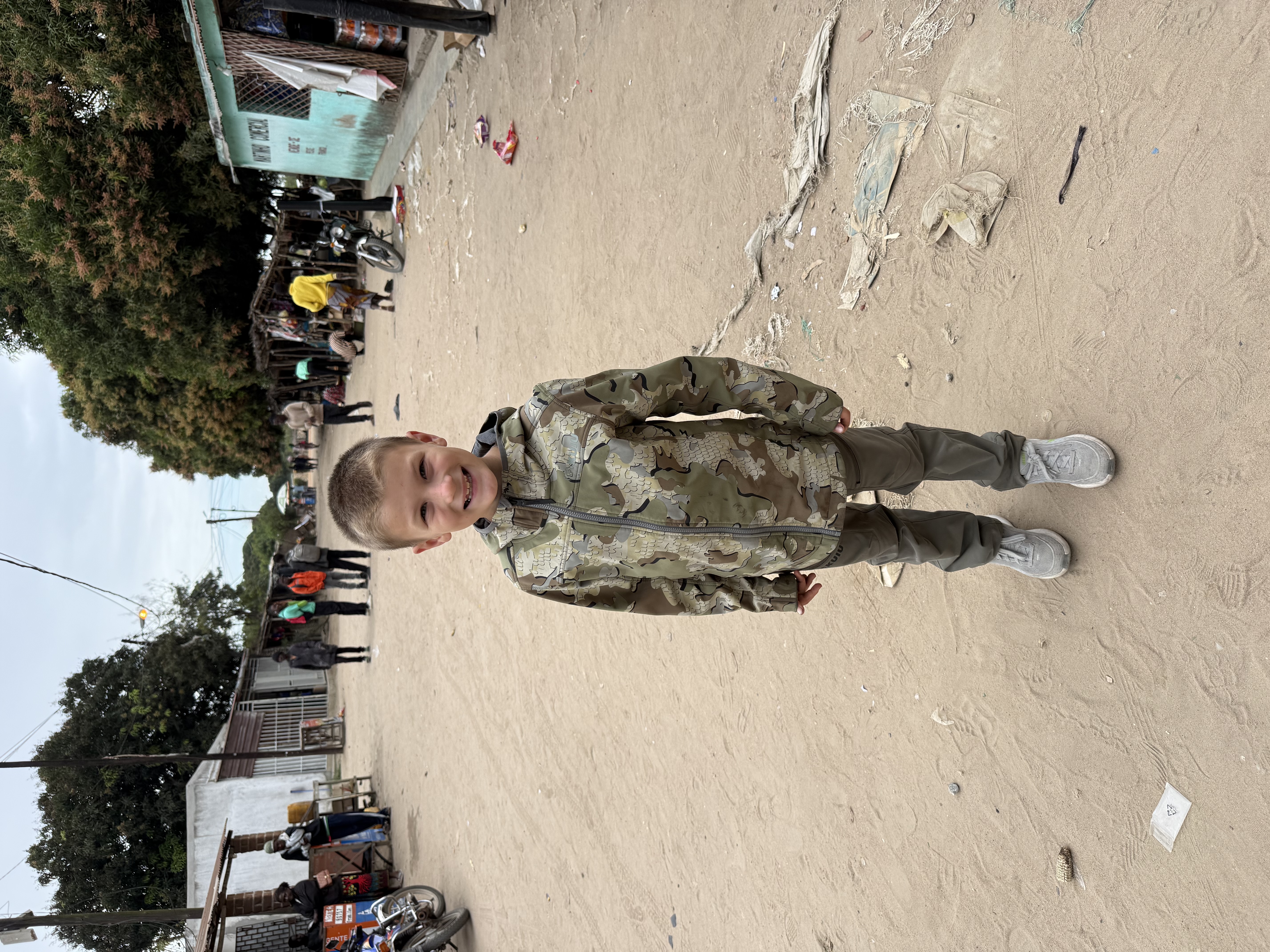
The following morning, we took a break from hunting and made the hour-long drive into the village of Muanza to pick up supplies for camp. For Cole, the trip provided a chance to see a different side of Mozambique. The village was a contrast to the remote camps and hunting areas he had seen during the first part of the safari.
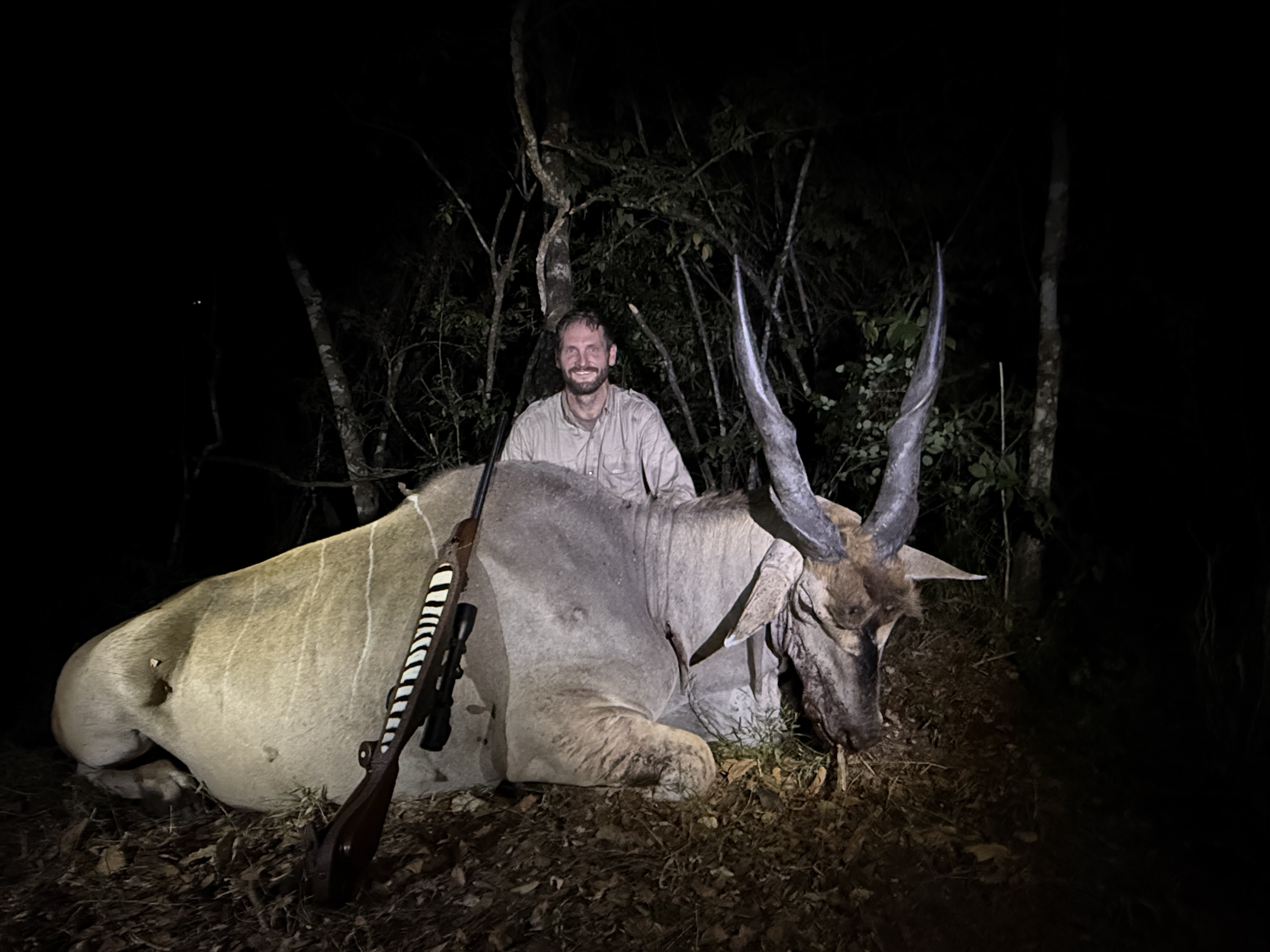
That evening, we went looking for eland again. Cole stayed behind this time to ensure there was no lulls in the conversations around camp. We had barely left the truck when Gavin spotted a bull through the reeds near a marsh. The bull hadn’t seen us, so we began closing the distance. Apparently, he had the same idea. Instead of moving away, the bull was coming toward us, and suddenly we met at much closer range than either of us had expected. There wasn’t time to find an elaborate shooting position. I took an offhand frontal shot with the .375, and the bull turned and disappeared. We immediately went after him. We caught another glimpse as he crossed an opening, and I fired on the run. This time I heard the bullet connect solidly. Even that wasn’t enough to stop him. I managed to put a third shot into his shoulder, but the bull continued into the dense forest and disappeared. By then, darkness had settled over the bush. We followed his track into the timber until we heard crashing somewhere ahead of us. After a short footrace through the dark forest, we closed the distance and finished the job with the .375 and 300-grain Swift A-Frames (note the three 300-grain lumps under the hide in the photo). I knew how large an eland bull was supposed to be, but standing beside one after two days of hunting them was still impressive. It was another memorable ending to a day in the Mozambique bush.
Days 11–14 — Final Days
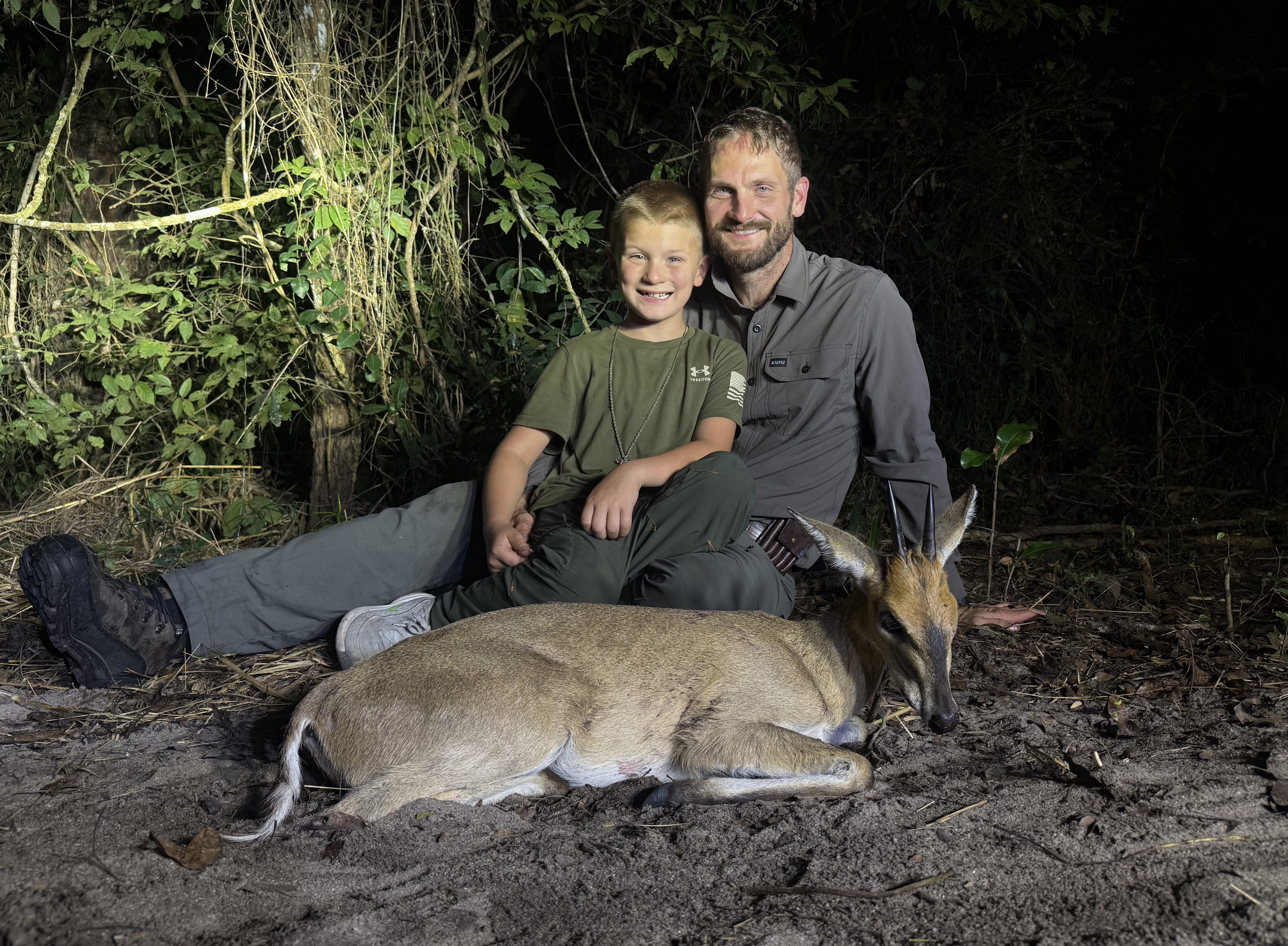
Day 11 was largely lost to bad weather. During Days 12 through 14, we concentrated on bushbuck and red duiker. We saw both species several times, but none of the opportunities developed into a successful shot. On the evening of Day 14, we encountered a grey, or common, duiker. I made a good shot, and that became the final animal of the safari.
Our completed hunting list was:
● Cape buffalo
● Waterbuck
● Reedbuck
● Roosevelt’s sable
● Leopard
● Livingstone’s suni
● Oribi
● Livingstone eland
● Grey duiker
We did not take a bushbuck or red duiker, but both were seen multiple times during the hunt. I also missed some difficult shots on Nyala and bushpig during the hunt.
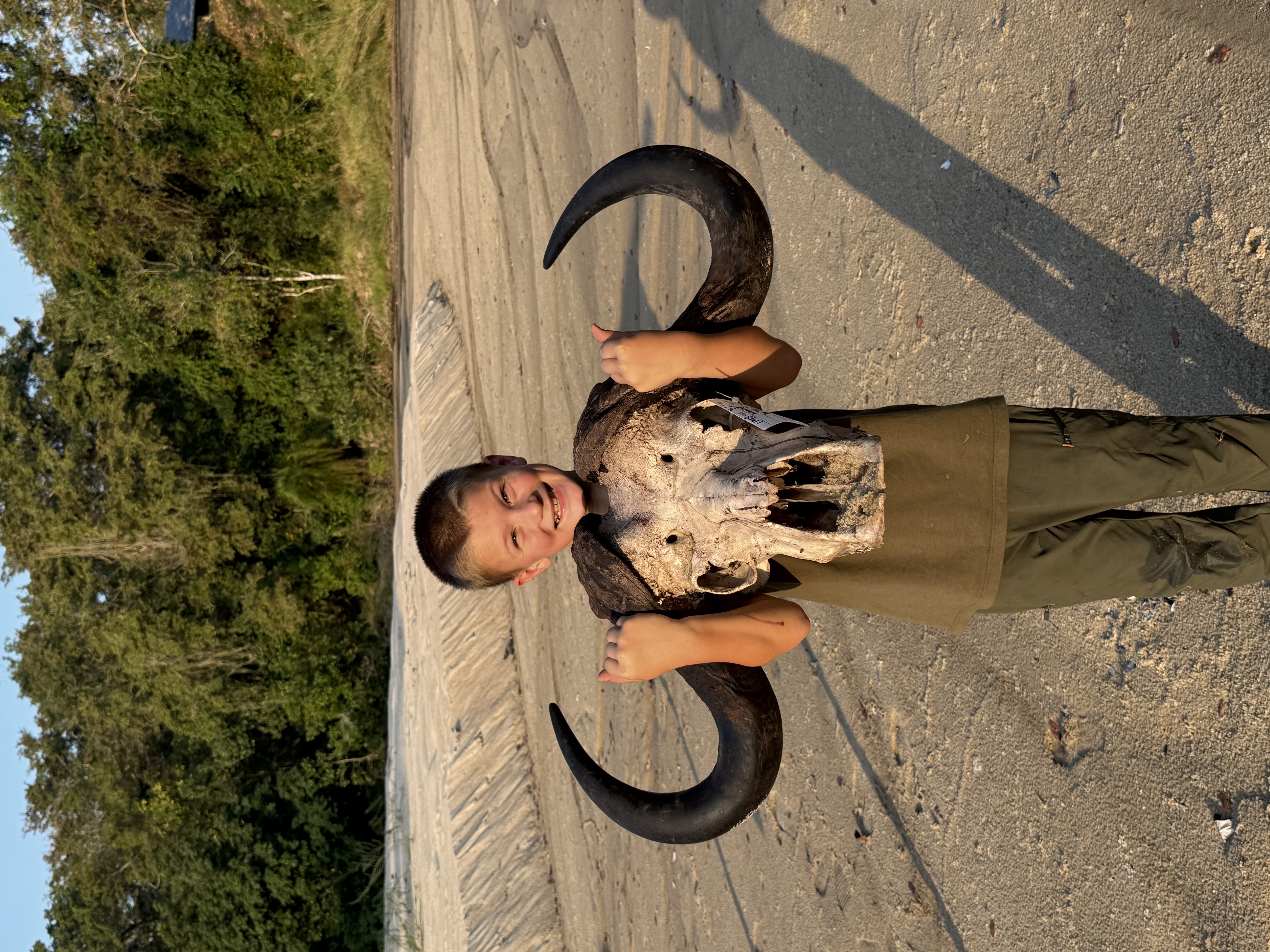
Hunting With Cole
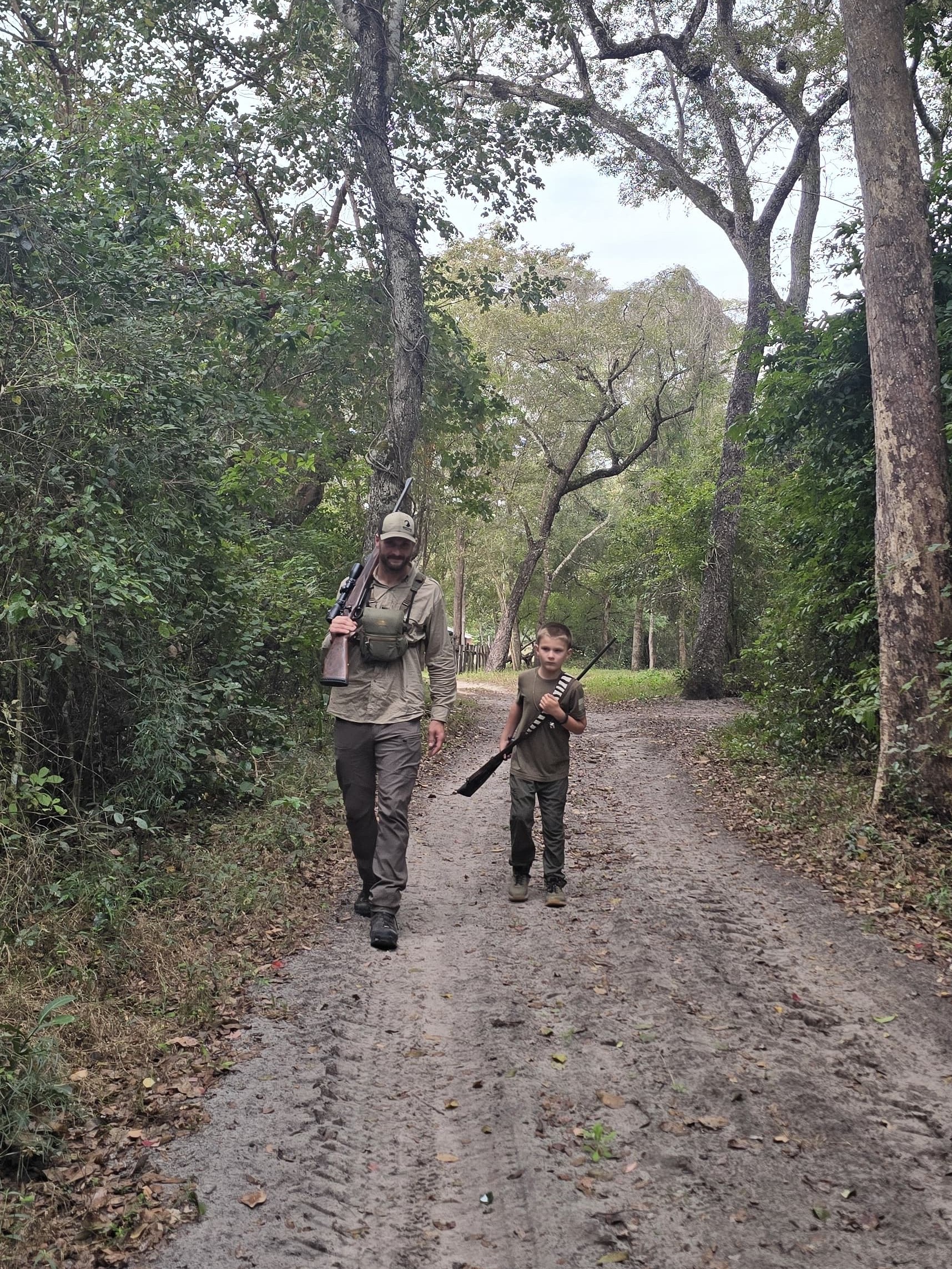
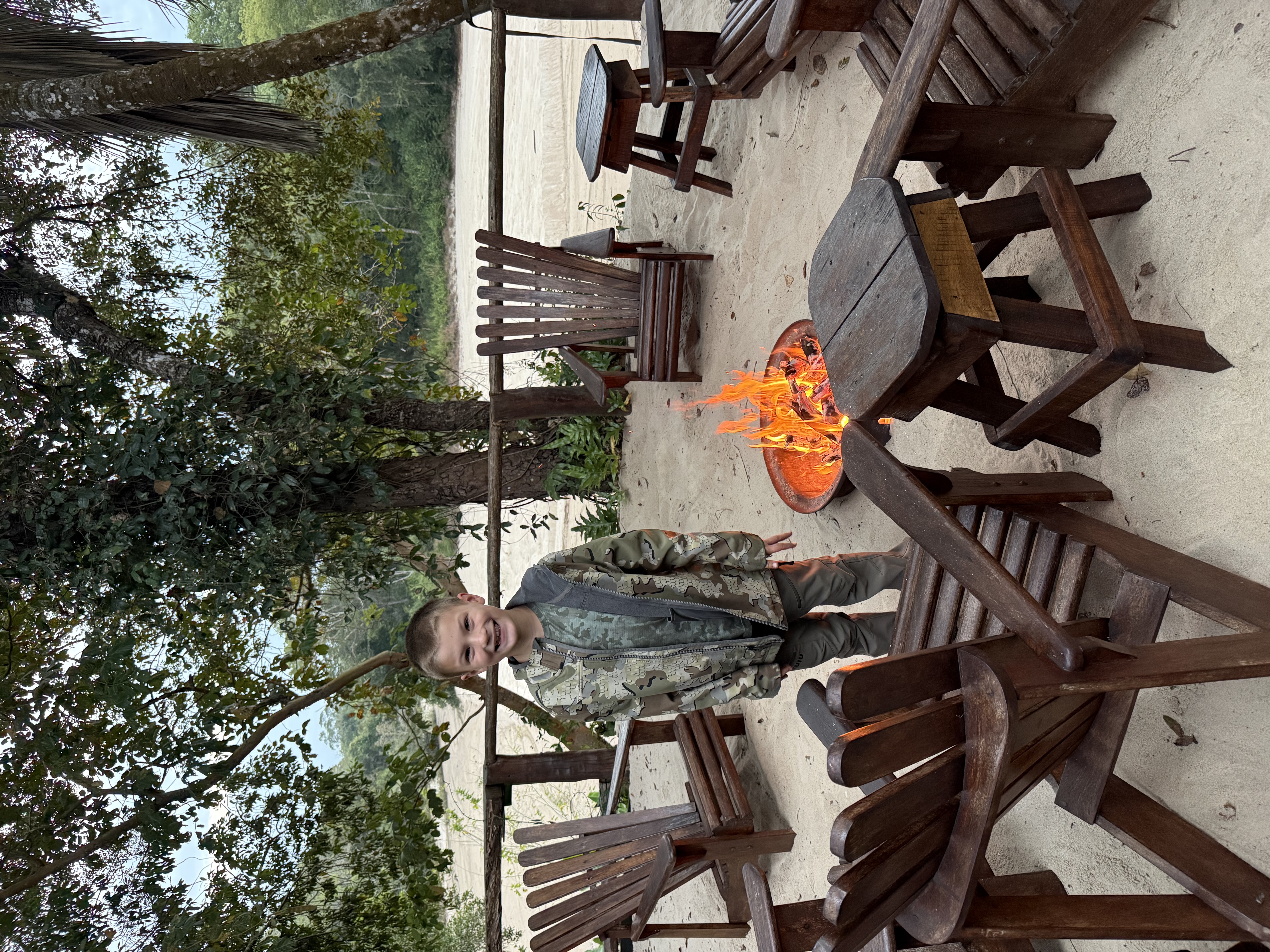
Taking an eight-year-old into a remote part of Mozambique required some preparation. Before the trip, I explained to Cole that there would be long days, rough travel, discomfort, and situations where he would need to listen immediately. He handled the trip well. He walked with us while tracking buffalo, traveled long distances on rough roads, spent time in remote camps, watched the trackers work, fished in the Mupa River, visited Muanza, and saw animals that he had previously only seen in books and photographs. The camp staff and trackers were very helpful with him throughout the safari. Willem and Lizelle made him comfortable in camp, while Gavin and the trackers managed the additional responsibility of guiding a father and son on a dangerous game safari.
Conclusion
The safari was successful from a hunting standpoint, but the main reason it was important to me was that Cole was able to experience it with me. He saw his first successful Cape buffalo hunt on the first day, accompanied me on several other hunts, experienced the celebrations of a successful leopard hunt, experienced village life in Muanza, and was present for most of the safari. He also learned that hunting includes missed opportunities, long periods of waiting, difficult travel, and animals that get away.
The leopard hunt remains the clearest example of what it meant to have him there. On Day 4, he stood with me beneath a tree holding a female leopard and watched the dogs work before we moved back when she began to come down. Two nights later, he waited safely at the vehicle while we pursued the male through the darkness. I wanted him to witness the entire experience, but I also had to accept that being a father sometimes meant keeping him safely at a distance.
After two weeks in Mozambique, we returned home healthy and with a long list of memories from the hunt. The animals were an important part of the trip, but sharing the experience with Cole was the most significant part for me. Long after the trophies and photographs fade into the background, I expect I will remember our first buffalo, his questions around camp, his raw excitement at every success, and the feeling of knowing that we had experienced a small part of Africa together. Although risk is assessed differently with my son than myself, sometimes risk is still required for the reward. This time, the reward was immense.
The trip included buffalo tracking, plains-game hunting, and several days of searching for a leopard with hounds. Cole accompanied me for most of the safari, although there were a few situations, particularly during the nighttime leopard hunt, where he remained with the vehicle or camp for safety.
Having him there changed the experience in ways I had not fully anticipated. Every stalk carried an added sense of responsibility, but it also gave the hunt a deeper meaning. I was not simply pursuing animals for myself; I was hunting for us both, and he shared in the excitement and disappointments of the hunts as if they were his own.
Our professional hunter was Gavin Lipjes. Willem and Lizelle managed the camps, and the trackers and camp staff were a major part of the experience.
Day 1 — Cape Buffalo
We began the safari by tracking Cape buffalo on foot from Muanza camp. On our first morning out, after following the herd for a couple of miles, we caught up with an old bull and were able to get into position. After a long standoff waiting for him to get up, I used a .375 H&H BRNO ZKK602, and made a clean shot. The bull went down shortly afterward, and the 300 grain Swift A-Frame was found under the hide on the opposite shoulder.
Cole was with me throughout the stalk and saw his first Cape buffalo on the first morning of the hunt. It was a special moment for me to take my first Cape Buffalo, but it was even more meaningful getting to share the excitement with my son. It was a good start to the safari.
Day 2 — Traveling to the Mupa Camp
On the second day, we loaded our equipment and traveled with Gavin through the Chinizuia Forest toward a satellite camp on the Mupa River. The drive took a few hours. After arriving at camp, we hunted that afternoon and took a waterbuck and a reedbuck. In a stroke of luck, I was able to harvest them approximately 30 yards apart from each other. That evening, the focus shifted to leopard. The roads were dragged, and trackers were assigned to walk sections of riverbed at night. They would report any fresh tracks in the morning.
Day 3 — Sable and the First Leopard Track
We were out at approximately 2:00 a.m. checking sandy roads and meeting trackers returning from their nighttime walks. One tracker had found the track of a large male leopard crossing into our area. We confirmed the track, but by the time it was evaluated, too much daylight had passed to release the hounds safely. The tsetse flies were becoming active, and we decided not to risk the dogs. While I rested during the middle of the day, Cole went fishing in the Mupa River with Willem. They caught a few of the small robber fish.
That afternoon, we hunted sable. We first saw several animals at a distance, then worked through the vegetation to get the wind in our favor. A few cows and a bull appeared close to us as we moved through the forest. I made a quick shot, and after a short track we recovered a Roosevelt’s sable bull. It was one of the animals I had most wanted to hunt in Mozambique, and Cole was with me when we found it. That night, we resumed looking for leopard tracks.
Days 4–6 — Leopard Hunting
Day 4 was spent canvassing the area for fresh leopard tracks. Late in the morning, we came across a promising set of tracks, and Gavin turned the eight hounds loose. We already knew the leopard was a female and were not expecting an opportunity at the big male we were pursuing. The purpose was to give the dogs some work and let them settle a leopard in a tree. After a little less than a mile, the dogs treed her. We worked through the vegetation to reach them and confirmed the identification. There was no opportunity at the male, so we observed her briefly and allowed the dogs to settle. Cole made it to the tree with me and was able to see the leopard. When she began to growl and come down, I grabbed Cole and we moved back toward the truck. He seemed unfazed and sang a mashup of “Welcome to the Jungle” and “Run Through the Jungle” as we went.
On Day 5, we did not find a mature male leopard track that we could work with. Shortly after daylight on Day 6, the trackers reported a fresh male leopard track in a riverbed. We went to the location and released the hounds. The dogs followed the track through the bush until it crossed a road. At that point, it appeared that the male had joined a female, so there was a chance the dogs could follow either leopard. The hounds soon treed one of them. When we reached the tree, it was the female. She came out with deep throaty growls and moved away, with the dogs following her. They treed her again, and the same thing happened. She eventually stayed in a third tree long enough for us to catch up and settle the dogs. We did not get an opportunity at the male that morning.
Day 6 — The Leopard
That evening, we returned to the roads and found very fresh tracks from the male. The female was still with him, so there was again a chance that the dogs would choose the wrong leopard. We released the hounds, and they followed the track for approximately half a mile before stopping at a tree. We moved toward the dogs and searched the branches with our lights, but initially could not see the leopard.
While scanning the nearby branches with the light, all of a sudden the small bushy tree behind us erupted in growls and started shaking wildly. The cat had been down low and concealed in the leaves maybe 10-20 yards behind us. It had lost its patience and was coming out. Based on our relative positions to each other, it had us dead to rights at that point. I jumped back, spun around, and shouldered my rifle. I was half expecting a cat in my lap before I could raise the rifle, but the leopard had taken off in the opposite direction with the dogs hot on the trail. It’s hard to describe the feeling in your stomach that comes from hearing the deep guttural roars of a leopard from a short distance behind you, while you are in the dark of night and mired in brush and vines.
The dogs eventually treed him again. This time we finally found him perched on a limb, and Gavin was able to identify him as the male we had been tracking. The shooting position was difficult because of the vegetation and limited room. One of the trackers, Felton, provided a shoulder rest. I used the rest, located the leopard through the branches, and fired.
He died on the spot, wedged in the tree limb. One of our trackers, Batiste, had to scale the tree to push him out for us. After admiring him for a bit, and giving the hounds their praises, a pole was cut and the cat was fastened to it. Then we chopped our way back out of the dense forest.
Cole stayed in the vehicle during this part of the hunt. Because it involved a treed leopard in thick vegetation at night, I did not think it was appropriate for him to be on the ground with us. He was able to see the leopard and take part in the celebration that ensued in camp when we returned.
Day 7 — Back to Muanza
After the leopard hunt, Day 7 was a transition between the two halves of our safari. Before leaving Mupa Camp, Cole and I said goodbye to the place that had been our home during the leopard hunt. We checked on the biltong drying from our earlier harvests and looked over the camp’s hot-water system. Then we loaded up and began the journey southwest toward Muanza. Aside from a flat tire along the way, the trip was uneventful. By the time we arrived at Muanza Camp, the leopard hunt was behind us and we were ready to begin the second half of our 14-day safari.
Day 8 — Suni and Oribi
The following evening, we were slipping quietly through the forest when we caught a glimpse of a Livingstone’s suni. I was fortunate enough to take it, giving me my first member of Africa’s Tiny Ten.
We continued hunting into the evening and soon encountered a pair of oribi. I was able to make a good shot on the male. After a short track through the tall grass, we found him. In one evening, I had added both Livingstone’s suni and oribi to the safari. It was a great way to cap off our first full day back at Muanza Camp. Both were shot with the 375 H&H shooting solids, and I was pleasantly surprised as the minimal damage it caused.
Days 9–10 — Livingstone Eland
Days 9 and 10 brought a little bit of everything. We spent Day 9 tracking Livingstone eland through several miles of wilderness. They proved difficult to approach, and we never managed to put everything together.
The following morning, we took a break from hunting and made the hour-long drive into the village of Muanza to pick up supplies for camp. For Cole, the trip provided a chance to see a different side of Mozambique. The village was a contrast to the remote camps and hunting areas he had seen during the first part of the safari.
That evening, we went looking for eland again. Cole stayed behind this time to ensure there was no lulls in the conversations around camp. We had barely left the truck when Gavin spotted a bull through the reeds near a marsh. The bull hadn’t seen us, so we began closing the distance. Apparently, he had the same idea. Instead of moving away, the bull was coming toward us, and suddenly we met at much closer range than either of us had expected. There wasn’t time to find an elaborate shooting position. I took an offhand frontal shot with the .375, and the bull turned and disappeared. We immediately went after him. We caught another glimpse as he crossed an opening, and I fired on the run. This time I heard the bullet connect solidly. Even that wasn’t enough to stop him. I managed to put a third shot into his shoulder, but the bull continued into the dense forest and disappeared. By then, darkness had settled over the bush. We followed his track into the timber until we heard crashing somewhere ahead of us. After a short footrace through the dark forest, we closed the distance and finished the job with the .375 and 300-grain Swift A-Frames (note the three 300-grain lumps under the hide in the photo). I knew how large an eland bull was supposed to be, but standing beside one after two days of hunting them was still impressive. It was another memorable ending to a day in the Mozambique bush.
Days 11–14 — Final Days
Day 11 was largely lost to bad weather. During Days 12 through 14, we concentrated on bushbuck and red duiker. We saw both species several times, but none of the opportunities developed into a successful shot. On the evening of Day 14, we encountered a grey, or common, duiker. I made a good shot, and that became the final animal of the safari.
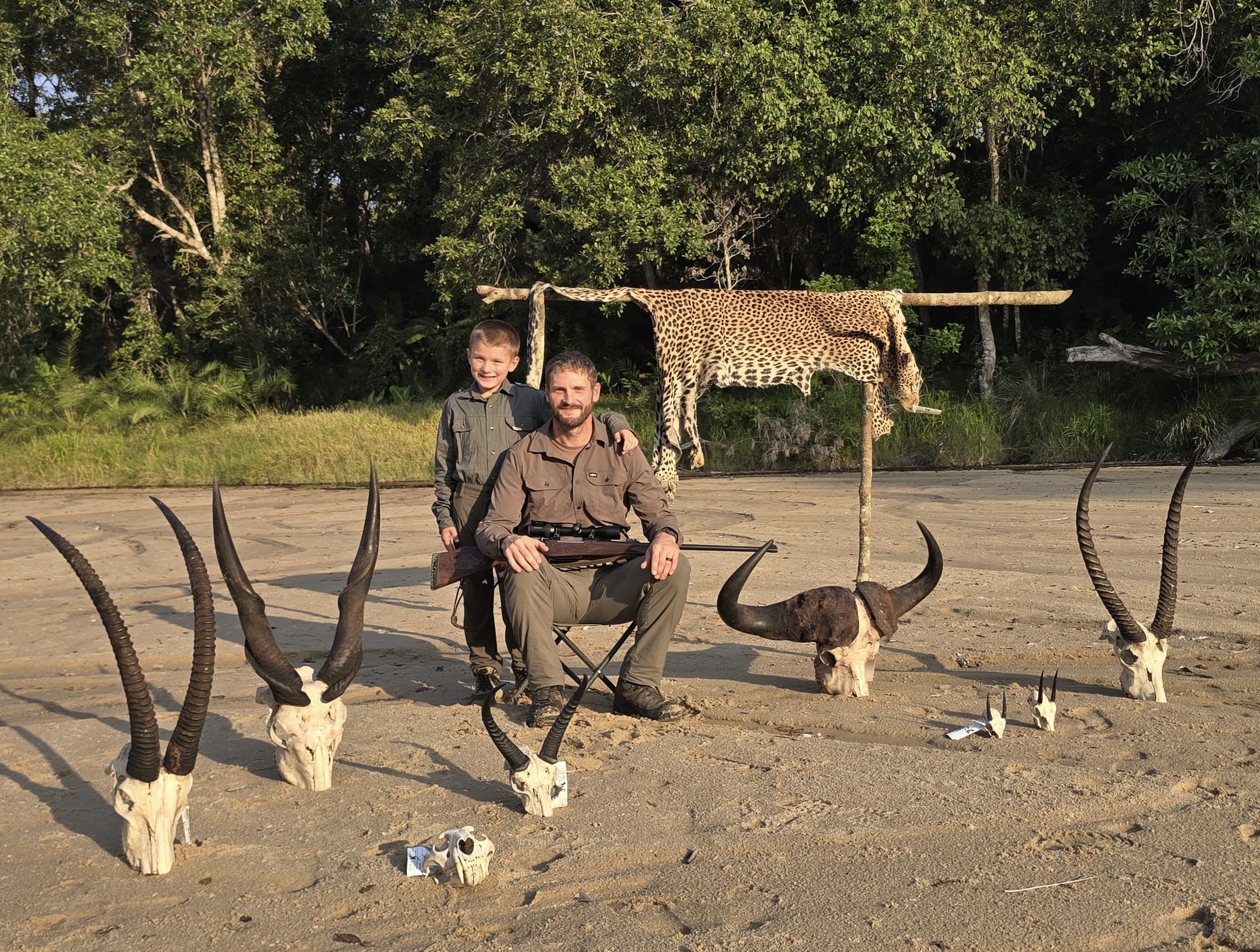
Our completed hunting list was:
● Cape buffalo
● Waterbuck
● Reedbuck
● Roosevelt’s sable
● Leopard
● Livingstone’s suni
● Oribi
● Livingstone eland
● Grey duiker
We did not take a bushbuck or red duiker, but both were seen multiple times during the hunt. I also missed some difficult shots on Nyala and bushpig during the hunt.
Hunting With Cole
Taking an eight-year-old into a remote part of Mozambique required some preparation. Before the trip, I explained to Cole that there would be long days, rough travel, discomfort, and situations where he would need to listen immediately. He handled the trip well. He walked with us while tracking buffalo, traveled long distances on rough roads, spent time in remote camps, watched the trackers work, fished in the Mupa River, visited Muanza, and saw animals that he had previously only seen in books and photographs. The camp staff and trackers were very helpful with him throughout the safari. Willem and Lizelle made him comfortable in camp, while Gavin and the trackers managed the additional responsibility of guiding a father and son on a dangerous game safari.
Conclusion
The safari was successful from a hunting standpoint, but the main reason it was important to me was that Cole was able to experience it with me. He saw his first successful Cape buffalo hunt on the first day, accompanied me on several other hunts, experienced the celebrations of a successful leopard hunt, experienced village life in Muanza, and was present for most of the safari. He also learned that hunting includes missed opportunities, long periods of waiting, difficult travel, and animals that get away.
The leopard hunt remains the clearest example of what it meant to have him there. On Day 4, he stood with me beneath a tree holding a female leopard and watched the dogs work before we moved back when she began to come down. Two nights later, he waited safely at the vehicle while we pursued the male through the darkness. I wanted him to witness the entire experience, but I also had to accept that being a father sometimes meant keeping him safely at a distance.
After two weeks in Mozambique, we returned home healthy and with a long list of memories from the hunt. The animals were an important part of the trip, but sharing the experience with Cole was the most significant part for me. Long after the trophies and photographs fade into the background, I expect I will remember our first buffalo, his questions around camp, his raw excitement at every success, and the feeling of knowing that we had experienced a small part of Africa together. Although risk is assessed differently with my son than myself, sometimes risk is still required for the reward. This time, the reward was immense.


